
The truce
The devas had been weakened, in most accounts by the curse of the sage Durvasa, and could no longer hold against the asuras. Vishnu’s advice was to co-operate: the amrita lay dissolved in the ocean of milk, and recovering it needed more strength than either side had.
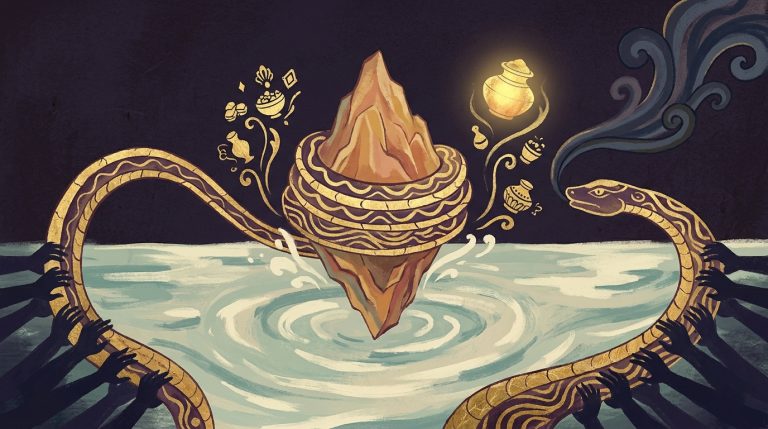
Mount Mandara would be the churning rod and Vasuki the rope. The asuras, offered first choice, took the serpent’s head; the devas took the tail. Vasuki’s breath scorched the asuras throughout, a detail the texts record without much sympathy.
Kurma beneath the mountain
The mountain immediately began sinking into the soft seabed. Vishnu took the form of Kurma, an enormous tortoise, and let Mandara rest and spin on his shell. It is the least spectacular intervention in the avatar sequence and the one without which nothing else happens.
The poison, then the treasures
The first thing to surface was not a treasure but halahala, a poison virulent enough to end all three worlds. Shiva drank it and held it in his throat, which turned blue — the origin of the name Nilakantha.
After it came the ratnas, commonly counted as fourteen: Lakshmi, who chose Vishnu; Dhanvantari, physician of the gods, carrying the pot of amrita; Kamadhenu the wish-fulfilling cow; Uchchaihshravas the white horse; Airavata the white elephant; the Kaustubha gem; the Kalpavriksha; the apsaras; Chandra the moon; Varuni; the Parijata tree; the conch Panchajanya; and the bow Sharanga. Lists vary between texts and none is definitive.
Why the Kumbh Mela is held where it is
When the amrita appeared the truce ended at once. In the struggle that followed the pot was carried off in flight — by Garuda in some accounts, by Mohini or by Indra’s son Jayanta in others — and tradition holds that drops fell at four places: Prayagraj, Haridwar, Ujjain and Nashik.
Those four cities host the Kumbh Mela in rotation, and pilgrims bathe there at astrologically determined moments in the belief that the rivers still carry that purifying power. It is the largest religious gathering in the world, and its location is decided by this story. The four-drops detail belongs to later tradition rather than the earliest tellings, but it is the reason the festival is where it is.
Vishnu recovered the nectar by taking the form of Mohini, an enchantress, and distributing it to the devas — an episode counted in some traditions as an avatar in its own right.
Angkor Wat
The most celebrated depiction of the churning is not in India. A bas-relief nearly fifty metres long runs along the eastern gallery of Angkor Wat in Cambodia, showing ranks of devas and asuras hauling on Vasuki with Mount Mandara turning at the centre. That a twelfth-century Khmer temple gives the episode its grandest surviving treatment is a useful reminder of how far these stories travelled.
See also the ten avatars of Vishnu and the Kali Yuga.
Frequently asked questions
What is the Samudra Manthan?
Why did the gods and demons co-operate?
What came out of the churning?
How is the Kumbh Mela connected?
Where is the churning of the ocean depicted?
Sources & further reading
These accounts are drawn from and can be checked against the following primary texts and reference works:
Based on the classical texts of Hindu mythology, see our sources.