In a world filled with uncertainties and challenges, Durga’s protective aspects offer a sense of security and hope. She doesn’t just fight external demons; she also helps us battle our inner fears and doubts. By understanding and embracing Durga’s protective qualities, we can find the strength to overcome obstacles and lead a life of resilience and confidence.
Understanding Durga’s Protective Aspects
Trishul
Durga’s trishul, a trident, ranks among her most significant weapons. Given to her by Shiva – The Destroyer, it manifests the three qualities: Satwa (inactivity), Rajas (activity), and Tamas (non-activity). This trident illustrates her proficiency in eliminating all three miseries: physical, mental, and spiritual.
Conch Shell
The conch shell in Durga’s hand embodies the sacred word “Om” and signifies her divine connection. Serving a dual purpose, the shell also heralds the start of a battle, underscoring her role in initiating the fight against malefic forces.
Bow and Arrow
Durga wields a bow and arrow, symbolizing energy and control over both potential and kinetic forms. This weapon set emphasizes her command over dynamic forces, showcasing her ability to maintain balance and order in the universe.
Durga’s protective attributes, through these symbols, offer a profound understanding of her role as a divine guardian.
Historical Background
Durga, a prominent figure in Hindu mythology, embodies the protective aspects of the mother goddess known as Devi. Her worship has deep historical roots and is evident in ancient civilizations and texts.
Origin of Durga
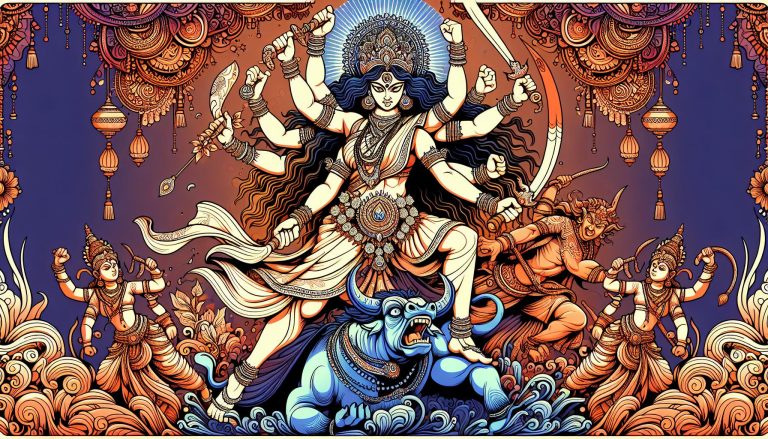
Durga was created specifically to defeat the buffalo demon Mahishasura – Buffalo Demon. The gods, unable to overcome Mahishasura’s powers, combined their energies to manifest Durga. This divine creation embodies the supreme energy necessary to protect the universe from devastating forces, reinforcing her role as a protector.
Mythological Stories
Durga’s myths depict her as a powerful and protective deity. In the epic battle, her relentless fight against Mahishasura stands as a testament to her unparalleled strength and protective nature. Such stories emphasize her active role in annihilating evil and safeguarding righteousness. Her narratives from various Puranas highlight inconsistent legends but all converge on her protective attributes, showcasing different dimensions of her divine guardianship.
Durga appears in different forms and legends throughout the ancient Indian epics. The tales often show her combating formidable enemies, emphasizing her role as the ultimate protector and warrior.
Symbolism in Durga’s Iconography
Durga’s protective nature manifests vividly through her iconography. I explore the symbolism behind her weapons, tools, and the lion she rides.
Weapons and Tools
Durga’s arsenal portrays her multifaceted protective capabilities. Each weapon in her eight arms signifies a unique form of divine intervention. Her trishul embodies the control over inactivity, activity, and non-activity. Holding a conch shell signifies her divine readiness to combat evil with the sound of “Om.” Her bow and arrow represent her focused energy, highlighting her ability to target and control dynamic forces. These elements collectively depict her as a supreme protector against various forms of evil and imbalance.
The Lion as Her Vehicle
The lion beneath Durga represents raw animalistic traits like greed, anger, and jealousy. Sitting atop this formidable creature, Durga symbolizes mastery over these instincts. Her position on the lion conveys the message that one must not be dominated by destructive tendencies. Instead, control and righteousness should prevail. This scene exemplifies her role as a warrior who maintains moral and emotional control while protecting her devotees.
Manifestations and Their Protective Roles
Durga’s manifestations embody her protective essence in different forms. Each form represents unique aspects of her strength and courage, offering her devotees varied means of protection.
Mahishasuramardini
Mahishasuramardini, one of Durga’s key forms, symbolizes the triumph of good over evil through the tale of Mahishasura. Mahishasura, a buffalo demon, terrorized the heavens and earth until Durga, in her fierce form, vanquished him.
Protective Role: This manifestation of Durga highlights her ability to eradicate evil and restore dharma (righteousness). By protecting her devotees from malign forces, Mahishasuramardini ensures cosmic order and peace. Her story encourages individuals to combat personal and external evils with resilience and courage.
Katyayani
Katyayani, another prominent form of Durga, is revered during the Navaratri festival as one of the nine forms of the goddess. Depicted as a fierce warrior, Katyayani’s legend is rooted in her creation from the collective energies of the gods to defeat the demon Mahishasura.
Protective Role: Katyayani symbolizes fierce protection and strength. She serves as a guardian against demonic forces, empowering her followers with courage and fortitude. Her worship is believed to imbue devotees with the power to face challenges and adversities head-on, fostering inner strength and bravery.
Kalaratri
Kalaratri, one of the darker and more fearsome manifestations of Durga, is known for her destructive powers. Often depicted with dark skin and four arms, she is both awe-inspiring and terrifying. Her legend speaks of her role in destroying demons and purifying the world of negativity.
Protective Role: Kalaratri’s significance lies in her ability to annihilate evil and darkness. She protects her devotees from negative energies and dispels fear, bringing peace and spiritual clarity. Her form is a reminder that destruction can be a necessary step in the process of renewal and transformation.
Each of these manifestations highlights different facets of Durga’s protective nature, offering her devotees confidence in overcoming evil and adversity.
Cultural Significance
Durga’s protective aspects resonate through various cultural traditions, showcasing her profound influence in Hinduism and beyond.
Festivals Dedicated to Durga
Numerous festivals celebrate Durga’s power and grace. Durga Puja, for example, is an annual festival predominantly celebrated in West Bengal, Assam, and Odisha. Over five days, devotees honor her victory over the buffalo demon Mahishasura, signifying the victory of good over evil. Navratri, celebrated across India, dedicates nine nights to worshiping Durga’s nine forms, each day highlighting a different aspect of her power, such as Shailaputri (daughter of the mountains) and Kalaratri (the dark night).
Practices and Rituals
Various practices and rituals ensure Durga’s influence remains strong in devotees’ lives. Offerings and prayers, for example, mark the core of these rituals. Devotees offer flowers, sweets, and other items during pujas to invoke her blessings. Recitations of the Durga Saptashati are common during Navratri, where 700 verses extol Durga’s virtues and powers. Yajnas (sacrificial fires) and fasting demonstrate devotion, while cultural programs include traditional dance and music performances that narrate her exploits.
Overall, these festivals and rituals reflect the deep reverence for Durga’s protective aspects, intertwining spirituality with cultural heritage.
Modern Interpretations
Durga’s protective aspects have evolved in modern contexts, resonating with contemporary societal themes. Artists and scholars explore her symbolism to reflect current challenges and aspirations.
Durga in Contemporary Art
Modern artists reinterpret Durga’s protective qualities through innovative expressions. Rina Banerjee, known for her intricate installations, visualizes Durga as a guardian against environmental degradation. Shilpa Gupta’s multimedia works address themes of freedom and safety, embodying Durga’s fierce defense against oppression. Bharti Kher, through her mixed media sculptures, depicts Durga’s multifaceted strength, highlighting resilience and empowerment. These interpretations bridge traditional symbols with present-day issues, making Durga relevant to new audiences.
Relevance in Today’s Society
Durga represents strength, resilience, and protection in contemporary society. Her symbolism resonates in movements advocating women’s rights and empowerment. Durga’s imagery inspires campaigns against gender-based violence, showcasing her as a symbol of resistance. In a technology-driven world, she symbolizes safeguarding values and ethics against corruption and moral decline. Durga’s protective nature continues to inspire and uphold principles of justice and courage in modern life.
Conclusion
Durga’s protective aspects transcend time and culture. Her enduring symbolism of strength and resilience continues to inspire and empower individuals today. Whether through traditional festivals or modern artistic interpretations Durga’s essence remains a beacon of courage and justice. In our ever-evolving world her protective spirit guides us in addressing contemporary challenges and upholding ethical values. By embracing Durga’s principles we can foster a society rooted in empowerment and equality.
Sources & further reading
These themes are explored in greater depth across the following authoritative resources:
- Encyclopaedia Britannica, Hindu Mythology
- Internet Sacred Text Archive, Hinduism
- Mythopedia, Hindu Mythology
- Harvard Pluralism Project, Hindu Tradition
- Wendy Doniger, The Hindus: An Alternative History (Penguin, 2009), ISBN 978-0143116691
External resources for further reading. Apam Napat is not affiliated with these publishers; citation does not imply endorsement.
Based on the classical texts of Hindu mythology, see our sources.