
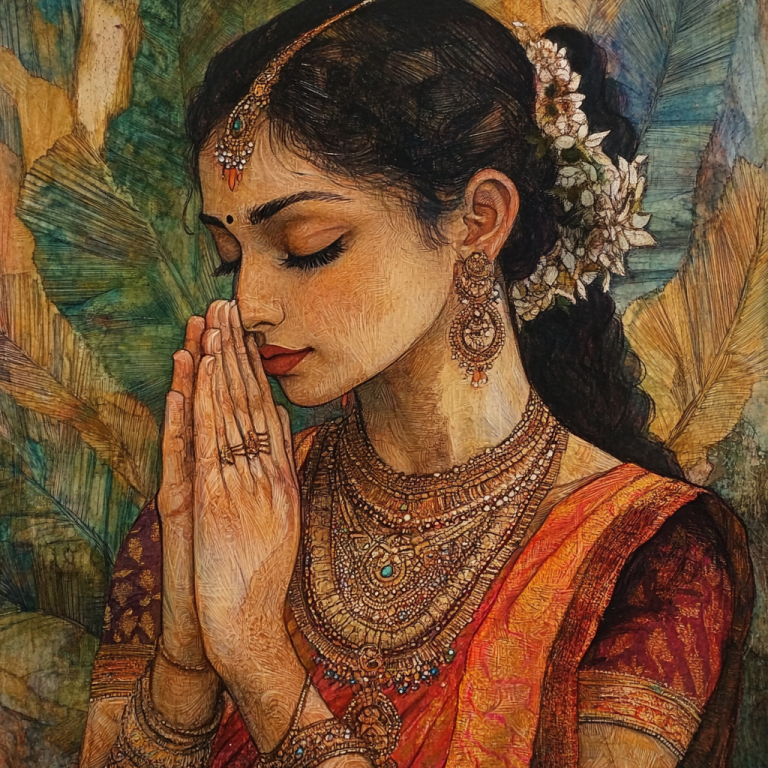
Uttara – Princess of Matsya and Mother of Parikshit – Son of Abhimanyu
Uttara, the daughter of King Virata of Matsya, occupies a pivotal role in the latter part of the Mahabharata – The Great Epic, connecting the heroic legacy of the Pandavas with the future lineage of the Kuru dynasty. Her life intertwined with critical events of the epic, from the Pandavas’ incognito exile to the aftermath of the Kurukshetra War, where her son, Parikshit, became the beacon of hope for the Kuru lineage.
The Pandavas in Matsya and Uttara’s Connection to Arjuna
During their thirteenth year of exile, the Pandavas took refuge in the kingdom of King Virata, ruler of Matsya, where Uttara resided under the protection of her royal family.
Arjuna, under the guise of Brihannala, became the dance instructor for the royal ladies, including Princess Uttara of Matsya, whose innocence and grace drew his paternal affection rather than romantic interest.
Arjuna, however, declined the proposal, stating:
“She is like a daughter to me, as I have taught her like a father would guide his child.”
Arjuna grew fond of Uttara, seeing her as a daughter rather than a romantic prospect. When the Pandavas revealed their true identities at the end of their exile, King Virata, grateful for their assistance in protecting his kingdom from the Trigartas and Kauravas, proposed Uttara’s marriage to Arjuna.
The royal family of Matsya, including Queen Sudeshna and Prince Shweta, played key roles during the Pandavas’ incognito stay, underscoring the broader influence of Uttara’s family on the epic’s unfolding events.
Instead, he suggested Uttara be married to his son, Abhimanyu – The Brave Young Warrior, the valiant warrior and son of Subhadra and Krishna, which was readily accepted.
| Event | Significance |
|---|---|
| Arjuna’s Role as Brihannala | Strengthened the bond between Arjuna and Uttara, laying the foundation for her marriage to Abhimanyu. |
| Proposal of Marriage | Highlighted Arjuna’s integrity and his respect for familial relationships. |
Marriage to Abhimanyu
Uttara’s marriage to Abhimanyu, one of the most skilled warriors of his generation, symbolized the alliance between the Matsya and Pandava families. Their union was celebrated with grandeur, as it united two prominent royal families during a time of great conflict. Abhimanyu’s bravery in the Kurukshetra War made him a central figure in the Pandava cause, but his untimely death left Uttara widowed at a young age.
Uttara and the Birth of Parikshit
Uttara’s significance grew immensely after the Kurukshetra War. At the time of her husband Abhimanyu’s death, Uttara was carrying his child. This unborn child, who represented the continuation of the Kuru dynasty, became the target of Ashwatthama – Son of Drona, the son of Drona, who launched a deadly Brahmastra at Uttara to eliminate the Pandava lineage entirely.
Krishna’s Intervention
When Ashwatthama unleashed his Brahmastra, Uttara cried out in desperation, seeking divine intervention:
“O Krishna, protect me and my unborn child from this disaster!”
Moved by her plea, Lord Krishna, who had vowed to protect the Pandavas and their descendants, shielded Uttara and Her unborn child, Parikshit – Son of Abhimanyu, became the final heir of the Kuru dynasty. His eventual revival by Krishna ensured the lineage would not perish, connecting Uttara directly to the spiritual narrative of the Bhagavata Purana.
Parikshit’s Revival
Uttara’s son was named Parikshit, which means “the one who has been tested,” as he was brought back to life by Krishna’s divine grace. Krishna pressed the stillborn child with his foot, testing for signs of life and breathing vitality into him. This act ensured the continuation of the Kuru dynasty.
Parikshit grew up to become a just and noble king, heralding a new era for the Kuru lineage. His rule is chronicled in the Mahabharata and the Bhagavata Purana, where he is depicted as a devout ruler whose actions paved the way for the teachings of the Srimad Bhagavatam.
| Event | Significance |
|---|---|
| Ashwatthama’s Brahmastra | Represented the final attempt to destroy the Pandavas’ lineage. |
| Parikshit’s Revival | Ensured the survival of the Kuru dynasty and symbolized Krishna’s divine protection. |
Connections to Other Entities and Stories
| Entity/Story | Connection to Uttara |
|---|---|
| Arjuna | Served as her mentor and dance instructor, shaping her future. |
| Abhimanyu | Her husband, whose heroism and death in the Chakravyuha deeply impacted the Pandavas. |
| Krishna | Protected Uttara and her unborn child, symbolizing divine intervention in times of crisis. |
| Ashwatthama | The antagonist who sought to annihilate Uttara’s lineage with the Brahmastra. |
| Parikshit | Her son, who became the heir to the Kuru dynasty and a key figure in the Bhagavata Purana. |
Themes and Symbolism in Uttara’s Story
| Theme | Symbolism |
|---|---|
| Sacrifice and Resilience | Uttara’s story exemplifies the resilience of women in the Mahabharata, enduring loss and hardship. |
| Divine Protection | Krishna’s intervention underscores the idea of divine grace safeguarding dharma and justice. |
| Legacy and Continuation | Through Parikshit, Uttara ensured the survival and renewal of the Kuru dynasty. |
Legacy of Uttara
Uttara’s role in the Mahabharata transcends her personal experiences, symbolizing hope and continuity amidst devastation. As the mother of Parikshit, she became the link between the heroic age of the Pandavas and the subsequent generations of rulers. Her story reflects the resilience of women in the epic, who endured immense suffering but played crucial roles in shaping the future. Through her trials, Uttara remains a poignant figure of strength, devotion, and perseverance in Hindu mythology.
Sources & further reading
These themes are explored in greater depth across the following authoritative resources:
- Internet Sacred Text Archive, Rig Veda (Griffith translation)
- Internet Sacred Text Archive, Upanishads
- Britannica, Veda
- Britannica, Upanishad
- Patrick Olivelle, The Early Upanishads (Oxford University Press, 1998)
External resources for further reading. Apam Napat is not affiliated with these publishers; citation does not imply endorsement.
Frequently asked questions
Who was Uttara in the Mahabharata?
Who did Uttara marry?
Who was Uttara's son?
Why did Arjuna refuse to marry Uttara?
Based on the classical texts of Hindu mythology, see our sources.