
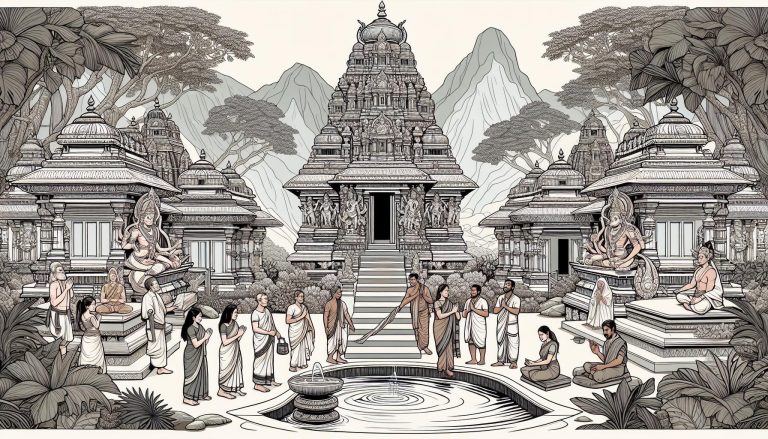
From the Vedas and Upanishads to the epics like the Mahabharata – The Great Epic and Ramayana, Hindu canonical literature isn’t just about religious rituals. It’s a treasure trove of wisdom, poetry, and stories that continue to resonate with millions. Exploring these texts can provide a deeper understanding of Hindu culture and its timeless teachings.
Overview Of Hindu Canonical Literature
Hindu canonical literature forms the bedrock of Hinduism, encompassing texts that guide spiritual and philosophical practices. These texts, split into Shruti and Smriti, each serve specific roles in the Hindu tradition.
Shruti (Revealed Texts)
Shruti texts are believed to be divinely revealed. These include:
- Vedas: The most ancient texts, consisting of:
- Rig Veda: Hymns and praises for deities.
- Yajur Veda: Instructions for rituals and ceremonies.
- Sama Veda: Melodic chants and hymns.
- Atharva Veda: Spells, charms, and incantations.
- Brahmanas: Detailed explanations of Vedic rituals.
- Aranyakas: Meditations and interpretations of rituals, composed in forest settings.
- Upanishads: Philosophical texts exploring metaphysical concepts and self-realization.
Smriti (Remembered Texts)
Smriti texts are human compositions. They include:
- Mahabharata: An epic narrating the Kurukshetra War, including the Bhagavad Gita.
- Ramayana: The story of Lord Rama’s quest to rescue Sita.
- Puranas: Mythological texts detailing cosmology, legends, and traditions.
- Dharma Shastra: Legal and ethical treatises guiding daily life.
Hindu canonical literature, both Shruti and Smriti, shapes the core beliefs and practices of Hinduism, ensuring its transmission through generations.
Vedas: The Foundation Of Hindu Literature

The Vedas form the cornerstone of Hindu canonical literature. They are four primary texts: Rigveda, Samaveda, Yajurveda, and Atharvaveda, originating around 1500 BCE in ancient India.
Rigveda
The Rigveda is the oldest Veda, composed of 10 books (mandalas) with 1,028 hymns and 10,600 verses. It deals with proper religious observance and practice, addressing fundamental questions about existence and the universe.
Samaveda
The Samaveda is a collection of melodies and chants, primarily drawn from the Rigveda, with some original content. It focuses on melodic recitations and chants, often used in rituals and ceremonies.
Yajurveda
The Yajurveda contains sacrificial formulas and mantras, also largely drawn from the Rigveda. It plays a crucial role in rituals involving sacrifices and offerings.
Atharvaveda
The Atharvaveda consists of hymns, spells, and incantations, addressing daily life issues and healing. It complements the other Vedas by focusing on practical aspects of existence and well-being.
Upanishads: The Philosophical Texts

The Upanishads stand as a keystone in Hindu philosophy, representing the concluding portion of the Vedas, often referred to as vedanta. These texts investigate deeply into the nature of reality and self.
Principal Upanishads
I find 108 Upanishads, with the earliest dozen recognized as the core texts:
- Brihadaranyaka Upanishad: One of the oldest and considered among the most significant, it explores the self and the universe in greater detail.
- Chandogya Upanishad: Known for its rich philosophical and mystical lessons, it introduces Ahimsa (non-violence) as a principal ethical guideline.
- Taittiriya Upanishad: This text concentrates on the essence of the self and the cosmos, emphasizing the significance of self-discipline and self-awareness.
Philosophical Themes
The Upanishads address various philosophical themes:
- Atman and Brahman: Central concepts, Atman refers to the individual soul, while Brahman signifies the ultimate reality encompassing all existence.
- Moksha: This theme covers the liberation from the cycle of rebirth, which is attainable through self-realization and understanding of the divine.
- Karma and Reincarnation: These texts explore the law of cause and effect and the continuous cycle of birth and rebirth.
- Meditation and Knowledge: Importance is placed on meditation and obtaining wisdom to comprehend the deeper truths of life.
The Upanishads, through these themes, profoundly influence Hindu thought and practice.
Smriti Literature
Smriti literature, based on human tradition and memory, comprises various texts attributed to specific authors. These texts provide essential insights and narratives that guide Hindu practices and societal norms.
Mahabharata
The Mahabharata, attributed to the sage Vyasa, is one of the longest epic poems in history, with over 100,000 verses. It narrates the Kurukshetra War between the Pandavas and the Kauravas, alongside important Hindu teachings like the Bhagavad Gita. The Bhagavad Gita addresses themes such as dharma (duty), karma (action), and bhakti (devotion), making it a key philosophical and spiritual text within the epic.
Ramayana
The Ramayana, authored by the sage Valmiki, recounts the story of Prince Rama’s quest to rescue his wife Sita from the demon king Ravana. Comprising 24,000 verses, this epic highlights values like duty, honor, and loyalty. Rama’s righteousness and Sita’s devotion serve as exemplary models for ethical behavior and adherence to dharma in Hindu tradition.
Puranas
The Puranas consist of a vast genre of ancient texts that cover mythology, cosmology, and religious practices. There are 18 major Puranas, including the Vishnu Purana, the Shiva Purana, and the Bhagavata Purana. These texts chronicle the creation, preservation, and destruction of the universe, and provide narratives of gods, goddesses, heroes, and significant historical events. The Bhagavata Purana is particularly revered for its devotion to Vishnu and its tales of Krishna.
Smriti literature, through its diverse and profound texts, continues to shape and influence Hindu thought and tradition.
Influence On Modern Hindu Thought
Modern Hindu thought integrates multiple influences, blending traditional concepts with contemporary insights. Among these, Western ideas, particularly from Christianity, science, and social constructs, have left a significant mark. These influences have led to the reinterpretation and reconfiguration of ancient Hindu principles.
The contributions of individual thinkers in the modern period are notable. These thinkers have analyzed and reformed Hindu concepts to address modern issues. Swami Vivekananda, for example, introduced the principles of Vedanta to the Western world, emphasizing universal spirituality. His speeches at the Parliament of the World’s Religions in 1893 remain influential.
Also, Mohandas K. Gandhi’s application of ahimsa (non-violence) and satyagraha (truth-force) shows the practical implementation of ancient Hindu values in socio-political contexts. His leadership in India’s independence movement illustrated these principles effectively, showcasing their relevance in modern activism.
The modernization period also witnessed the rise of new religious movements and organizations, such as the Brahmo Samaj and Arya Samaj. These institutions aimed at purifying and rationalizing Hindu practices, discarding superstitions and promoting monotheism.
Canonically, the reinterpretation of texts like the Upanishads and Bhagavad Gita through modern lenses has also contributed to contemporary Hindu thought. For instance, the Gita’s teachings on duty and righteousness find applications in personal and professional life today, far beyond their original martial context.
Overall, modern Hindu thought reflects a dynamic interplay between traditional literature and contemporary external influences, demonstrating the adaptability and enduring relevance of ancient philosophies in today’s world.
Conclusion
Hindu canonical literature remains a cornerstone of understanding the rich world of Hinduism. The dynamic interplay between ancient texts and modern influences continues to shape contemporary Hindu thought. Figures like Swami Vivekananda and Mohandas K. Gandhi have successfully bridged the gap between age-old wisdom and modern ideologies. New religious movements like the Brahmo Samaj and Arya Samaj have further contributed to the evolution of Hindu practices. The ongoing reinterpretation of classical texts ensures that Hinduism remains a living, breathing tradition, adaptable to the ever-changing world of the modern world.
Sources & further reading
These themes are explored in greater depth across the following authoritative resources:
- Stanford Encyclopedia of Philosophy, Hindu Philosophy
- Mythopedia, Hindu Mythology
- Britannica, Hindu Mythology
- Sheldon Pollock, The Language of the Gods in the World of Men (University of California Press, 2006)
- A. K. Ramanujan, The Collected Essays (Oxford University Press, 1999)
External resources for further reading. Apam Napat is not affiliated with these publishers; citation does not imply endorsement.
Frequently asked questions
What are the two main divisions of Hindu canonical literature?
What are the four Vedas?
What are the principal Upanishads?
What are the Brahmanas and Aranyakas?
Which Smriti texts shape daily Hindu life?
Based on the classical texts of Hindu mythology, see our sources.