
In an age where material pursuits often overshadow inner peace, the Upanishadic principles remind us to look within. They challenge us to question our perceptions and seek a deeper understanding of our existence. By embracing these teachings, we can uncover a path to true fulfillment and harmony.
The Essence Of Upanishadic Eternal Principles
The Upanishadic eternal principles are rooted in the philosophical and spiritual teachings of the Upanishads, forming the foundation of Hinduism. These principles revolve around the pursuit of eternal truth and understanding of the self and the universe.
The Quest for Eternal Truth
The Upanishads aim to grasp the eternal and unchanging reality that underpins all existence. This pursuit is epitomized by the seeker’s question in the Mundaka Upanishad: “What is it that, by being known, all else becomes known?” This highlights the intrinsic search for ultimate knowledge as the key to understanding all of existence.
The Concept of Brahman – The Supreme Truth
Brahman is seen as the supreme, eternal, and unchanging reality in the Upanishads. Described as ineffable, infinite, conscious, and blissful, Brahman represents the ultimate essence of everything. The texts stress that comprehension of Brahman is crucial for achieving moksha, or liberation from the cycle of birth and death.
Key Teachings Of The Upanishads
The Upanishads offer profound teachings on the nature of reality, the self, and liberation. These teachings form the foundation of Hindu philosophy and offer insights for introspection and personal growth.
Brahman: The Ultimate Reality
Brahman represents the supreme, unchanging reality, beyond the physical world. It’s described as infinite, omnipresent, and the source of all existence. The Chandogya Upanishad states, “Sarvam khalvidam Brahma – The Creator,” meaning “All this is Brahman.” This signifies that the entire universe is an expression of Brahman, encouraging a holistic view of life. Understanding Brahman leads to spiritual enlightenment and the realization of the interconnectedness of all beings.
Atman – The Soul: The Inner Self
Atman refers to the individual soul or the true self, distinct from the physical body and mind. The Upanishads focus on the unity of Atman and Brahman, asserting that realizing this connection leads to spiritual liberation. The Mandukya Upanishad explains, “Ayam Atma Brahma,” translating to “This self (Atman) is Brahman.” Through meditation and self-inquiry, individuals can discover their Atman, transcending ego and experiencing true essence.
Moksha: Liberation And Freedom
Moksha denotes liberation from the cycle of birth, death, and rebirth (samsara). It represents the ultimate goal of human existence in the Upanishadic teachings. Achieving moksha involves realizing the oneness of Atman and Brahman, resulting in freedom from material desires and suffering. The Katha Upanishad mentions, “When all desires that dwell in the heart cease, then the mortal becomes immortal and attains Brahman.” This highlights the path to moksha through renunciation and spiritual wisdom.
Philosophical Concepts
Ancient Indian philosophies reveal intricate and profound thoughts. Here, key Upanishadic principles are explored in-depth.
Karma And Its Implications
Karma, an essential concept in the Upanishads, signifies action and its subsequent results. Every action, whether thought, word, or deed, carries energy and creates corresponding reactions. If virtuous acts are performed, positive outcomes result; negative actions bring adverse effects. The law of karma governs ethical conduct, encouraging individuals to act with righteousness and integrity to attain favorable future conditions.
The Cycle Of Birth And Rebirth
Central to Upanishadic philosophy is Samsara, the cycle of birth, death, and rebirth. Samsara defines the continuous cycle that every soul undergoes. Life, as described in the Upanishads, is not a single event but a sequence of existences shaped by accumulated karma. Liberation, or moksha, is attained when one fully grasps the unity of Atman and Brahman, breaking free from this cycle. Hence, understanding and transcending Samsara is key to achieving spiritual liberation and ultimate freedom from suffering.
Relevance In Modern Times
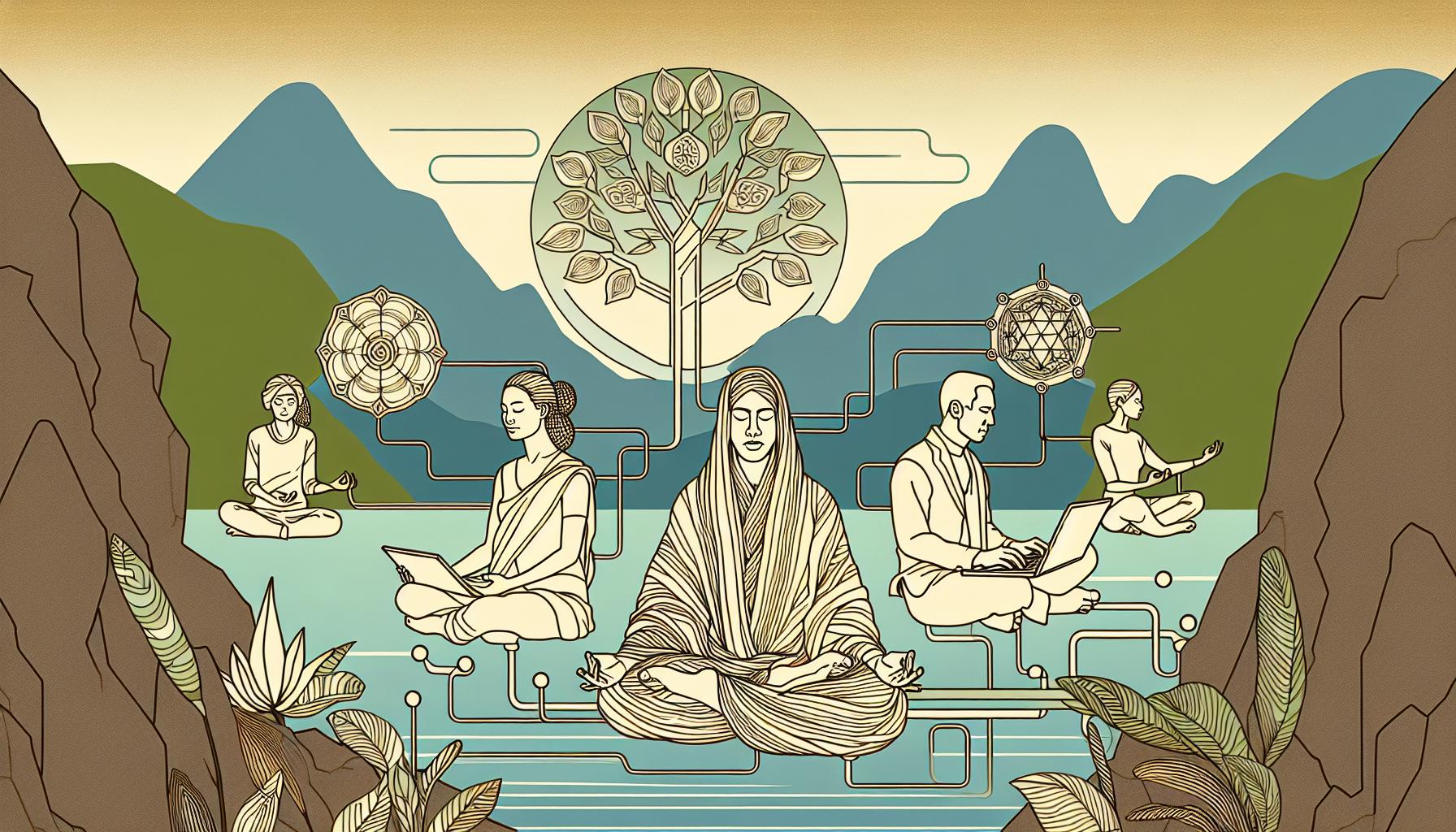
Upanishadic eternal principles, though ancient, hold significant relevance today. The concept of Atman and Brahman underscores the unity of all existence, offering a framework for addressing modern issues like environmental sustainability and social justice. Recognizing the interconnectedness of life encourages a holistic approach to problem-solving.
The quest for knowledge, emphasized in the Upanishads, aligns with contemporary values of lifelong learning and self-improvement. Engaging in introspection and dialogue fosters personal growth and innovation. This principle is reflected in today’s emphasis on mental health and mindfulness practices.
Karma, or the law of cause and effect, resonates with modern understandings of accountability and ethical living. Awareness of the consequences of one’s actions promotes responsible behavior and social harmony. Concepts from the Upanishads inspire movements focused on ethical consumerism and corporate responsibility.
Also, the Upanishadic principle of transcending Samsara offers insights into improving quality of life. Modern life’s stress and material pursuits mirror Samsara’s endless cycle. Applying Upanishadic teachings helps individuals seek deeper meaning and contentment beyond material wealth.
Incorporating Upanishadic principles into daily life enables a balanced, reflective approach to modern challenges, aligning ancient wisdom with contemporary needs.
Impact On Hindu Philosophy
The Upanishads have significantly shaped Hindu philosophy. They lay the foundational concepts of Brahman and Atman, deepening the understanding of the self and the ultimate reality. Hindu thinkers, such as Adi Shankaracharya, used these texts to formulate Advaita Vedanta. This non-dualistic school emphasizes the unity of Atman and Brahman, stating that realizing this unity leads to moksha. The Upanishads’ teachings also influence other philosophical schools like Vishishtadvaita and Dvaita, each interpreting the relationship between the individual soul and the supreme differently.
Key principles from the Upanishads have permeated daily Hindu practices. The law of karma teaches that actions have consequences, affecting one’s future. This principle fosters moral behavior, encouraging adherence to dharma (duty and righteousness). Samsara, the cycle of birth and death, and the pursuit of moksha drive many spiritual practices. Many Hindus practice meditation and yoga, rooted in Upanishadic thought, to attain spiritual knowledge and peace.
Also, the Upanishadic focus on inner knowledge and self-realization prompts lifelong learning and reflection among Hindu practitioners. The idea that the divine resides within every individual supports a sense of equality and respect for all life forms. This reverence extends to environmental stewardship, as the belief in the interconnectedness of all beings promotes sustainable living. The Upanishads, though ancient, continue to offer timeless wisdom that aligns with contemporary values and challenges.
Conclusion
Exploring the eternal principles of the Upanishads offers a transformative journey into the depths of human consciousness and spirituality. These ancient texts provide timeless wisdom that continues to resonate with contemporary values and challenges.
By embracing the interconnectedness of Brahman and Atman, we can strive for spiritual enlightenment and liberation. The teachings on karma and Samsara guide us toward moral behavior and environmental stewardship, while practices like meditation and yoga enhance our daily lives.
The Upanishads not only shape Hindu philosophy but also inspire a lifelong pursuit of inner knowledge and self-realization. Their enduring relevance reminds us of the profound connection between ancient wisdom and modern life.
Sources & further reading
These themes are explored in greater depth across the following authoritative resources:
- Internet Sacred Text Archive, Rig Veda (Griffith translation)
- Internet Sacred Text Archive, Upanishads
- Britannica, Veda
- Britannica, Upanishad
- Patrick Olivelle, The Early Upanishads (Oxford University Press, 1998)
External resources for further reading. Apam Napat is not affiliated with these publishers; citation does not imply endorsement.
Based on the classical texts of Hindu mythology, see our sources.