
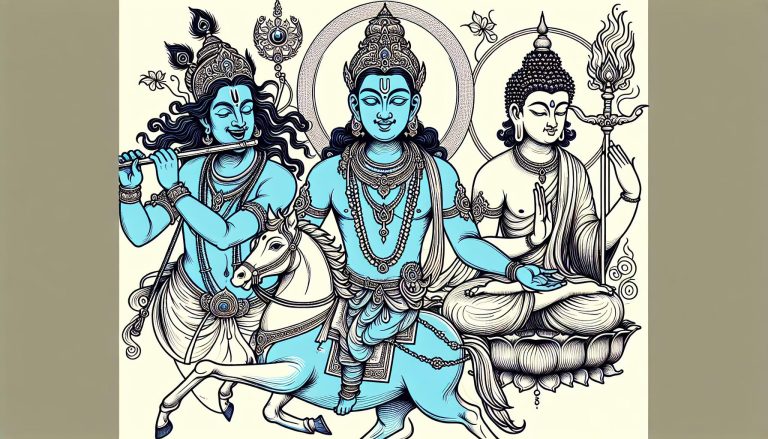
Each avatar of Vishnu serves a distinct purpose, reflecting the diverse ways in which he intervenes to restore cosmic order. Whether it’s through wisdom, strength, or divine playfulness, Vishnu’s avatars demonstrate a spectrum of qualities that offer profound lessons and inspiration. Join me as we explore the captivating characteristics of these divine incarnations and their significance in the broader tapestry of Hindu mythology.
Overview Of Vishnu’s Avatars
Vishnu’s avatars, known as Dashavatar, play crucial roles in Hindu mythology to preserve cosmic order. Each avatar embodies unique features and purposes, reflecting stages of evolution and human development.
- Matsya (Fish): The first avatar symbolizes the early stages of aquatic life. Matsya saved the sacred Hindu scriptures from a great deluge, demonstrating divine intervention in preserving knowledge.
- Kurma (Tortoise): The second avatar represents the amphibious stage of evolution. As Kurma, Vishnu supported Mount Mandara on his back during the churning of the ocean, a pivotal event in Hindu cosmology.
- Varaha (Boar): The third avatar signifies the emergence of land-based life. Varaha rescued the Earth, personified as the goddess Bhudevi, from the demon Hiranyaksha, illustrating the triumph of good over evil.
- Narasimha (Man-Lion): The fourth avatar is a semi-human form marking the transition from animal to human. Narasimha defeated the tyrant demon king Hiranyakashipu, demonstrating the power of deity in different forms to protect devotees.
- Vamana (Dwarf): The fifth avatar represents the developmental stages of human intelligence. Vamana, in dwarf form, subdued the demon king Bali by covering the universe with his three steps, highlighting themes of humility and righteousness.
- Parasurama (Rama with the Axe): The sixth avatar showcases early humans with primitive weapons. Parasurama wields an axe received from Shiva, symbolizing the warrior archetype. He purges the Earth of corrupt rulers, reinstating dharma (righteous path).
- Rama (Ideal Hero): The seventh avatar is a perfect human being representing heroism and virtue. Rama, known from the epic Ramayana, embodies dharma and is aided by the vanara deity Hanuman. His narrative highlights the importance of duty, loyalty, and justice.
Characteristics Of Matsya
Matsya, the fish avatar of Vishnu, holds a unique place among the Dashavatar. Representing themes of salvation and restoration, Matsya carries profound symbolism and captivating stories.
Appearance And Symbolism
Matsya can be depicted in two primary forms. The zoomorphic form shows Matsya as a giant fish, often golden in color. In the anthropomorphic form, the representation combines a fish’s lower half with the upper body of Vishnu. Vishnu’s half includes four arms, adorned with traditional ornaments and a tall conical crown. Two hands hold the Sudarshana – Ancestor of Rama chakra (discus) and a shankha (conch), while the other two hands display the varadamudra (granting boons) and abhayamudra (reassuring protection) gestures. Matsya is often linked with flood myths, depicting him as the savior who guides humanity through great deluges.
Key Contributions And Stories
Matsya is best known for saving the world from a catastrophic flood. In this tale, Matsya guided Manu, the first man, to safety. Vishnu, in his Matsya form, ensured that the sacred Vedas were protected from drowning, preserving critical knowledge and wisdom for future generations. This story highlights Matsya’s role in maintaining cosmic order during times of immense upheaval and serves as a testament to Vishnu’s enduring commitment to saving and restoring balance in the universe.
Throughout the narrative of the Dashavatar, Matsya stands out for his unique combination of forms and his crucial role in protecting humanity and preserving knowledge.
Characteristics Of Kurma
Kurma, Vishnu’s second avatar, holds a unique place in Hindu mythology.
Appearance And Symbolism
Kurma is depicted as a tortoise, representing resilience and steadfastness. This form symbolizes finding inner refuge and protection during challenges. The tortoise also embodies firmness and steadiness, qualities essential for overcoming difficulties. W. Caland and P.N. Sinha highlight these symbolic meanings in their works.
Key Contributions And Stories
Kurma’s primary story centers around the Samudra Manthana episode. In this tale, Kurma supports Mount Mandara on his back, helping the gods and demons churn the ocean of milk. This act produces the elixir of immortality, Amrita. By maintaining balance during the churning process, Kurma symbolizes harmony in life’s challenges.
Characteristics Of Varaha
Varaha, the third avatar of Vishnu, is known for his distinctive appearance and his role as a preserver. Varaha’s attributes and stories emphasize protection and restoration.
Appearance And Symbolism
Varaha is typically depicted with a unique combination of a human body and a boar head, symbolizing the connection between divine and earthly realms. In many representations, he holds a mace, a conch, a lotus, and sometimes Lakshmi on his left elbow. His most iconic pose shows him standing in the combative alidha stance, with one leg straight and the other bent, over the four-armed serpent Shesha. He is often golden in complexion and adorned with a vanamala, a garland of forest flowers, which reflects his link to nature and the earth.
Key Contributions And Stories
Varaha’s primary story involves rescuing Earth from the demon Hiranyaksha. According to myth, Hiranyaksha submerged Earth into the cosmic ocean. Varaha dove into the depths, lifted Earth on his tusks, and restored her to her rightful place. This avatar symbolizes Vishnu’s role in maintaining cosmic order and portrays him as a protector against chaos and evil forces.
By providing these details, I aim to highlight the significance of Varaha among Vishnu’s avatars and how each characteristic and story underlines his role as a preserver.
Characteristics Of Narasimha
Continuing our exploration of Vishnu’s avatars, I now focus on Narasimha, the fourth avatar. This unique incarnation depicts a blend of human and animal forms, showcasing specific attributes and stories that signify eternal truths.
Appearance And Symbolism
Narasimha has a distinct appearance. He’s depicted with a lion face and a human body. Often shown with three eyes and clawed fingers, this form represents power and ferocity. In many representations, he emerges from a pillar, symbolizing his omnipresence.
Narasimha embodies several powerful symbols. He represents creative resistance, hope against insurmountable odds, and victory over persecution. As the God of Destruction, he’s associated with the annihilation of evil. His connection to yoga highlights the spiritual strength and discipline required to overcome darkness.
Key Contributions And Stories
The story of Hiranyakashipu is central to understanding Narasimha’s significance. Hiranyakashipu, a demon king, secured a boon making him invincible to conventional harm. He couldn’t be killed by human or animal, inside or outside, day or night, or with any weapon.
Narasimha’s emergence from a pillar at dusk—neither day nor night—circumvented these constraints. With his lion-human form—neither human nor animal—he used clawed fingers—no weapon—to kill Hiranyakashipu. By defeating the demon, he saved his devotee Prahlada, illustrating how divine intervention conquers evil despite overwhelming obstacles.
This narrative reinforces Narasimha’s role as a destroyer of evil and protector of devotees, cementing his place among Vishnu’s avatars.
Characteristics Of Vamana
Vamana, the fifth avatar of Vishnu, holds a vital place in Hindu mythology. His story intertwines humility, wisdom, and decisive action.
Appearance And Symbolism
Vamana appears as a dwarflike Brahmin, occasionally depicted as a deformed dwarf or a brahmacharin (monastic student) dressed in traditional attire. He symbolizes divine humility and connects to the concept of Trivikrama, the “God of the Three Strides.”
Key Contributions And Stories
The story of Vamana primarily revolves around the defeat of Bali, a powerful demon king who had seized control of the universe. To overthrow Bali, Vamana requested land that he could cover in three paces. Using his giant form, he took two strides to cover the earth and the midworld. Bali then offered his head for the third step, and Vamana sent him to rule the netherworld. The Rigveda mentions that Vishnu measured the three worlds—earth, heaven, and the space between them—with three strides, highlighting his immense power.
Characteristics Of Parashurama – Rama of the Axe
Parashurama, the sixth avatar of Vishnu, showcases distinct features and significant contributions in Hindu mythology.
Appearance And Symbolism
Parashurama is depicted as a man with matted locks, typically seen carrying an axe. Sometimes, he is portrayed with four hands, each holding an axe, bow, arrow, and sword. This representation highlights his prowess in both physical combat and spiritual duties. Embodying the dual characteristics of a Kshatriya (warrior) and a Brahmin (priest), Parashurama unites martial strength and spiritual wisdom in one avatar. This unique combination of traits underscores his role in enforcing cosmic balance through both warfare and penance.
Key Contributions And Stories
Parashurama’s contributions to Hindu mythology are numerous and impactful.
- Killing of Kshatriyas: He avenged his father’s murder by killing all male Kshatriyas on earth 21 times. This act, though brutal, was seen as a necessary purging of corrupt rulers.
- Founding of Malabar: Parashurama is credited with founding the Malabar region and bestowing land upon the priestly class, ensuring the spread of Vedic knowledge and practices.
- Encounter with Rama: In a significant encounter, Parashurama met Rama, another avatar of Vishnu, and was subdued by him in a fight, acknowledging Rama’s supremacy and solidifying the cosmic order.
Some key stories illustrate Parashurama’s life:
- Birth: Born to the Brahman sage Jamadagni and the Kshatriya princess Renuka, Parashurama’s lineage blended both priestly and warrior classes, foreshadowing his unique role.
- Murder of Mother: Ordered by his father to behead his mother Renuka due to an unchaste thought, Parashurama obeyed. His father later revived her, impressed by Parashurama’s unwavering obedience. This story exemplifies his commitment to duty, regardless of personal cost.
Characteristics Of Rama
Rama stands as one of Vishnu’s most prominent avatars, embodying various noble qualities and elements of divine intervention.
Appearance And Symbolism
Rama is typically depicted as a strong and handsome man, often with blue skin, symbolizing his divine nature. In many representations, he stands tall, adorned in regal attire and carries a bow and arrow, emphasizing his readiness for battle and protection. His blue skin, similar to other avatars like Krishna, signifies his connection to divinity and the sky.
Symbolically, Rama represents chivalry, virtuousness, and reason. His life and actions illustrate adherence to Dharma (righteousness), duty, and moral order. He is associated with warfare, depicted as a hero battling against evil forces. His steadfast loyalty to his wife, Sita, and his commitment to righteousness reflect his inherent virtues.
Key Contributions And Stories
Rama’s key contributions to Hindu mythology revolve around his battle against the demon king Ravana. His bravery and strength were central to this epic struggle, culminating in Ravana’s defeat and the rescue of Sita. This narrative, detailed in the Ramayana, highlights his role as a protector and restorer of Dharma.
Another significant aspect of Rama’s story is his devotion to Sita. Their relationship exemplifies ideal virtues, such as love, loyalty, and mutual respect. The episode of Sita’s abduction and subsequent rescue marks a pivotal moment in Hindu lore, showcasing Rama’s unwavering dedication to his loved ones and his duty.
These elements together reinforce Rama’s status as an enduring symbol of virtue, strength, and devotion in Hindu tradition.
Characteristics Of Krishna
Krishna, the eighth avatar of Vishnu, stands out for his multifaceted personality and impactful presence in Hindu mythology. Renowned for his profound teachings and joyous nature, Krishna remains a pivotal figure in Hindu traditions.
Appearance And Symbolism
Krishna’s blue skin symbolizes eternity and divine essence. Depictions frequently show him with yellow clothing, representing pure, limitless consciousness linked to the earth. His cheerful demeanor is usually accompanied by a flute, highlighting his affinity for music and art.
Key Contributions And Stories
Krishna’s life and teachings are immortalized in texts like the Bhagavad Gita, where he offers wisdom on achieving harmony within individuals and society. Notably, the story of Krishna guiding the Pandavas in the Mahabharata – The Great Epic showcases his role as a strategic thinker and divine guide.
Overall, Krishna’s characteristics, from his enchanting appearance to his invaluable teachings, contribute significantly to his revered status in Hindu mythology.
Characteristics Of Buddha
As the ninth avatar of Vishnu, Buddha’s characteristics reflect his wisdom and intellectual depth.
Appearance And Symbolism
Buddha is typically depicted in serene meditation. His calm expression signifies inner peace and enlightenment. Statues often show him seated with eyes half-closed, reflecting deep contemplation. The elongated earlobes symbolize his royal heritage and renunciation of worldly life. The ushnisha, a cranial protuberance, represents his expanded wisdom and spiritual power. The Dharma Wheel (Dharmachakra) beside or behind Buddha signifies the spread of his teachings.
Key Contributions And Stories
Known for founding Buddhism, Buddha’s key contribution lies in delivering profound teachings aimed at alleviating suffering through the Eightfold Path and the Four Noble Truths. One significant story involves his renunciation of princely life in search of spiritual truth, culminating in enlightenment under the Bodhi tree. His first sermon at Sarnath laid the foundation of Buddhism, spreading messages of compassion, mindfulness, and ethical living. Each story emphasizes his role in promoting wisdom and non-violence.
Characteristics Of Kalki
Kalki, the tenth and final avatar of Vishnu, carries profound symbolism and distinct traits. His prophesied arrival signifies a pivotal transformation in Hindu cosmology.
Appearance And Symbolism
Kalki embodies the quintessential Brahmin warrior, riding a white horse with a fiery sword. This depiction resonates with power and intensity, highlighting his role in ending the chaos of Kali Yuga. The white horse symbolizes purity and the sword signifies the purging of evil. His appearance heralds the end of the dark age and the dawn of the Satya Yuga, a period marked by peace and righteousness.
Key Contributions And Stories
Kalki’s primary role involves the eradication of adharma (evil) at the conclusion of the Kali Yuga. Expected to restore dharma (righteousness), he represents the cycle of destruction and renewal inherent in Hindu belief. Numerous scriptures detail Kalki’s emergence to cleanse the world, reestablishing divine order and preparing for a new era of spiritual upliftment.
Conclusion
Exploring Vishnu’s avatars reveals a rich tapestry of characteristics that guide Hindu beliefs and practices. Each avatar, from Krishna’s eternal joy to Buddha’s profound wisdom and Kalki’s righteous fury, serves a unique purpose in the cosmic order. These divine manifestations not only highlight the cyclical nature of time but also offer timeless lessons on morality and spiritual growth. By understanding these avatars, we gain deeper insights into the principles of dharma and the continuous journey towards enlightenment and renewal.
Frequently asked questions
What are the ten avatars of Vishnu called?
What did Matsya, the fish avatar of Vishnu, do?
How did Narasimha kill Hiranyakashipu?
Why is Vamana, the dwarf avatar of Vishnu, significant?
Who is the tenth avatar Kalki?
Sources & further reading
These themes are explored in greater depth across the following authoritative resources:
- Encyclopaedia Britannica, Hindu Mythology
- Internet Sacred Text Archive, Hinduism
- Mythopedia, Hindu Mythology
- Harvard Pluralism Project, Hindu Tradition
- Wendy Doniger, The Hindus: An Alternative History (Penguin, 2009), ISBN 978-0143116691
External resources for further reading. Apam Napat is not affiliated with these publishers; citation does not imply endorsement.
Based on the classical texts of Hindu mythology, see our sources.