
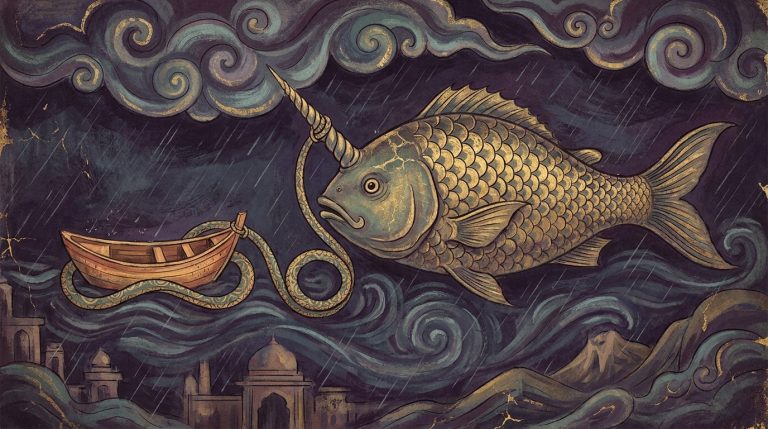
The fish in Manu’s hands
Manu, the progenitor of humankind, was making a water offering at a river when he found a tiny fish cupped in his palms. It spoke, asking to be protected from the larger fish that would eat it. He put it in a jar.
By morning it had outgrown the jar. He moved it to a larger vessel, then to a well, then to a tank, then to the Ganges, and finally to the ocean, and at every stage it outgrew the space within a day. When it had grown beyond the sea itself, Manu understood what he was dealing with and asked who it was. The fish revealed itself as Vishnu, and delivered a warning: a flood was coming that would dissolve the world.
The boat and the serpent
Matsya instructed Manu to build a boat and to carry aboard the seven sages, the saptarishi, and the seeds of every living kind. When the waters rose, the fish reappeared, now vast and bearing a single horn. The great serpent Vasuki was used as a rope, tied to that horn, and the boat was towed through the deluge until the waters receded and it came to rest on a mountain peak.
Several Puranas add a second rescue. A demon, most often named Hayagriva, had stolen the Vedas and hidden with them in the cosmic waters while Brahma slept. Matsya recovered them. The avatar therefore preserves two things through the flood: life, and the knowledge required to live rightly.
The Vedic original
The oldest surviving version of this story is in the Shatapatha Brahmana, and it is worth knowing how different it is. There, the fish is simply a fish. It is not Vishnu, there is no avatar theology, and the account is short and practical. The identification with Vishnu, and the fish’s place as the first of ten descents, is a later Puranic development.
This makes Matsya an unusually clear case study in how the tradition works: an ancient flood narrative is preserved, then absorbed, and finally given a place in a devotional scheme that did not exist when it was first told.
Matsya and the other flood stories
The resemblance to the flood of Genesis, and to the older Mesopotamian accounts of Utnapishtim and Ziusudra, is obvious and has been discussed for well over a century. All feature a warned survivor, a vessel, the preservation of living kinds and a world begun again.
Two differences are worth holding on to. First, Manu is warned by a creature he had himself protected, which makes the rescue reciprocal rather than purely a matter of divine selection. Second, the Hindu flood is not a singular judgement on human wickedness but a pralaya, a periodic dissolution built into a cyclical cosmos. It has happened before and will happen again. What ends is an age, not the story.
After the waters recede comes Kurma, the tortoise, and the churning of the ocean. See the full Dashavatara list in order.
Frequently asked questions
What is the story of Matsya and Manu?
Why was Vishnu’s first avatar a fish?
How does Matsya compare with Noah’s flood?
Which text tells the Matsya story?
Did Matsya also recover the Vedas?
Sources & further reading
These accounts are drawn from and can be checked against the following primary texts and reference works:
Based on the classical texts of Hindu mythology, see our sources.