
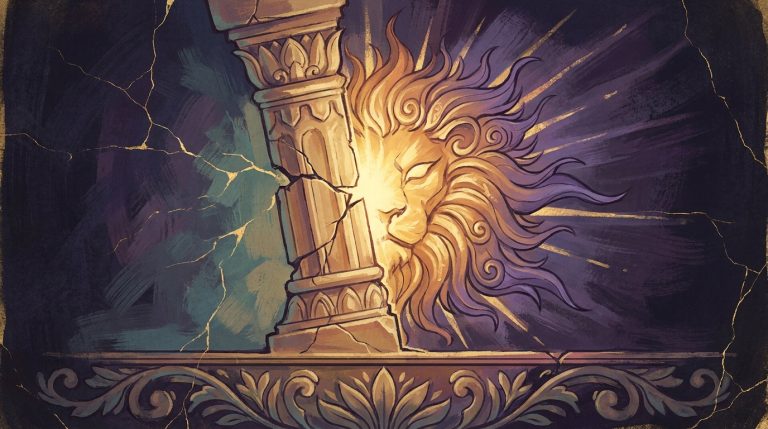
The story is told most fully in the seventh canto of the Bhagavata Purana. It is a story about a tyrant, about his son who would not stop praying, and about the moment a stone pillar broke open at dusk.
The boon that could not be broken
Hiranyakashipu was an asura king, and his hatred of Vishnu was personal. Vishnu had already killed his brother Hiranyaksha in the form of Varaha, the boar who lifted the earth out of the cosmic ocean. Hiranyakashipu set out to make himself immune to any repetition of that.
He performed austerities severe enough that Brahma appeared and offered him a boon. Immortality outright was refused, as it always is. So Hiranyakashipu built a cage of conditions instead. He asked that he not be killed:
- by any created being, nor by man or animal;
- neither indoors nor outdoors;
- neither by day nor by night;
- neither on the earth nor in the sky;
- and not by any weapon, whether astra or shastra.
Brahma granted it. Hiranyakashipu, believing himself now beyond reach, took the three worlds and demanded he be worshipped in place of the gods.
Prahlada, the son who would not comply
His son Prahlada was a devotee of Vishnu from early childhood, and no amount of instruction or threat changed that. The Bhagavata Purana records a sequence of attempts on the boy’s life: poison that did not work, elephants that would not trample him, serpents that would not bite, and a fire he walked out of unharmed while his aunt Holika, who was supposed to be immune to fire, burned instead. That episode is remembered in the festival of Holi.
Eventually Hiranyakashipu demanded to know where this Vishnu of his son’s actually was. Prahlada answered that he was everywhere, in all things. His father, pointing at a pillar of the hall, asked whether Vishnu was in that. Prahlada said he was. Hiranyakashipu struck the pillar.
How every condition was met
The pillar split, and Narasimha came out of it. What followed satisfied the boon in every particular, and the precision is the point of the story:
| The condition | How it was answered |
|---|---|
| Not by man or animal | Narasimha is neither: a man-lion |
| Not indoors or outdoors | On the threshold of the palace doorway |
| Not by day or night | At twilight, which is neither |
| Not on earth or in the sky | Across Narasimha’s lap |
| Not by any weapon | With claws, which are not a weapon but part of the body |
Hiranyakashipu was killed, and Prahlada was spared and later made king. The Purana notes that Narasimha’s fury was so extreme afterwards that none of the gods could approach him, and it was Prahlada, the child, who calmed him.
Why a lion, and why a pillar
The form is not arbitrary. The lion is the traditional emblem of sovereign power and of righteous ferocity, and Narasimha is invoked precisely as a protector who intervenes at the last possible moment. The pillar matters just as much: Prahlada had claimed that Vishnu is present in all things, and his father chose the most inert object in the room to disprove it. Vishnu emerging from that specific pillar is the theological argument of the story made visible.
This is why Narasimha occupies an unusual place in devotion. He is fierce, and images of him are often kept for protection rather than for contemplation. The Narasimha Kavacham, a protective hymn attributed to Prahlada and preserved in the Brahmanda Purana, asks for that ferocity to be turned outward on the reciter’s behalf.
Narasimha Jayanti
The appearance of Narasimha is observed on the fourteenth day of the bright fortnight of Vaishakha, falling in April or May. The customary observance is a daytime fast broken at dusk, mirroring the hour at which the pillar broke. It is kept most widely in Andhra Pradesh, Telangana and Tamil Nadu.
Where Narasimha is worshipped
Ahobilam in the Nallamala hills of Andhra Pradesh is the principal centre, and unusually it is not a single temple but nine, each identified with a different aspect or moment of the story and spread across some miles of hill country. Simhachalam near Visakhapatnam and Yadagirigutta in Telangana are the other major sites. In iconography Narasimha appears both in the violent moment itself and, more often in domestic shrines, as Lakshmi-Narasimha, seated and calmed, with Lakshmi beside him.
Narasimha is the fourth of the ten. Before him came Varaha, who killed Hiranyakashipu’s brother; after him comes Vamana, who dealt with Prahlada’s own grandson Bali by an entirely gentler method. See the full Dashavatara list in order.
Why not simply cancel the boon?
This is the question readers ask more than any other, and it is a fair one. If Vishnu is supreme, why work around Brahma’s boon instead of revoking it?
The answer the tradition gives is that a boon, once granted, is binding — and that this constraint is the point rather than an inconvenience. Dharma applies to the gods as much as to anyone. To simply void Brahma’s word would have made the divine order arbitrary, which is precisely the disorder Vishnu descends to correct. The story works because the solution respects the letter of the promise absolutely while denying its intent.
There is a further clause often missed. Hiranyakashipu also asked not to be killed by any being created by Brahma. Narasimha satisfies this too: Vishnu is not among Brahma’s creations, and in the Vaishnava reading Brahma proceeds from Vishnu rather than the reverse. The boon is airtight against everything in creation; it simply does not reach beyond it.
The Sharabha controversy
One episode attached to Narasimha is genuinely disputed between traditions, and it is worth setting out plainly rather than quietly omitting.
Certain Shaiva Puranas relate that after killing Hiranyakashipu, Narasimha’s fury remained so destructive that Shiva took the form of Sharabha — a composite beast, part lion, part bird — to subdue and pacify him. Vaishnava tradition rejects this account, and some Vaishnava texts supply a counter-narrative in which Vishnu answers as Gandaberunda, a two-headed bird, which defeats Sharabha in turn.
Neither version appears in the Bhagavata Purana’s account. Both belong to a later layer of sectarian argument between Shaiva and Vaishnava communities about the supremacy of their respective deities. The Bhagavata’s own resolution is quieter and, most readers find, more satisfying: it is the child Prahlada who calms Narasimha, not another god.
Frequently asked questions
Why did Vishnu take the Narasimha form?
What exactly was Hiranyakashipu’s boon?
Who was Prahlada?
When is Narasimha Jayanti?
What is the Narasimha Kavacham?
Where are the main Narasimha temples?
Why did Vishnu not simply cancel Hiranyakashipu's boon?
Did Shiva take the form of Sharabha to subdue Narasimha?
Sources & further reading
These accounts are drawn from and can be checked against the following primary texts and reference works:
Based on the classical texts of Hindu mythology, see our sources.