
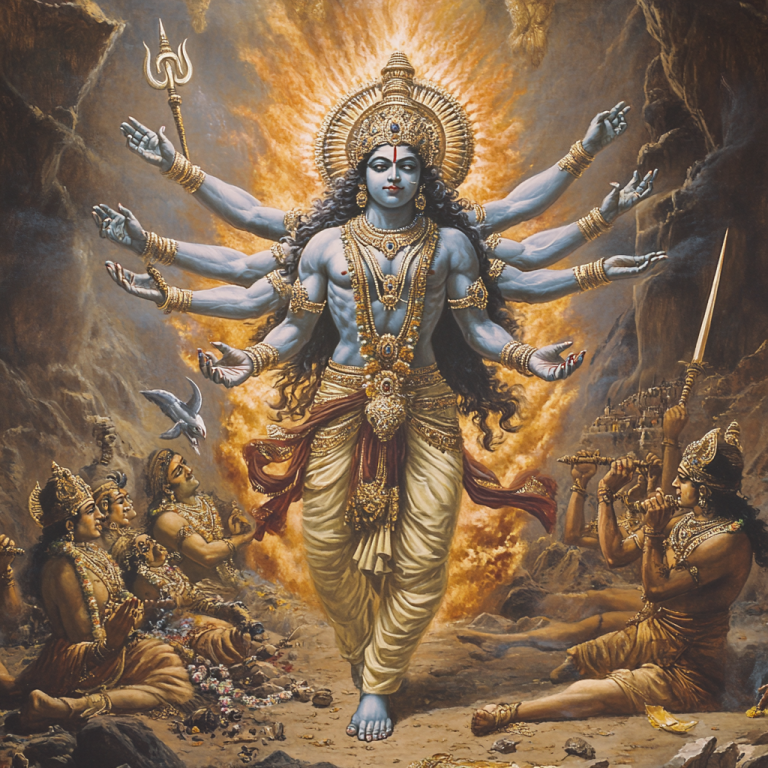
The Slaying of Madhu and Kaitabha: A Story of Creation, Boons, and Divine Trickery
The Cosmic Sleep and Birth of Madhu-Kaitabha
In the beginning, when the universe was submerged in the boundless “Kshirasagara” (ocean of milk), Lord Vishnu-Narayana – The Lord Himself, the preserver of creation-rested in his yogic slumber, a state central to many narratives about Vishnu’s avatars and cosmic role..
- The Birth of the Asuras:
From the wax in Vishnu’s ears, two formidable Asuras named Madhu (honey) and Kaitabha (one born of foam) emerged. The names symbolize chaos born from stagnation and ignorance during the dormant state of creation. They drank the oceanic waters and grew immeasurably strong.
Madhu-Kaitabha’s Boon and the Power of Devi
Madhu and Kaitabha, curious about their existence, wandered in the watery expanse until they heard Mantras reverberating from above. A streak of divine lightning accompanied the sound, leading them to conclude that it must be a powerful force worthy of reverence.
- Austerities for Devi:
The Asuras began a thousand-year penance, meditating upon the Divine Feminine Force-Devi. Their intense tapasya pleased the eternal Goddess, who appeared before them. Devi spoke: “Ask for any boon you desire. I am pleased with your devotion.” - Their Arrogant Boon:
Madhu and Kaitabha, filled with pride and ambition, asked for “the power to choose their moment of death”-essentially granting them practical immortality. Devi, in her wisdom, granted this boon, knowing it would eventually lead to their downfall.
The Assault on Brahma – The Creator and His Supplication to Vishnu
With their newfound power and arrogance, Madhu and Kaitabha wandered the cosmic waters. Soon, they found Lord Brahma, the Creator, seated on the lotus that sprouted from Vishnu’s navel.
- The Asuras, mocking Brahma, declared: “Why sit on this high seat meant only for the victorious? Either fight us or submit as our servant!”
Brahma, recognizing their divine boon and his inability to defeat them, sought refuge with Vishnu-a recurring pattern in many stories where the gods rely on Vishnu’s cosmic intervention.
The Role of Nitra-Devi and Brahma’s Praise of Shakti
Brahma realized that Vishnu’s slumber was under the influence of Nidra-Devi (Goddess of Sleep), an aspect of Shakti. He fervently prayed to Devi, extolling her as the ultimate power:
“O Devi, you are the primordial energy, the Mother of all creation. By your will, Vishnu sleeps. Only you can wake him or destroy these mighty demons yourself!”
Moved by his prayers, Devi released Vishnu from her sleep.
Vishnu’s Battle with Madhu-Kaitabha
Awakened, Vishnu saw Brahma trembling with fear and learned of the two Asuras. With a smile, he said:
“Fear not, Brahma. These Asuras have invited their destruction by their pride. I shall vanquish them.”
The Wrestling Match
Madhu and Kaitabha, emboldened by their boon, challenged Vishnu to battle. The ensuing fight was a titanic struggle, with Vishnu wrestling the Asuras for five thousand years. Yet, they remained undefeated.
Vishnu’s Prayer to Devi and Her Trick
Realizing that their invincibility was due to Devi’s boon, Vishnu joined his hands in prayer, even while fighting:
“O Eternal Mother, I bow to you. Show me the way to overcome these Asuras, who are protected by your blessing.”
Devi appeared and said:
“O Vishnu, use trickery to defeat them. I shall cloud their minds with illusion, weakening their reason. They shall fall prey to their own pride.”
This act of divine deception reflects a recurring motif in many traditional accounts of Vishnu’s avatars, where wit and illusion triumph over brute strength. Under her spell, they became arrogant and foolish.
The Trickery and Death of Madhu-Kaitabha
Vishnu, seizing the moment, praised their strength and valor:
“O mighty Asuras, none have displayed such skill and power as you two. I am so pleased that I wish to grant you a boon.”
Deluded and overconfident, the Asuras laughed:
“We are the victors. It is for us to grant boons to you. Ask, and it shall be yours!”
Vishnu immediately replied:
“Grant me the boon of your death at my hands.”
Too late, the Asuras realized they had been tricked. Bound by their promise, they said:
“We agree, but let us not die on water.”
Vishnu smiled and, assuming his Vishwarupa – Son of Tvashta (cosmic form), lifted the Asuras onto his massive thighs, which were above the water. With his Sudarsana Chakra, Vishnu beheaded them.
The Creation of the Earth
From the fat and blood of the slain Asuras, Bhu-devi (Mother Earth) was formed. As the material emerged from an impure source, it is said that soil is unfit for consumption. Thus, Vishnu’s act of slaying Madhu and Kaitabha resulted in the creation of land, signifying order emerging from chaos.
Connections to Broader Hindu Mythology
| Theme | Connections |
|---|---|
| The Role of Devi/Shakti | Devi, as the primordial force, empowers and withdraws strength, echoing her role in slaying Mahishasura – Buffalo Demon. |
| Vishnu and Maya | Vishnu’s reliance on illusion highlights Maya’s role as both protector and deceiver in cosmic balance. |
| Creation from Chaos | This mirrors the churning of the ocean (Samudra Manthan), where forces of chaos give rise to creation. |
| Cosmic Sleep | Vishnu’s Yoga Nidra aligns with his role during Pralaya (cosmic dissolution) before creation resumes. |
Moral and Symbolic Lessons
- The Power of Shakti: Even the mightiest gods like Vishnu rely on Devi’s grace. She is the ultimate source of creation, preservation, and destruction.
- Pride Leads to Downfall: Madhu and Kaitabha, despite their strength, succumbed to their arrogance, showcasing the timeless theme of hubris leading to destruction.
- Cosmic Order from Chaos: Vishnu’s act restores balance, reiterating that divine intervention preserves dharma and harmony.
Conclusion
The story of Madhu and Kaitabha reflects the interplay between Devi’s grace, Vishnu’s strength, and the cosmic forces that sustain creation. It is a reminder that while power may grant temporary dominance, the will of the Divine Feminine-Shakti-always determines the final outcome. The tale serves as a cornerstone for understanding Hindu cosmology, where destruction is not the end but a prelude to creation.
For those exploring how this tale fits into the broader cosmological narrative of Hindu belief, it connects seamlessly with other foundational myths of Vishnu’s avatars and symbolic traditions that shape his divine roles.
Through this act, Vishnu reaffirms his role as the preserver, Devi demonstrates her eternal sovereignty, and the universe witnesses the triumph of divine will over chaos.
Sources & further reading
These themes are explored in greater depth across the following authoritative resources:
- Britannica, Asura
- Britannica, Naga
- Mythopedia, Hindu Mythology
- Internet Sacred Text Archive, Mahabharata
- Wendy Doniger, Hindu Myths (Penguin Classics, 1975)
External resources for further reading. Apam Napat is not affiliated with these publishers; citation does not imply endorsement.
Frequently asked questions
Who were Madhu and Kaitabha?
What boon did Madhu and Kaitabha receive from Devi?
How did Vishnu kill Madhu and Kaitabha?
How was Bhu-devi (Mother Earth) created in this story?
Based on the classical texts of Hindu mythology, see our sources.