
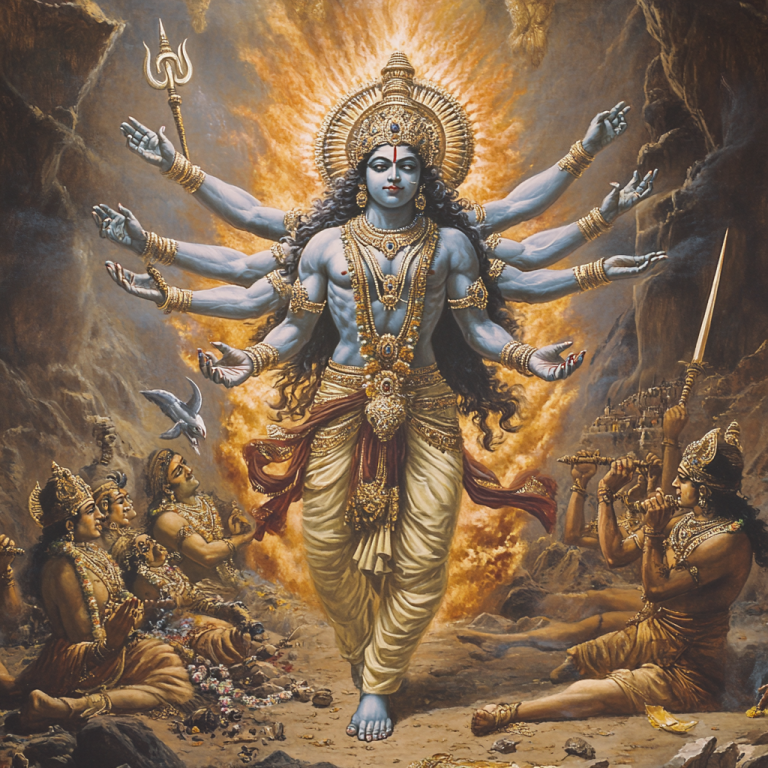
The Birth of Skanda (Kartikeya): The Divine Commander of the Deva Army
The War Between the Devas and Asuras
In the days of old, a fierce and prolonged war raged between the Devas (gods) and their half-brothers, the Asuras (demons). Led by their mighty commanders, the Asuras gained strength through boons granted by the gods, and their armies wreaked havoc upon the celestial forces.
- Indra’s Dilemma:
Purandara (Indra), the king of the gods, realized that without a mighty general to lead the Deva army, they would never prevail. Walking through the Manasa mountains, he pondered his next move: “We need a warrior whose strength rivals the gods, who is pious, righteous, and capable of subduing the Asuras. Without such a leader, we cannot hope for victory.”
While lost in thought, Indra heard a cry for help-a voice filled with desperation.
The Rescue of Devasena
Indra followed the cries to a clearing where he found Devasena, a daughter of Daksha Prajapati – The Creators, being abducted by the Asura Kesin, a fearsome commander of the Asura host.
- The Battle with Kesin:
Indra intervened, wielding his Vajra (thunderbolt). Kesin hurled a massive iron mace and a colossal boulder, but Indra shattered them into dust with his Vajra. Injured and realizing his defeat, Kesin fled. - Devasena’s Plea:
Grateful for her rescue, Devasena introduced herself: “I am Devasena, daughter of Daksha. My sister Mahasena fell to this Asura’s false promises, but I resisted. Now, O Indra, I need a husband-a mighty warrior who can protect me from such threats.”
Devasena outlined the qualities she sought in a husband:
| Qualities of Devasena’s Ideal Husband |
|---|
| He must be all-powerful. |
| Respected by Devas and Asuras alike. |
| Capable of defeating Asuras, Yakshas, and Uragas. |
| Pious, righteous, and devoted to the gods. |
Indra, though doubtful such a being existed, reassured her and took her to Brahma for counsel.
The Celestial Union and the Birth of Skanda
At Brahma’s suggestion, Indra attended a great sacrifice being conducted by the Sapta Rishis (seven great sages). All the gods partook of the sacred Soma offered by Agni (the fire god).
- Agni’s Desire:
During the yajna, Agni was smitten by the beauty of the sages’ wives-golden-complexioned and radiant. Overcome with desire, Agni secretly observed them through their household fires in his Grahapatya form. - Swaha’s Trickery:
Swaha, a daughter of Daksha and a devotee of Agni, saw his longing and devised a plan. Transforming herself into the forms of six of the sages’ wives (except the virtuous Arundhati – The Ideal Wife, wife of Vasishta – Perceptor of the Ishvahu Clan), Swaha approached Agni and fulfilled her love for him. - The Golden Lake and the Six Seeds:
After their union, Swaha deposited Agni’s seed into a golden lake in the White Mountains. On the sixth day of the lunar month, a divine being emerged-a child with: Feature Description Heads Six heads Arms Twelve arms Body A single, powerful form Cry A leonine roar that shook the forests.
The sages, upon witnessing this being, named him Skanda (meaning “cast off”), as he was born from Agni’s seed that had been discarded. His identity is further explored in this detailed account of Skanda as a divine entity, where his mythological importance and celestial role are highlighted.
The Celestial Crisis and the Birth of Vishaka
The sages feared that Skanda’s unmatched energy would destroy the world and asked Indra to intervene. Indra, unable to confront Skanda alone, summoned the Matrikas-terrible female beings who devoured infants.
- However, the Matrikas, seeing Skanda’s divine radiance, were filled with maternal affection. They nursed him and declared him their child.
- Indra’s Attack:
Indra, leading the celestial army, attacked Skanda. Skanda retaliated fiercely, cutting down Indra’s weapons. When Indra hurled his Vajra at Skanda, it struck his right side and caused another being, Vishaka, to emerge. Together, Skanda and Vishaka defeated Indra and his forces.
Indra, realizing his folly, surrendered to Skanda:
“O Skanda, mighty warrior, I bow to you. Be our leader and general. Lead the Deva army to victory over the Asuras.”
Skanda magnanimously refused Indra’s throne but accepted the role of Commander-in-Chief of the Deva forces.
Skanda and the Krittikas
The wives of the Sapta Rishis were accused of infidelity due to Swaha’s deception and abandoned by their husbands. Kartikeya absolved them of blame and honored them as his mothers.
- He also elevated the Krittikas-the six forest nymphs who cared for him-to celestial status, associating them with the star cluster Krittika (Pleiades), a symbol of fire and energy.
Victory Over Taraka and the Marriage to Devasena
As the Commander of the Devas, Skanda led them to victory against the formidable Asura Taraka, fulfilling his destiny and proving his divine might.
- In gratitude, Indra bestowed Devasena’s hand upon Skanda, fulfilling her desire for a strong, divine husband.
Thus, Devasena became the wife of Kartikeya, and he became the eternal protector of the gods and the upholder of dharma.
Connections to Broader Hindu Mythology
| Themes | Connections |
|---|---|
| Divine Birth | Similar to Krishna – An Incarnation of Vishnu’s or Rama’s birth, Skanda’s emergence signifies divine intervention in times of chaos. |
| Symbol of Power | Kartikeya symbolizes youth, vigor, and divine strength, leading the Devas to victory. Learn more about how he fits within the Hindu pantheon of gods, alongside other deities of power and cosmic significance. |
| The Role of Shakti (Devi) | Shakti, through Swaha, enables Skanda’s birth, emphasizing her role as the ultimate cosmic force. |
| Connection to Stars | Kartikeya’s association with the Krittikas reflects his role as the God of Fire and War. |
Conclusion
The birth of Skanda (Kartikeya) showcases a profound interplay of divine will, cosmic forces, and human-like emotions among gods and sages. From Agni’s passion to Swaha’s devotion, from Indra’s dilemma to Devasena’s plea, the story highlights the intricate relationships in Hindu mythology.
Ultimately, Kartikeya emerges as the supreme warrior-the Deva Senapati (Commander of the Gods)-restoring dharma and protecting the cosmos from the forces of adharma. Through his tale, we witness not just the shaping of a cosmic commander but also his multidimensional roles as depicted across various facets of Hindu mythology. His tale, steeped in symbolism and celestial drama, underscores themes of power, sacrifice, and the eternal triumph of good over evil.
Sources & further reading
These themes are explored in greater depth across the following authoritative resources:
- Britannica, Asura
- Britannica, Naga
- Mythopedia, Hindu Mythology
- Internet Sacred Text Archive, Mahabharata
- Wendy Doniger, Hindu Myths (Penguin Classics, 1975)
External resources for further reading. Apam Napat is not affiliated with these publishers; citation does not imply endorsement.
Based on the classical texts of Hindu mythology, see our sources.