
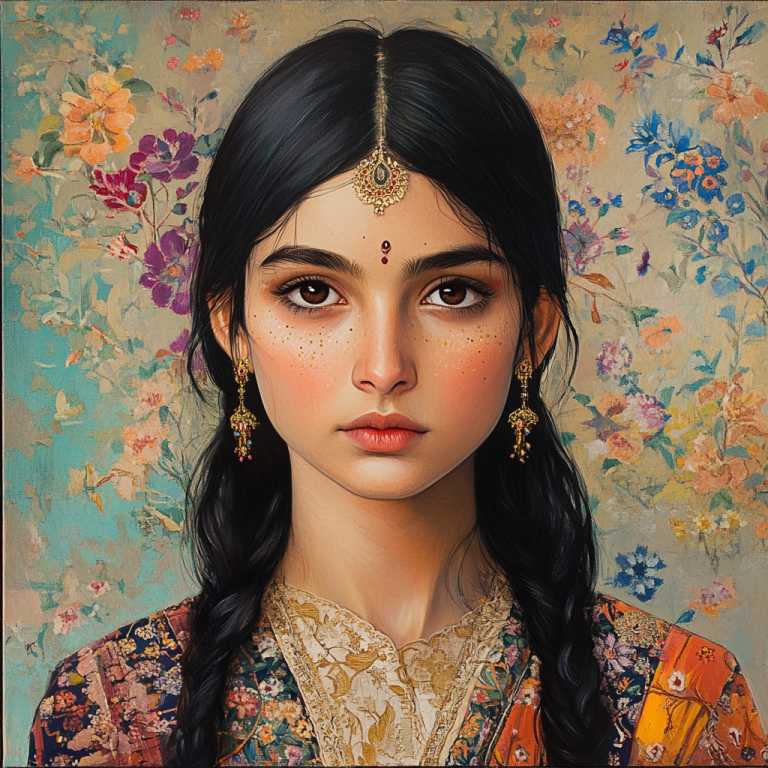
Subhadra, the sister of Krishna and Balarama – Brother of Krishna, is a significant figure in the Mahabharata – The Great Epic, not only as a symbol of familial bonds but also as the mother of Abhimanyu – The Brave Young Warrior, the great boy-warrior. Her life story intertwines themes of love, loyalty, and divine intervention, and it holds a prominent place in the narrative of the Pandavas.
Subhadra and the Question of Marriage
Subhadra, born into the Yadava clan, was the only daughter of Vasudeva and Rohini, making her the younger sister of Krishna and Balarama. Known for her grace and beauty, she was highly sought after as a bride. While Krishna favored her marriage to Arjuna, one of the five Pandavas, Balarama opposed the idea. Balarama, being closer to the Kauravas and influenced by Duryodhana, preferred that Subhadra marry Duryodhana instead.
Krishna’s Plot and the Elopement
Krishna, aware of the importance of Subhadra’s union with Arjuna in the context of dharma and the alliances it would form, devised a clever plan. Under Krishna’s guidance, Arjuna, disguised as a hermit, visited Dwarka, the Yadava stronghold, where he won Subhadra’s affection with his valor and charm. The mutual love between Subhadra and Arjuna grew stronger, and Krishna encouraged Subhadra to act boldly.
One day, when Balarama was unaware, Subhadra drove Arjuna’s chariot, and the two eloped. The act of a woman driving a chariot, a rare occurrence in that era, symbolized Subhadra’s agency in the decision. Their elopement caused a great uproar in Dwarka, with Balarama enraged at what he perceived as a dishonorable act. However, Krishna intervened and pacified Balarama, convincing him that the union of Subhadra and Arjuna was divinely ordained and in the best interest of all.
Subhadra and Abhimanyu
Subhadra and Arjuna’s union resulted in the birth of Abhimanyu – The Brave Young Warrior, one of the most celebrated warriors in the Mahabharata. Abhimanyu inherited the valor of his father Arjuna and the divine traits of his maternal uncles, Krishna and Balarama. He played a pivotal role in the Kurukshetra War, where his bravery and tragic demise in the Chakravyuha formation became one of the most poignant moments in the epic. You can explore Abhimanyu’s heroic stand in the Chakravyuha for a deeper look at this defining episode.
During her pregnancy, Subhadra listened to Arjuna narrate the strategies of breaking into the Chakravyuha formation. However, she fell asleep halfway through, and Abhimanyu, still in the womb, absorbed only the part of entering the formation but not the method of exiting it. This incomplete knowledge ultimately contributed to his martyrdom in the war.
Connections to Other Entities and Stories in Hindu Mythology
| Entity/Character | Role and Story | Connection to Subhadra |
|---|---|---|
| Krishna | The divine strategist and Subhadra’s brother. | Facilitated her marriage to Arjuna, ensuring alliances between the Pandavas and Yadavas. |
| Balarama | Subhadra’s elder brother, who initially opposed her marriage to Arjuna. | His acceptance of the union highlights Krishna’s influence and the importance of familial bonds. |
| Arjuna | Subhadra’s husband, one of the five Pandavas and a master archer. | Their marriage strengthened the ties between the Pandavas and the Yadavas. |
| Abhimanyu | Son of Subhadra and Arjuna, a young warrior who fought valiantly in the Kurukshetra War. | Subhadra’s role as a mother is immortalized through Abhimanyu’s valor and sacrifice. |
| Uttaraa | Daughter-in-law of Subhadra, wife of Abhimanyu, and mother of Parikshit – Son of Abhimanyu, who continued the Kuru dynasty. | Subhadra became the grandmother of Parikshit, ensuring the legacy of the Pandavas. |
| Draupadi | Arjuna’s first wife and the shared wife of all the Pandavas. | Subhadra’s marriage to Arjuna caused initial tension with Draupadi, later resolved by Krishna’s mediation. |
Broader Themes and Symbolism
- Divine Strategy and Dharma
Subhadra’s elopement orchestrated by Krishna reflects divine strategy in aligning the Pandavas and the Yadavas to ensure the triumph of dharma over adharma in the Kurukshetra War. - Agency and Choice
Subhadra driving the chariot symbolizes her active role in determining her future, an act of autonomy uncommon in the patriarchal society of the time. - Maternal Legacy
Through Abhimanyu, Subhadra’s legacy is tied to valor, sacrifice, and the continuation of the Pandava lineage. Her influence shaped one of the most heroic figures in the Mahabharata. - Unity Amidst Diversity
Subhadra’s marriage to Arjuna exemplifies the blending of familial, divine, and political alliances, reinforcing the theme of unity amidst diversity in Hindu mythology.
Comparative Analysis: Subhadra and Other Mythological Women
| Aspect | Subhadra | Comparable Figures in Hindu Mythology |
|---|---|---|
| Role in Alliances | United the Yadavas and Pandavas through her marriage to Arjuna. | Sita, who united the Ikshvaku – An Ancestor of Rama dynasty and Mithila through her marriage to Rama in the Ramayana. |
| Maternal Influence | Gave birth to Abhimanyu, who became a symbol of youthful valor and dharmic sacrifice. | Kunti, who shaped the destiny of the Pandavas as their mother and guide. |
| Autonomy in Marriage | Eloped with Arjuna with Krishna’s support, asserting her agency. | Rukmini, who similarly eloped with Krishna to escape an unwanted marriage arranged by her brother. |
Legacy of Subhadra
Subhadra’s story is a testament to the intricate interplay of family, love, and divine will in Hindu mythology. Her marriage to Arjuna not only solidified the alliance between the Yadavas and Pandavas but also ensured the birth of Abhimanyu, whose bravery and sacrifice remain immortalized in the Mahabharata.
Through her role as a sister, wife, and mother, Subhadra embodies the enduring values of loyalty, courage, and dharma. Her influence echoes through the legacy of her descendants, particularly her grandson Parikshit, who became the last ruler of the Kuru dynasty, ensuring the continuation of dharma in the age of Kali.
Sources & further reading
These themes are explored in greater depth across the following authoritative resources:
- Stanford Encyclopedia of Philosophy, Hindu Philosophy
- Britannica, Dharma
- Britannica, Karma
- Internet Sacred Text Archive, Bhagavad Gita
- A. K. Ramanujan, Speaking of Siva (Penguin Classics, 1973)
External resources for further reading. Apam Napat is not affiliated with these publishers; citation does not imply endorsement.
Frequently asked questions
Who was Subhadra in the Mahabharata?
Who were Subhadra's brothers?
How did Subhadra marry Arjuna?
Who was Subhadra's son?
Based on the classical texts of Hindu mythology, see our sources.