
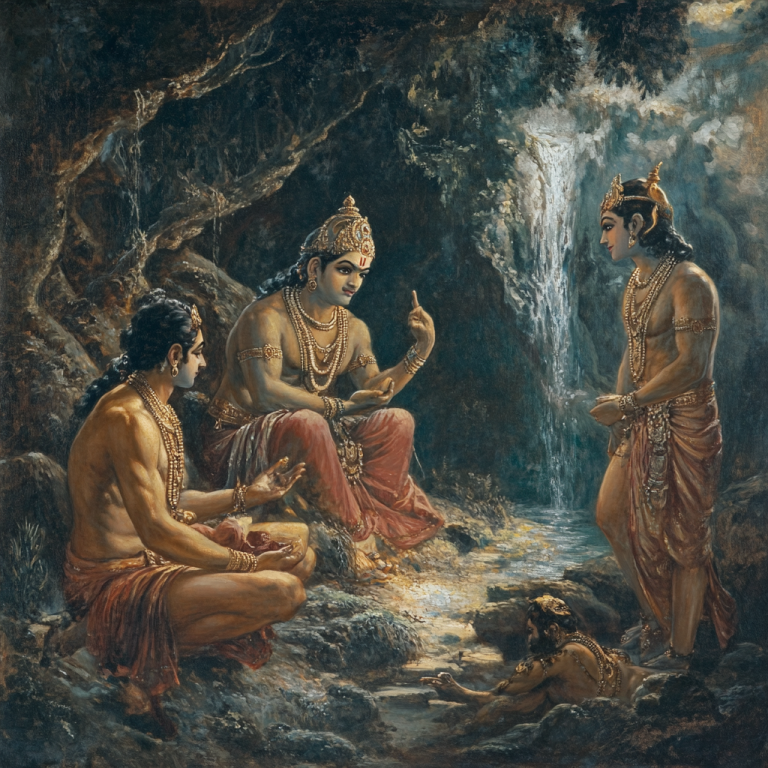
Vidura’s Message, The Pandavas’ New Kingdom, and Arjuna’s Exile
Vidura, known for his unwavering wisdom and loyalty, brought the offer from Dhritarashtra-a reminder of his critical role in steering the fates of the Pandavas, as highlighted in deeper studies of Vidura’s life and counsel.
“O sons of Pandu,” he said, “your uncle, King Dhritarashtra, has expressed his extreme happiness at learning of your miraculous escape from the accident at the house of lac. Furthermore, he is overjoyed at your victory in the Swayamvara of Draupadi and the alliance you have forged with the mighty Panchala kingdom. The King desires to restore harmony and offers you half of the Kuru kingdom. Yudhishthira is to be crowned as the ruler of this half. King Dhritarashtra requests you to return to Hastinapura with your allies, the Panchalas, for the coronation. Our revered elders-Bhishma, Kripacharya, and your Guru Dronacharya-await your return with great anticipation and send their blessings. Do not delay any further; come to Hastinapura at once.”
The Pandavas Consult Krishna and Drupada
The Pandavas, knowing Vidura’s unwavering loyalty and wisdom, trusted his message. Before deciding, they consulted with King Drupada and Krishna, who were present at the time. Krishna, with his divine insight, approved the offer, stating that it was fair and a significant step toward reclaiming their rightful place. After much deliberation, the Pandavas decided to accept Dhritarashtra’s offer and prepared to journey to Hastinapura, accompanied by Draupadi and the royal family of Panchala.
Return to Hastinapura
When the Pandavas arrived in Hastinapura, their return was met with a mixture of emotions. Bhishma, their grand-uncle, was deeply moved to see his grand-nephews safe and triumphant after enduring such trials. Even Dhritarashtra, burdened by guilt, felt a sense of relief at having done the right thing by restoring their rights. Draupadi paid her respects to Dhritarashtra and Gandhari, seeking their blessings. While Gandhari blessed her daughter-in-law, a fleeting thought crossed her mind: This woman will one day bring destruction to my sons. Startled by the thought, she remained silent.
Yudhishthira Crowned as King
An auspicious day was chosen for Yudhishthira’s coronation. With the blessings of the elders, Yudhishthira was crowned as the ruler of the northern half of the Kuru kingdom. After the ceremony, Dhritarashtra summoned Yudhishthira privately and said, “Now that you are a king, it is only proper that you rule from your own capital. My sons harbor ill will toward you, and constant proximity may lead to friction. I advise you to establish your kingdom at Khadava-Prastha, the ancient capital of our ancestors, Yayati and Nahusha.”
Though Khadava-Prastha had fallen into ruin and become overgrown with jungle, Yudhishthira, ever dutiful, accepted Dhritarashtra’s suggestion without protest. When he shared this plan with Krishna, Krishna summoned Vishwakarma – The Architect of the Devas, the divine architect of the Devas, and instructed him to build a magnificent city that would rival the splendor of Amaravati, the capital of Indra. Vishwakarma, with his divine expertise, constructed a resplendent city, complete with grand palaces, wide avenues, gardens, and fortifications. The city was named Indraprastha in honor of its celestial grandeur.
Life in Indraprastha
As the Pandavas settled into their new capital, many citizens of Hastinapura, deeply devoted to the Pandavas, chose to move to Indraprastha. Krishna, who had guided them through their trials, stayed with them for some time before returning to Dwaraka-his crucial interventions in the Pandavas’ journey shaping many pivotal episodes, as chronicled in Mahabharata’s key narratives.
Narada’s Visit and the Rule of Sharing Draupadi
Not long after, the divine sage Narada visited Indraprastha. Yudhishthira received him with the utmost respect, seeking his counsel on righteous administration. Narada shared valuable wisdom on governance and then, addressing the Pandavas, brought up the sensitive issue of Draupadi. He narrated the story of the Asura brothers Sundha and Upasundha, whose fraternal bond was broken by their mutual desire for the celestial beauty Tilottama, leading to their tragic deaths.
As a precaution against similar discord, Narada proposed a rule: Draupadi would spend one year exclusively with each Pandava in turn, and any violation of this arrangement would result in a year-long exile and a vow of celibacy for the transgressor. The Pandavas agreed to this rule to preserve harmony.
Arjuna’s Exile and His Adventures
Despite the precautions, an incident soon tested the arrangement. A Brahmana sought Arjuna’s help to recover stolen cows. Arjuna’s weapons were stored in Yudhishthira’s chamber, where Draupadi was present. To fulfill his duty, Arjuna entered the chamber, thereby breaching the agreement. Despite Yudhishthira’s assurances that his actions were justified, Arjuna insisted on undertaking the year-long exile as stipulated.
Arjuna’s exile, undertaken to uphold honor, mirrors many tales of dharmic sacrifice in the Mahabharata – The Great Epic, a theme deeply explored in the epic’s later turning points, including preparations for the great war.
Encounter with Ulupi
During his exile, Arjuna reached the Ganga River, where he was pulled underwater by Ulupi, a Naga princess. Ulupi confessed her love for Arjuna and argued that his vow of celibacy applied only to Draupadi, not to others. Persuaded by her reasoning, Arjuna married her. She later bore him a son named Iravan.
Marriage to Chitrangada – Princess of Manipur
Continuing his journey, Arjuna reached the kingdom of Manipur, where he fell in love with Princess Chitrangada. Her father, King Chitravahana – King of Manipur, consented to their marriage on the condition that their son would remain in Manipur as the heir. Arjuna agreed, and their son, Babruvahana – Son of Arjuna, was born.
Arrival in Dwaraka
Arjuna eventually arrived in Dwaraka, where he met Krishna and Subhadra, Krishna’s sister. This meeting set the stage for another significant chapter in Arjuna’s life, intertwining the fates of Dwaraka and Indraprastha, much like the complex alliances detailed throughout the epic’s buildup to the Kurukshetra war.
Legacy of Indraprastha
Indraprastha flourished under Yudhishthira’s rule, becoming a symbol of the the Pandavas’ return to Hastinapura rekindled old tensions beneath the surface, tensions that were part of the broader Pandava-Kaurava conflict destined to erupt into war.
Frequently asked questions
Why did Yudhishthira found Indraprastha?
What rule did Narada propose for the Pandavas about Draupadi?
Why did Arjuna go into exile during his marriage to Draupadi?
Who was Ulupi in Arjuna's adventures?
Sources & further reading
These themes are explored in greater depth across the following authoritative resources:
- Internet Sacred Text Archive, Mahabharata (Ganguli translation)
- Internet Sacred Text Archive, Ramayana of Valmiki
- Britannica, Mahabharata
- Britannica, Ramayana
- Bibek Debroy, The Mahabharata (10 vols., Penguin, 2010 to 2014)
External resources for further reading. Apam Napat is not affiliated with these publishers; citation does not imply endorsement.
Based on the classical texts of Hindu mythology, see our sources.