
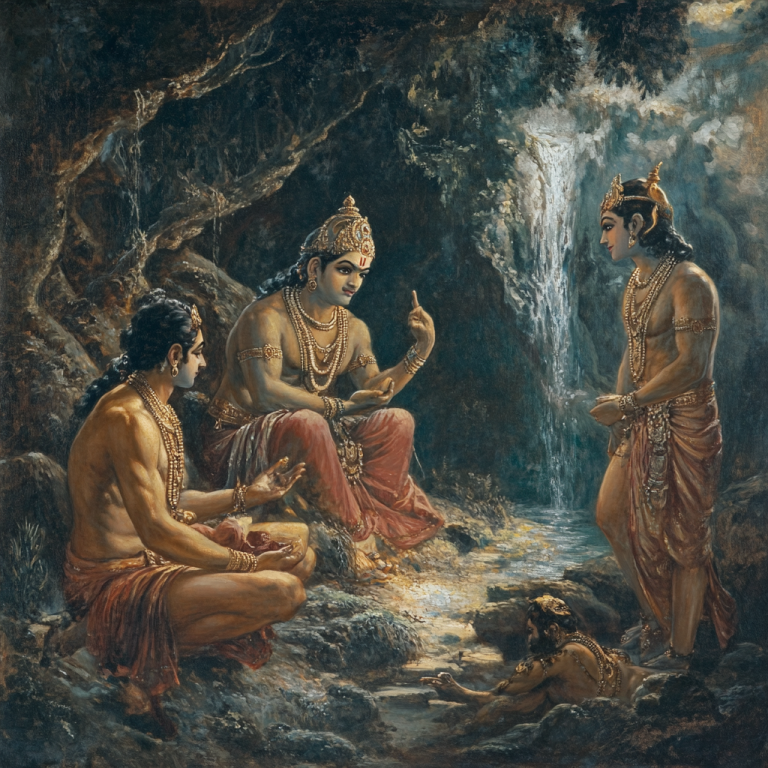
The Pandavas’ Journey to Ekachakrapura and the Slaying of Bakasura – A Rakshasa Killed by Bheema
The Pandavas’ Journey to Ekachakrapura
Following Vidura’s wise counsel, the Pandavas disguised themselves as Brahmanas and set out toward Ekachakrapura to avoid detection and recover from the perilous events surrounding the house of lac. Bheema, endowed with immense strength, often carried his brothers and mother when they grew too tired to walk. Despite his extraordinary endurance, even Bheema began to tire, and the group decided to rest. Bheema volunteered to keep watch while his mother and brothers slept under the canopy of trees.
As his family rested, Bheema reflected on their plight. Born to rule a mighty kingdom, they were now exiles fleeing their treacherous relatives. His hatred for Duryodhana intensified as he watched his beloved mother, Kunti, the wife of the great King Pandu, sleep on the hard ground, with only the root of a tree for a pillow. The sight of Arjuna, the peerless archer, clad in the coarse garments of a mendicant, filled Bheema’s heart with a silent vow to make Duryodhana pay dearly for their humiliation.
The Encounter with Hidimba and Hidimbi
While Bheema stood guard, a Rakshasa named Hidimba, who lived in the forest, sensed the presence of humans. Hungry and eager for fresh prey, he sent his sister, Hidimbi, to kill the intruders. However, upon seeing the handsome and powerful Bheema, Hidimbi fell in love with him. Using her magical powers, she transformed herself into a beautiful maiden and approached him.
Hidimbi warned Bheema, saying, “O noble warrior, you have ventured into the domain of my fearsome brother, Hidimba, who has a voracious appetite for human flesh. Flee with your family while there is still time!”
Bheema’s fierce battle with Hidimba echoed the broader conflicts between humans and Rakshasas, a recurring theme later seen in his encounter with other demons like Jatasura – An Asura Killed by Bheema, who similarly sought to harm the Pandavas.
Bheema, unperturbed, replied, “Maiden, I thank you for your concern, but we are the Pandavas. I am Bheema, the strongest man in the world. My brothers and I are skilled warriors, and we fear no Rakshasa, not even a horde of them.”
As they spoke, Hidimba grew impatient and stormed onto the scene, enraged at his sister’s betrayal. He scolded Hidimbi for aiding their prey and declared, “Stand aside, traitor! Once I have feasted on these intruders, I shall deal with you!”
Bheema calmly responded, “Shout all you want, but do not disturb my family’s rest. If you seek battle, let us move away from here.”
Ignoring Bheema’s suggestion, Hidimba attacked. A fierce battle ensued, with both combatants displaying immense strength and skill. The commotion awakened Kunti and the other Pandavas, who were astonished to witness Bheema locked in combat with a Rakshasa while a beautiful maiden watched anxiously. Despite Hidimba’s ferocity, Bheema ultimately overpowered and killed him, freeing the forest from his tyranny.
Hidimbi’s Plea and Marriage to Bheema
Hidimbi, now free from her brother’s oppressive rule, confessed her love for Bheema and begged to marry him. This request created a dilemma for the Pandavas. Yudhishthira, the eldest brother, was still unmarried, and the idea of Bheema marrying a Rakshasa maiden seemed unwise. However, Hidimbi’s eloquent plea moved Kunti, and a compromise was reached: Bheema would marry Hidimbi and stay with her until they had a son, after which he would return to his family.
Bheema and Hidimbi were married, and soon, a son named Ghatotkacha was born. Even as a child, Ghatotkacha exhibited extraordinary strength, with his first cry resonating like the roar of a lion. True to their agreement, Hidimbi and Ghatotkacha bid farewell to Bheema, who rejoined his family.
Life in Ekachakrapura and the Plight of the Brahmana Family
The Pandavas reached the town of Ekachakrapura and found refuge in the humble home of a Brahmana family. They lived modestly, with Kunti cooking meals from the alms the brothers collected during their morning rounds. Bheema, known as Vrikodhara (wolf-bellied) for his prodigious appetite, was given half the food, while the rest was divided among the others.
One day, Kunti overheard the Brahmana family lamenting their fate. The family was distraught because it was their turn to send a member to deliver food to the Rakshasa Bakasura, who terrorized the town by demanding a daily tribute of food, cattle, and a human sacrifice.
Kunti, moved by their plight, offered to send Bheema to face Bakasura. Despite the Brahmana’s protests, she assured him of Bheema’s strength and ability to defeat the Rakshasa. Yudhishthira initially objected, fearing for Bheema’s safety, but Kunti’s unwavering faith in her son’s prowess convinced him.
The terror of the town under Bakasura’s reign mirrored the plight faced by countless villages and towns in the Mahabharata – The Great Epic where demons and tyrants thrived amidst human suffering.
Bheema’s Victory Over Bakasura
At dawn, Bheema set off with the cart of food. Upon reaching Bakasura’s lair, he decided to eat the food himself, reasoning that it would otherwise go to waste during the ensuing battle. When Bakasura arrived, he was enraged to find the food gone and a mortal sitting calmly in his domain. A brutal fight ensued, with Bheema’s strength and skill eventually overpowering the Rakshasa.
Bheema dragged Bakasura’s lifeless body to the gates of Ekachakrapura, leaving it as a testament to the town’s liberation. He then returned to the Brahmana’s house, instructing them to keep his identity a secret. The townspeople celebrated their newfound freedom, while the Pandavas continued to tread the difficult road that would eventually pit them against their own kin, foreshadowing the great Pandava-Kaurava conflict that lay ahead.
Thus, the Pandavas continued their journey, gaining strength and allies as they prepared for the challenges ahead. The slaying of Bakasura became one of many tales that showcased the valor and righteousness of the Pandavas.
The Pandavas’ victories, like the slaying of Bakasura, were not merely isolated feats but stepping stones leading toward their destiny, as explored more deeply in the broader unfolding of the Mahabharata.
Sources & further reading
These themes are explored in greater depth across the following authoritative resources:
- Britannica, Asura
- Britannica, Naga
- Mythopedia, Hindu Mythology
- Internet Sacred Text Archive, Mahabharata
- Wendy Doniger, Hindu Myths (Penguin Classics, 1975)
External resources for further reading. Apam Napat is not affiliated with these publishers; citation does not imply endorsement.
Frequently asked questions
Why did the Pandavas travel to Ekachakrapura?
Who was Hidimba and how did he die?
Who was Ghatotkacha?
How did Bakasura terrorize Ekachakrapura?
Based on the classical texts of Hindu mythology, see our sources.