
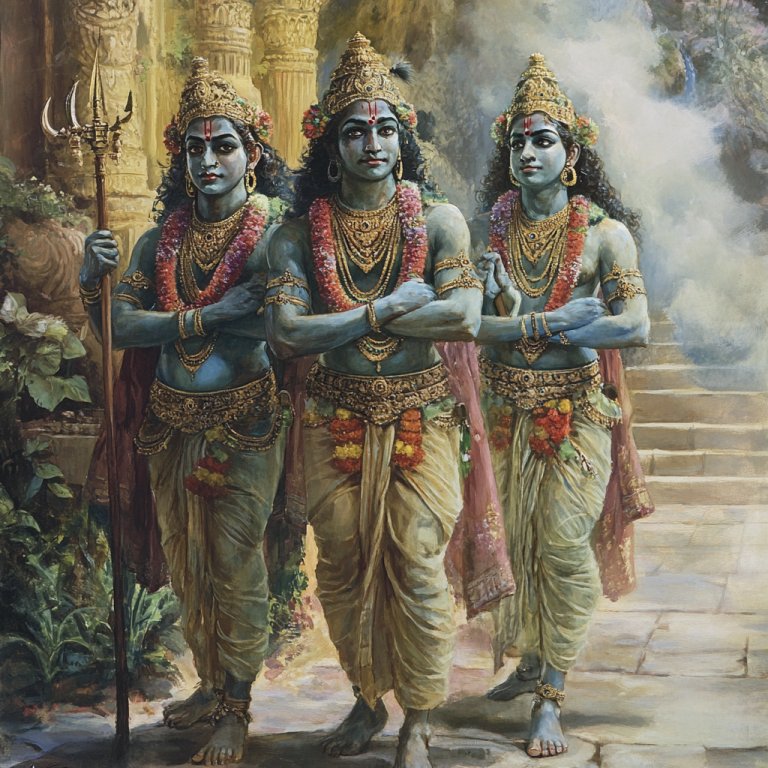
The Pandavas’ Journey into Exile
The Departure from Hastinapura
The Pandavas’ departure was marked by grief, and their silence mirrored their inner turmoil. When Yudhishtra – The Eldest Pandava, the eldest Pandava, noticed the multitude trailing behind them, he was both moved and troubled. The citizens sent their elders to address Yudhishtra, expressing their desire to live under his virtuous rule, even in exile.
Yudhishtra’s Plea to the Citizens
The citizens said, “O prince, life under Duryodhana’s rule is intolerable. We cannot bear to stay in Hastinapura, a kingdom bereft of righteousness. We wish to follow you, for salvation lies in living with virtuous rulers like you.”
Yudhishtra, overwhelmed with emotion, responded, “Your love and loyalty bring me great solace. However, I must ask you to return. Our grandfather Bhishma – The Grand Old Man of The Kurus, our uncle Dhritarashtra, and the wise Vidura remain in Hastinapura. They will need your support in these dark times. The path we tread is one of hardship. Please serve and protect them on my behalf. This will bring me the greatest comfort.”
Reluctantly, the citizens agreed to return, their hearts heavy. Yet, the Brahmanas-who were unattached to Hastinapura and bound by their allegiance to Yudhishtra-resolved to accompany the Pandavas, offering their wisdom and guidance.
This moment reflected one of the many pivotal turning points in the epic, as explored in detailed analyses of Mahabharata’s exile narratives, where loyalty and dharma often clashed with the grim realities of politics.
The Pandavas and the Brahmanas
The Pandavas and their followers soon reached the banks of the Ganga, where they performed their evening rituals. As night fell, the Brahmanas lit sacred fires, and the air resonated with Vedic chants, offering solace to the weary princes.
The next morning, Yudhishtra addressed the Brahmanas. “I deeply value your loyalty and wisdom, but I fear that the hardships of forest life will cause you great suffering. When I ruled Indraprastha, I could provide for you as was proper. Now, I am destitute, and the forest offers no luxuries, only dangers. I urge you to seek refuge with my father-in-law, Drupada, who will honor you as you deserve.”
One of the oldest Brahmanas, Saunaka, spoke on their behalf: “O King, we have pledged to follow you through prosperity and adversity. It does not behoove a righteous king to abandon his followers. Do not worry about our sustenance; we can live on fruits and roots. More importantly, in your time of need, you require our counsel and spiritual guidance.”
Yudhishtra’s Prayer to Surya
While Yudhishtra was moved by the devotion of the Brahmanas, he knew it was his duty to provide for them. Concerned about the insufficiency of forest resources, he sought advice from his priest, Dhaumya. The priest recounted an ancient tale about Surya (the Sun God), who once alleviated the world’s hunger. He suggested that Yudhishtra invoke Surya’s blessings to solve his predicament.
Yudhishtra, purifying himself, sat on a seat of Kusa grass facing east and began chanting the names of Surya with unwavering devotion. Pleased by Yudhishtra’s sincerity, Surya appeared before him and said, “O son of Dharma, I am aware of your plight. Take this copper vessel, a divine gift that will sustain you throughout your exile. It will produce unlimited food daily until your wife Panchali (Draupadi) has eaten her portion. Use it wisely, and may you succeed in all your endeavors.”
Yudhishtra’s divine boon from Surya also ties into the broader Mahabharata – The Great Epic tradition of divine interventions, where the gods guide mortals on their dharmic path, as illuminated in stories about heroes like Parikshit – Son of Abhimanyu, who similarly faced trials under divine watch.
The gift brought immense relief to Yudhishtra and his followers. Draupadi, entrusted with the vessel, ensured that everyone was fed abundantly.
The Journey to Kamyaka Forest
Strengthened by Surya’s boon, Yudhishtra led his brothers, Draupadi, and the Brahmanas to the Kamyaka Forest. There, they began their life in exile. Despite the hardships, the Pandavas upheld their dharma, finding solace in the counsel of the Brahmanas and the bond of their familial unity. The divine gift of Surya not only sustained them physically but also symbolized the support of the gods in their righteous path.
The hardships of Kamyaka Forest echo the classic theme of the forest as a crucible for transformation-a theme resonating throughout many sections of the Mahabharata’s character-driven arcs, where trials refine the hero’s spirit.
Connections in Mythology
- The Sun’s Benevolence: Surya’s boon highlights his role as the sustainer of life. His divine intervention emphasizes the importance of devotion and righteousness in overcoming adversity.
- The Brahmanas’ Loyalty: The unwavering support of the Brahmanas underscores the significance of dharma and spiritual counsel in Hindu tradition.
- The Forest as a Testing Ground: The Pandavas’ exile mirrors the trials faced by many heroes in Hindu mythology, where the forest serves as a place of penance, growth, and eventual triumph.
This episode from the Mahabharata reflects the enduring values of loyalty, sacrifice, and the unyielding pursuit of righteousness, even in the face of great adversity. It sets the stage for the Pandavas’ transformative journey during their years in exile.
These themes of loyalty, sacrifice, and divine support are intricately explored across other crucial Mahabharata reflections that illuminate how righteousness shapes destinies across generations.
Sources & further reading
These themes are explored in greater depth across the following authoritative resources:
- Britannica, Yoga in Hinduism
- Britannica, Puja
- Harvard Pluralism Project, Hindu Practice
- Internet Sacred Text Archive, Yoga Sutras of Patanjali
- Diana L. Eck, Banaras: City of Light (Princeton University Press, 1982)
External resources for further reading. Apam Napat is not affiliated with these publishers; citation does not imply endorsement.
Based on the classical texts of Hindu mythology, see our sources.