
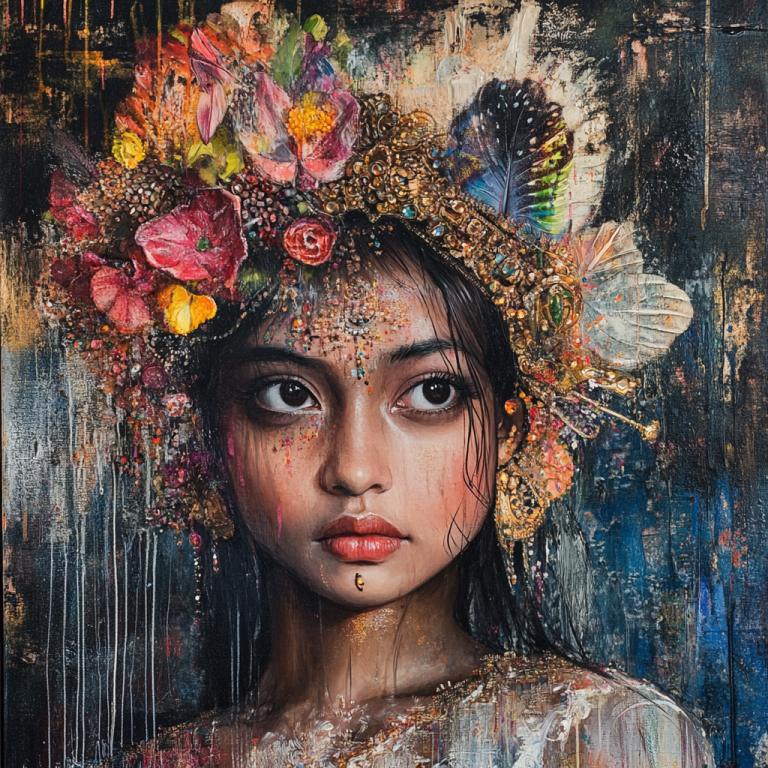
Sudyumna, a king of the Solar Dynasty (Suryavansha), is a fascinating figure whose life intertwines themes of transformation, divine intervention, and lineage creation in Hindu mythology. Born into the illustrious lineage of the sun god Surya, Sudyumna’s story bridges the Solar and Lunar dynasties, cementing his place in the broader tapestry of Indian mythology.
The Transformation into Ila
Once, while hunting in a dense forest, Sudyumna became separated from his retinue. Tired and thirsty, he waded into a serene forest pool along with his loyal stallion. This pool had been enchanted by Lord Shiva and was the site of Sudyumna’s transformation into Ila – Daughter of Vaivasvata Manu, a key figure whose dual nature is central to the myth. The enchantment was a result of a divine decree that the forest, Sharavana, be a sanctuary for Parvati and her attendants, free from the presence of males. Any male entering the pool would be transformed into a female.
As Sudyumna entered the pool, he was instantly transformed into a beautiful woman named Ila, and his stallion became a mare. In this new form, Ila wandered the forest, grappling with the profound change and seeking refuge.
Ila and Budha
Ila eventually found her way to the hermitage of Budha, the son of Chandra (Moon God). Budha was struck by her beauty and fell deeply in love with her. Ila, reconciling with her new identity, reciprocated his affection. Ila eventually found her way to the hermitage of Budha, as explored in entities related to Ila, where their union led to the birth of Puroorava – First King of Chandra Dynasty, who would later become the first king of the Lunar Dynasty (Chandravansha).
This union is significant in Hindu mythology as it symbolizes the merging of the Solar and Lunar dynasties, two of the most prominent royal lineages in ancient Indian texts.
Lifting the Curse
The curse of transformation placed upon Sudyumna had two variations in its resolution, as recounted by different scriptures:
- Automatic Reversal: According to one account, the curse was temporary, lasting only a year. After this period, Sudyumna’s male form was automatically restored.
- Intervention by Vasishta – Perceptor of the Ishvahu Clan: The Bhagavata Purana and Devi Bhagavata provide a more detailed account, stating that Sage Vasishta, the royal guru of Sudyumna, interceded on his behalf. Through fervent prayers to Lord Shiva, Vasishta persuaded the deity to alter the curse. Shiva decreed that Sudyumna would alternate between being male for one month and female for the next. This compromise allowed Sudyumna to fulfill his responsibilities as a king while preserving the divine decree over the enchanted forest.
The Legacy of Sudyumna
After his curse was lifted, Sudyumna returned to his kingdom, bringing with him his son Puroorava. While Puroorava became the progenitor of the Lunar Dynasty, Sudyumna had additional sons according to the Bhagavata Purana: Utkala, Gaya, and Vimala. These sons inherited portions of Sudyumna’s southern kingdom, while Puroorava inherited the major part of the empire.
The story of Sudyumna thus connects two significant dynasties and reflects the interplay of divine will and human effort in shaping the course of history.
Connections to Other Entities and Stories in Hindu Mythology
| Entity/Character | Role and Story | Connection to Sudyumna |
|---|---|---|
| Lord Shiva | Enchanted the forest pool to prevent males from entering as a sanctuary for Parvati and her attendants. | Transformed Sudyumna into Ila as a result of his divine decree. |
| Parvati | The consort of Shiva, for whom the forest was made a sacred space free of male presence. | Indirectly influenced Sudyumna’s transformation into Ila. |
| Budha | The son of Chandra (Moon God) and consort of Ila. | Fathered Puroorava, uniting the Solar and Lunar dynasties through his union with Ila. |
| Puroorava | The son of Ila and Budha, who became the first king of the Lunar Dynasty. | Represents the continuation of Sudyumna’s legacy and the blending of two divine lineages. |
| Vasishta | The royal guru of the Solar Dynasty, who prayed to Shiva for alleviation of Sudyumna’s curse. | His intervention led to the alternating transformation of Sudyumna between male and female. |
| Chandra (Moon God) | The progenitor of Budha and the Lunar Dynasty. | Through Budha, Chandra’s lineage merged with the Solar Dynasty, thanks to Sudyumna/Ila’s story. |
Symbolism and Broader Themes
- Transformation and Duality
Sudyumna’s alternating genders highlight themes of transformation, duality, and balance. This narrative reflects the fluidity of identity and the acceptance of changing roles, resonating with broader Hindu philosophical ideas of the self. - Union of Dynasties
The birth of Puroorava symbolizes the union of two divine lineages-Solar and Lunar-bridging cosmic and royal heritages. This marks the origin story of Puroorava and Urvashi, a romance that would later become legendary in Vedic literature. - Divine Will and Human Agency
Sudyumna’s story emphasizes the role of divine intervention (Shiva’s curse) and human effort (Vasishta’s prayers) in overcoming challenges and fulfilling destiny. - Legacy and Continuity
Through his children, Sudyumna ensured the continuation of the Solar Dynasty while also founding the Lunar Dynasty, highlighting the interconnectedness of Indian mythological genealogies.
Comparative Analysis: Sudyumna and Other Mythological Figures
| Aspect | Sudyumna | Comparable Figures in Hindu Mythology |
|---|---|---|
| Transformation | Changed between male and female forms due to Shiva’s curse. | Arjuna, who lived as Brihannala, a eunuch, during the Pandavas’ incognito exile, reflecting a similar theme of duality. |
| Lineage Connection | United the Solar and Lunar Dynasties through his child Puroorava. | Rama, a descendant of the Solar Dynasty, whose actions bridged divine and human realms. |
| Divine Intervention | His curse and partial alleviation were tied to divine decrees and prayers. | Shakuntala – Mother of Bharata, whose reunion with Dushyanta and restoration of her honor were influenced by divine will. |
Legacy of Sudyumna
Sudyumna’s story is a testament to resilience, transformation, and legacy. Despite the challenges of divine curses and personal transformation, he embraced his roles, both as a man and a woman, and contributed significantly to the dynastic history of Hindu mythology. His tale underscores the interconnectedness of the Solar and Lunar Dynasties, reflecting the unity of cosmic forces and royal lineage. Through his son Puroorava and his southern heirs, Sudyumna’s legacy continues to resonate in the broader tapestry of Indian mythological history.
Sources & further reading
These themes are explored in greater depth across the following authoritative resources:
- Internet Sacred Text Archive, Rig Veda (Griffith translation)
- Internet Sacred Text Archive, Upanishads
- Britannica, Veda
- Britannica, Upanishad
- Patrick Olivelle, The Early Upanishads (Oxford University Press, 1998)
External resources for further reading. Apam Napat is not affiliated with these publishers; citation does not imply endorsement.
Based on the classical texts of Hindu mythology, see our sources.