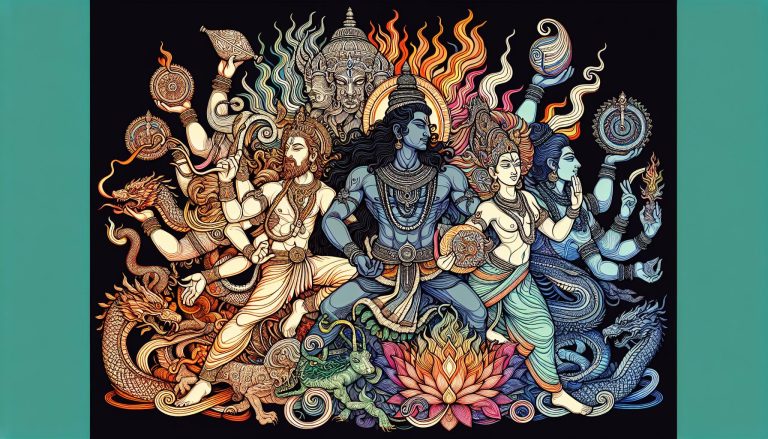
Exploring Hindu mythology, I find recurring themes like dharma (duty), karma (action and consequence), and moksha (liberation). Each story, whether it’s the epic battles of the Mahabharata – The Great Epic or the divine exploits of the Ramayana – Epic of Hinduism, weaves these themes into its fabric, offering lessons that are as relevant today as they were millennia ago.
Overview Of Hindu Mythology
Hindu mythology, rich with diverse narratives, reflects a vast cultural and spiritual heritage. Its texts include the Ramayana, the Mahabharata, and various Puranas, offering intricate tales and profound teachings.
Major Epics: Ramayana and Mahabharata
The Ramayana and the Mahabharata form the backbone of Hindu mythology. The Ramayana narrates the journey of Prince Rama to rescue his wife Sita from the demon king Ravana. The Mahabharata, one of the longest epic poems, recounts the Kurukshetra war and the fates of the Kaurava and the Pandava princes.
Concepts of Dharma, Karma, and Moksha
Central to Hindu mythology are the concepts of dharma (duty/righteousness), karma (action/consequence), and moksha (liberation). These ideas guide characters’ actions and shape the moral lessons within the stories. For instance, Arjuna’s struggle with his dharma in the Mahabharata exemplifies the complexity of righteous living.
Gods and Demons
The tales include a vast pantheon of gods and demons. Gods like Vishnu and Shiva often interact with humanity, while demons like Ravana and Mahishasura – Buffalo Demon challenge divine order, illustrating the eternal battle between good and evil.
Symbolism and Morality
Every story in Hindu mythology is rich with symbolism and morality. The churning of the ocean (Samudra Manthan) represents the quest for knowledge and immortality, while the tale of King Harishchandra highlights unwavering commitment to truth and duty.
Hindu mythology offers a window into the spiritual and cultural values of ancient India, revealing timeless lessons applicable to modern life. Its narratives, characters, and themes continue to inspire and educate.
Major Deities And Their Symbolism
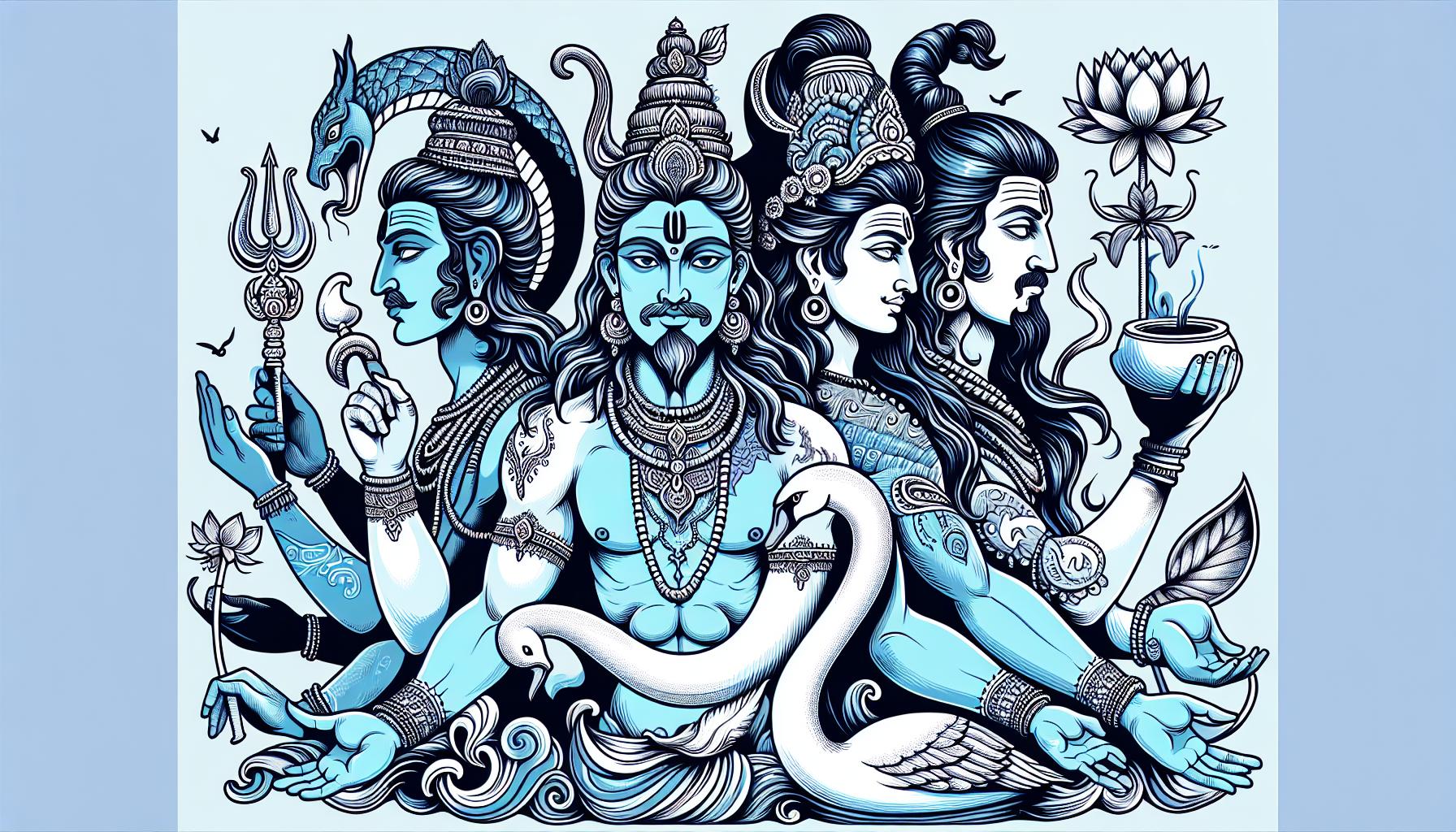
Hindu mythology features a multitude of deities, each embodying specific aspects of existence. The Trimurti, or Trinity, consists of the three primary gods, Vishnu, Shiva, and Brahma, who symbolize preservation, destruction, and creation.
Vishnu: The Preserver
Vishnu represents the sustaining force in the universe. He’s often depicted with blue skin and holding a conch, discus, lotus, and mace. The conch signifies the sacred Om sound, the discus symbolizes the mind, the lotus represents purity, and the mace stands for power. Vishnu’s ten avatars, including Rama and Krishna – An Incarnation of Vishnu, descend to restore cosmic order.
Shiva: The Destroyer
Shiva embodies both destruction and regeneration. His third eye, capable of emitting flames, indicates his power to destroy evil. The serpent around his neck represents control over fear and ego. The crescent moon signifies time, and the Ganges river, flowing from his hair, denotes purity and sanctity. Shiva’s dance, the Tandava, illustrates the cycle of creation and destruction.
Brahma: The Creator
Brahma is the god of creation, depicted with four heads representing the four Vedas and four directions. His symbolism includes the lotus, symbolizing wisdom and purity, and the swan, signifying discernment. Each of his four faces recites one of the Vedas, highlighting his role in the creation of sacred knowledge and order.
Themes Of Creation And Destruction
Hindu mythology intricately intertwines themes of creation and destruction, playing out across cosmic cycles and divine acts. This duality reflects a profound understanding of life’s constant flux.
Cosmic Cycles
Cosmic cycles, or Yugas, represent the eternal sequence of creation, preservation, and destruction. There are four Yugas: Satya Yuga, Treta Yuga, Dvapara Yuga, and Kali Yuga. Each Yuga marks an era with distinct characteristics and durations.
For instance, Satya Yuga spans 1.728 million years, symbolizing an age of truth and virtue. Treta Yuga follows, lasting 1.296 million years, featuring notable events like the epic of Ramayana. Dvapara Yuga covers 864,000 years, where an era of diminished virtue unfolds. Last is Kali Yuga, extending 432,000 years, representing the current age of darkness and moral decline. These cycles highlight the relentless progression and regression of universal and human conditions.
The Dance Of Shiva
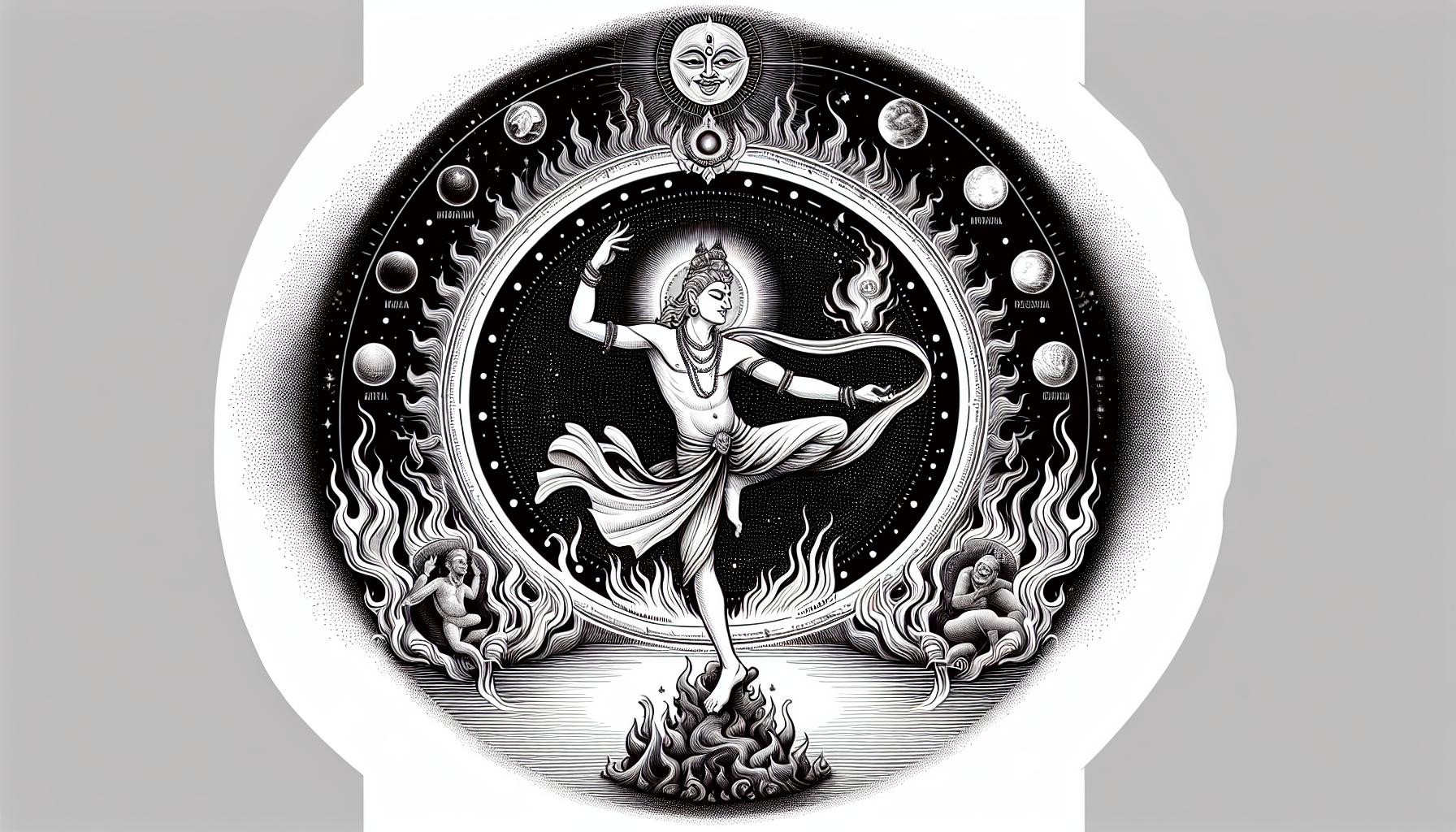
Shiva’s Tandava dance symbolizes destruction and creation. The cosmic dance is performed in both majestic and destructive forms. An example is Ananda Tandava, symbolizing creation and bliss, while Rudra Tandava depicts dissolution.
In iconography, Shiva usually dances within a ring of flames, symbolizing the universe. His right foot stands on the demon Apasmara, representing ignorance. The dance, encapsulated with gestures, signifies five cosmic functions: creation (srishti), preservation (sthiti), destruction (samhara), concealment (tirobhava), and grace (anugraha). This dance, central to Shiva’s mythology, underscores the cyclical nature of existence, mirroring the endless dance of the cosmos.
Good Versus Evil

Hindu mythology often portrays the timeless struggle between good and evil. This theme is vividly illustrated through epic narratives and profound characters.
Epic Battles In Ramayana
The Ramayana, an ancient Indian epic, presents the moral struggle between good and evil through its protagonist, Rama, and antagonist, Ravana. Rama embodies dharma, righteousness, while Ravana symbolizes adharma, chaos. Their clash culminates in the epic battle of Lanka, demonstrating the triumph of good over evil. This story imparts moral values, emphasizing virtues like loyalty, courage, and integrity. The characters of Hanuman, Lakshmana, and Sita further illustrate these themes, reinforcing the importance of ethical living.
Mahabharata And The Battle Of Kurukshetra
The Mahabharata, another grand epic, delves into the complexity of good and evil through the monumental battle of Kurukshetra. The Pandavas, representing righteousness, clash with the Kauravas, embodying greed and injustice. This conflict, driven by virtue and moral dilemmas, highlights the nuanced nature of dharma. Lord Krishna’s guidance to Arjuna, documented in the Bhagavad Gita, serves as a philosophical discourse on duty, righteousness, and the eternal fight against evil. The narrative underscores the idea that good, though often challenged, eventually prevails.
Karma And Dharma
Karma and dharma are pivotal themes in Hindu mythology, shaping the moral and ethical framework for individuals.
The Concept Of Duty
Duty, or dharma, denotes the moral responsibilities and righteous actions expected of individuals. Dharma is central to characters in Hindu epics like the Ramayana and Mahabharata. In the Ramayana, Rama embodies the ideal of dharma by fulfilling his role as a dutiful son, a righteous king, and a devoted husband. In the Mahabharata, Arjuna internalizes his dharma as a warrior after instruction from Krishna, who explains the significance of performing one’s duty without attachment to results. The Bhagavad Gita emphasizes that adherence to dharma leads to balance and harmony in life.
Influence On Modern Hindu Culture
In contemporary Hindu culture, karma and dharma continue to guide individual and social behavior. Practices such as performing puja (ritual worship) and participating in community service stem from the principles of karma and dharma. Karma, the belief in the law of cause and effect, influences daily decisions and long-term actions, encouraging people to act ethically for future benefits. Dharma shapes various aspects of life, including occupational duties, family roles, and social obligations. These themes permeate educational teachings, religious discourses, and cultural rituals, cementing their importance in modern Hindu society.
Mystical Creatures and Legends
Hindu mythology is rich with stories of mystical creatures and legends, each symbolizing deeper truths about the universe and human nature.
Asuras and Devas
Asuras and Devas represent opposing cosmic forces in Hindu mythology. Asuras embody chaos and disorder, often challenging the Devas, who uphold order and righteousness. For instance, in the story of the churning of the ocean (Samudra Manthan), Asuras and Devas cooperated and conflicted in search of Amrita, the nectar of immortality. This tale highlights the interaction between positive and negative forces, signifying the balance necessary for cosmic harmony.
Nagas and Garudas
Nagas and Garudas feature prominently in many Hindu myths. Nagas, serpent beings, are guardians of treasures and symbolize rebirth and fertility. In contrast, Garudas, massive eagle-like birds, represent power and speed. One famous legend describes the constant battle between Garuda and the Nagas, symbolizing the perpetual struggle between power and protection. This story illustrates the dualities inherent in existence, showcasing the eternal balance within the natural world.
Hindu mythology infuses these creatures with profound symbolic meanings, enriching the narrative world with complex relationships and timeless lessons.
Conclusion
Hindu mythology offers profound insights into the human condition and the cosmos. Its rich world of deities, cosmic cycles, and epic battles between good and evil reveals timeless truths that continue to resonate today. The principles of karma and dharma provide a moral compass, guiding both individual actions and societal norms.
Mystical creatures and legends further enrich this mythology, offering layers of meaning and lessons that transcend time. These stories not only entertain but also impart wisdom, shaping the cultural and spiritual world of millions.
Exploring Hindu mythology allows us to appreciate its complexity and its enduring relevance in guiding ethical behavior and understanding the universe’s intricate balance.
Sources & further reading
These themes are explored in greater depth across the following authoritative resources:
- Stanford Encyclopedia of Philosophy, Hindu Philosophy
- Mythopedia, Hindu Mythology
- Britannica, Hindu Mythology
- Sheldon Pollock, The Language of the Gods in the World of Men (University of California Press, 2006)
- A. K. Ramanujan, The Collected Essays (Oxford University Press, 1999)
External resources for further reading. Apam Napat is not affiliated with these publishers; citation does not imply endorsement.
Based on the classical texts of Hindu mythology, see our sources.