
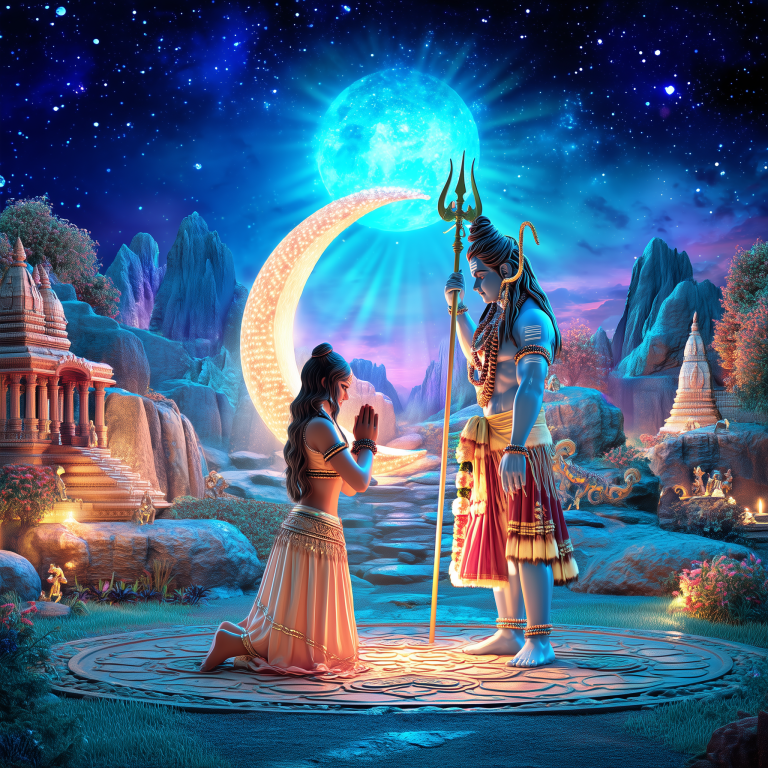
The Story of Nara-Narayana and the Birth of Urvashi
Kashyapa and the Curse of Varuna
Kashyapa, one of the most revered progenitors in Hindu mythology, also plays a pivotal role in shaping the divine and mortal realms. Explore more about Kashyapa’s divine lineage and contributions and how his choices ripple through various mythological events.
The story begins with Kashyapa, one of the Sapta Rishis and a progenitor of many divine and mortal beings, borrowing a divine cow from Varuna, the god of waters, to assist in a Yagna (sacrifice). Despite repeated requests, Kashyapa did not return the cow, prompting Varuna to curse him:
“May you be born among the cowherds (Yadavas) on earth. Your wives, Diti and Surasa, shall also share your fate. Just as my cow’s calves grieve their separation, Aditi shall suffer the sorrow of watching her children perish before her eyes, living a life filled with sorrow and imprisonment.”
This curse foretold the earthly incarnations of:
- Kashyapa as Vasudeva, father of Krishna.
- Aditi as Devaki, Krishna’s mother, who would endure the death of her children at the hands of Kamsa.
This theme of divine beings accepting mortal forms to restore cosmic balance echoes in other myths, such as Vishnu’s ten avatars, and reinforces the cyclical nature of life in Hindu philosophy.
The Penance of Nara and Narayana
In another episode, Kashyapa fathered Narayana and Nara through Moorthy, a form of Devi Lakshmi. These ascetic brothers undertook severe penance on the banks of the Ganga, meditating on Brahman, the supreme reality. Their austerities were so intense that they generated unbearable heat, tormenting the three worlds and drawing the attention of Indra, the king of the Devas.
Fearing that the brothers sought to usurp his throne-a recurring theme in Hindu mythology where ascetics’ penances challenge divine authority-Indra tried to disrupt their meditation.
| Similar Incidents | Description |
|---|---|
| Ravana’s penance | Disturbed the celestial realms until Lord Shiva granted him boons. |
| Hiranyakashipu’s penance | Threatened cosmic order, leading to Vishnu’s incarnation as Narasimha to restore balance. |
| Kartikeya’s penance | His intense austerities earned him the title of commander-in-chief of the Devas. |
Indra’s First Attempt: Illusions and Beasts
Indra’s initial attempt involved creating ferocious illusions:
- Ferocious lions, tigers, and elephants appeared to attack the hermits.
- Natural calamities and celestial disturbances were conjured.
However, the divine essence of Nara and Narayana rendered these illusions powerless. Undeterred, Indra returned to Amravati, his heavenly abode, to formulate another plan.
Indra’s Second Attempt: The Army of Love
Determined to disrupt the brothers’ penance, Indra summoned:
- Kama (Manmatha), the god of love.
- Rati, Kama’s wife.
- Celestial nymphs (Apsaras) including Rambha and Tilottama – An Apsara.
- Spring (Vasanta), who caused the forest to bloom with flowers, filling the air with intoxicating fragrances.
These divine figures created an atmosphere of irresistible beauty. The Apsaras sang melodiously and danced seductively, hoping to arouse the brothers’ desires.
Narayana’s Creation of Urvashi
The divine nymph Urvashi would later become central in another tale of celestial romance with King Puroorava – First King of Chandra Dynasty. Read the full story of Urvashi and Puroorava, a narrative blending longing, divine allure, and the impermanence of love.
Despite the combined allure of Kama, Rati, and the Apsaras, Nara and Narayana remained unmoved. Observing their vanity, Narayana resolved to humble them by demonstrating his superior power. Slapping his thighs (Uru), he created Urvashi, a nymph of unparalleled beauty.
| Urvashi’s Name and Symbolism | Explanation |
|---|---|
| Urvashi (Born of the Thigh) | Symbolizes divine creativity and the transcendence of penance over lust. |
| Embodiment of Feminine Grace | Her beauty surpassed all Apsaras, symbolizing the perfection of divine creation. |
Upon witnessing Urvashi’s radiance, the Apsaras, Kama, and Rati were ashamed of their attempts to disrupt the sages’ penance. They begged for forgiveness and offered to remain in the hermitage as servants.
Narayana’s Prophecy
Narayana forgave the celestial beings, saying:
“We have no enmity with Indra. His fears are baseless, for we seek no throne. However, your actions were guided by ignorance, and it is enough that you recognize your error. We have taken a vow of celibacy and cannot accept you as wives. In another life, we shall be born as Krishna and Arjuna. At that time, you shall be born as our wives. Urvashi and the other nymphs shall return to heaven as gifts to Indra.”
Thus, Urvashi became a prominent Apsara in Indra’s court, serving as a reminder of the sages’ superior power.
Reincarnation as Krishna and Arjuna
This story also foreshadows the reincarnation of Nara and Narayana:
- Narayana incarnates as Krishna, the divine strategist and eighth avatar of Vishnu.
- Nara incarnates as Arjuna, the greatest archer and a pivotal character in the Mahabharata – The Great Epic.
Their bond is further revealed during the Kurukshetra War, where Krishna delivers the Bhagavad Gita to Arjuna. This connection is deeply explored in the Mahabharata’s insights into divine destiny and Dharma.
| Nara-Narayana | Krishna-Arjuna |
|---|---|
| Represent penance and renunciation | Represent Dharma (righteousness) and action. |
| Meditated to uphold cosmic order | Fought to restore Dharma during the Mahabharata. |
Cosmic Lessons from the Tale
| Theme | Lesson and Connection |
|---|---|
| Power of Penance | Penance transcends worldly desires, as seen in stories of Shiva’s meditation and Vishwamitra – The King Who Became a Great Sage’s austerities. |
| Divine Intervention | Vishnu’s avatars arise whenever cosmic balance is threatened, as with Krishna and Rama. |
| Humility and Grace | Urvashi’s creation humbles the Apsaras, echoing similar lessons in the Churning of the Ocean story. |
| Celestial vs. Mortal Struggles | The conflict between Indra and ascetics reflects the tension between material power and spiritual ascension. |
Connections to Other Myths
| Story/Entity | Connection to Nara-Narayana |
|---|---|
| Indra vs. Meditating Sages | Similar to his interference with Shiva’s penance, highlighting Indra’s insecurity as king of the Devas. |
| Urvashi and Arjuna | Urvashi later attempts to seduce Arjuna, unaware of their shared divine connection. |
| Rambha and Ravana | Rambha’s role in this tale parallels her encounter with Ravana, where her beauty is misused to provoke desires. |
| Vishwamitra and Menaka | Kama and Apsaras disrupt Vishwamitra’s penance, echoing Indra’s repeated attempts to thwart ascetics. |
Conclusion
The tale of Nara-Narayana and the birth of Urvashi weaves together profound themes of penance, divine creativity, and the interplay of celestial and mortal destinies. By creating Urvashi, the sages underscore the futility of pride and temptation, demonstrating that true power lies in spiritual discipline. This story’s connections to Krishna, Arjuna, and other myths enrich its significance, making it a cornerstone in the vast tapestry of Hindu mythology.
Sources & further reading
These themes are explored in greater depth across the following authoritative resources:
- Britannica, Asura
- Britannica, Naga
- Mythopedia, Hindu Mythology
- Internet Sacred Text Archive, Mahabharata
- Wendy Doniger, Hindu Myths (Penguin Classics, 1975)
External resources for further reading. Apam Napat is not affiliated with these publishers; citation does not imply endorsement.
Based on the classical texts of Hindu mythology, see our sources.