
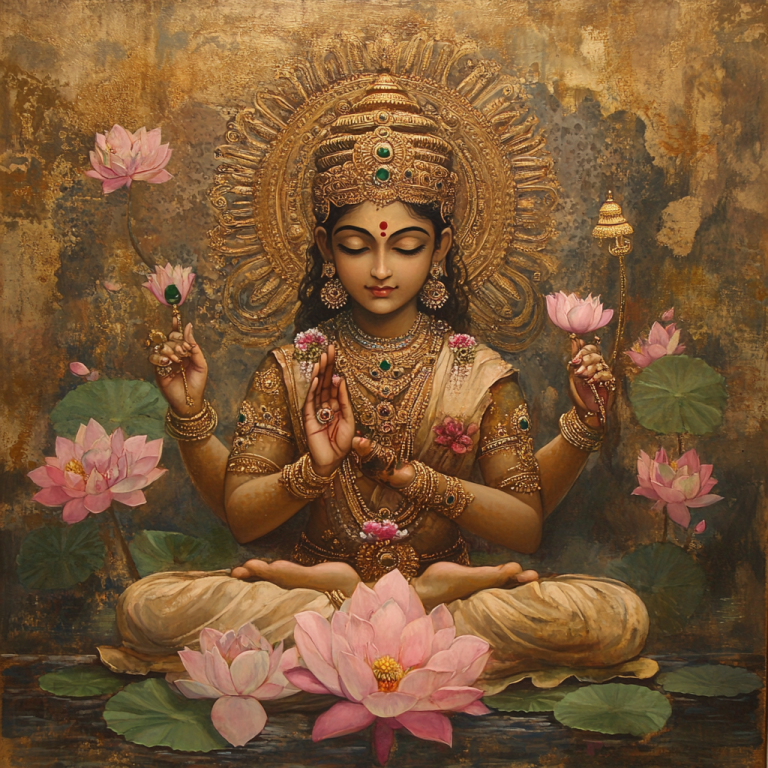
The Purusha Sukta (पुरुष सूक्त): A Cosmic Hymn
While the hymn has a literal layer, where it narrates creation, it also carries deeper symbolic and philosophical meanings. It provides insight into Vedic cosmology, metaphysics, and societal structure. This hymn is notable for introducing the varna system (social order) in Hinduism.
The Cosmic Scale of Purusha
| Verse | Translation | Meaning and Parallels |
|---|---|---|
| सहस्रशीर्षा पुरुषः सहस्राक्षः सहस्रपात्। | “A thousand heads has Purusha, a thousand feet, and on every side he pervades the Earth.” | Purusha symbolizes infinity, encompassing the entire cosmos. His cosmic dimensions and presence in Vedic art and theology often mirror the Vishvarupa (universal form) seen in Krishna – An Incarnation of Vishnu during the Bhagavad Gita (explore Hindu deities in art). |
| सभूमिं विश्वतो वृत्वात्यतिष्ठद् दशाङ्गुलम्। | “He fills a space ten fingers wide, larger than anything that can be measured.” | Suggests the immeasurable vastness of creation, echoing the concept of Brahman – The Supreme Truth in the Upanishads. |
The depiction of Purusha as immense yet condensed aligns with Vedic metaphysics, where the universe exists simultaneously as infinite and manifest.
Creation Through Sacrifice
The Purusha Sukta describes the first cosmic sacrifice, where Purusha becomes both the sacrificial offering and the recipient.
| Verse | Translation | Cosmic Implications |
|---|---|---|
| यत् पुरुषेण हविषा देवा यज्ञमतन्वत। | “When the Gods prepared the sacrifice with Purusha as their offering.” | Creation stems from the first yagna (sacrifice), representing transformation and renewal. |
| तं यज्ञं बर्हिषि प्रौक्षन् पुरुषं जातमग्रतः। | “They balmed as victim on the grass, Purusha born in earliest time.” | Mirrors other divine sacrifices, such as the offering of Dadhichi’s bones for Indra’s Vajra. |
This cosmic act reflects the Vedic principle of interconnectedness, where creation is both an act of self-giving and self-realization.
The Origin of the Cosmos
| Aspect of Creation | Verse | Significance |
|---|---|---|
| Celestial Bodies | “The moon from his mind, the sun from his eye, Indra and Agni from his mouth, and Vayu from his breath.” | Highlights the panchabhutas (five elements) and their interconnectedness with cosmic forces. |
| Earth and Sky | “From his navel came the space, from his head the sky, from his feet the Earth, and from his ears the directions.” | Echoes the creation narrative in Vishnu’s Varaha Avatar, where he lifts the Earth from the cosmic ocean. |
The hymn’s imagery portrays Purusha as both the macrocosm (the universe) and the microcosm (the individual).
The Birth of Society
The hymn introduces the concept of varna, or the division of society based on functional roles, symbolizing the unity of humanity arising from Purusha’s body:
| Part of Purusha | Social Class | Role in Society |
|---|---|---|
| Mouth | Brahmana (Priests) | Guardians of knowledge and rituals, akin to Agni as the mouth of the gods in Vedic sacrifices. |
| Arms | Kshatriya (Warriors) | Protectors of society, similar to Indra’s role as the celestial defender. |
| Thighs | Vaishya (Merchants) | Providers of wealth and sustenance, analogous to the nourishing role of the Earth. |
| Feet | Shudra (Servants) | Supporters of society’s foundation, reflecting humility and service. |
While later misinterpretations led to the rigid caste system, the original intent of the hymn was to emphasize functional interdependence and unity.
Viraj and Vamana: Connections to Other Myths
| Verse | Translation | Connections to Other Myths |
|---|---|---|
| त्रिपादूर्ध्व उदैत् पुरुषः पादोऽस्येहाभवत् पुनः। | “Three-fourths of Purusha went up, one-fourth remained on Earth.” | Reflects Vishnu’s Vamana Avatar, where he claims the three worlds in three steps, symbolizing transcendence and immanence. |
| तस्माद् विराळ् अजायत विराजो अधि पूरुषः। | “From him Viraj was born; again Purusha from Viraj was born.” | Viraj, as the cosmic principle, parallels the creative energy of Shakti, the consort of Shiva in the form of Parvati – The Consort of Shiva or Kali. |
The mention of three steps aligns with Vishnu’s cosmic stride in the Vamana Avatar, representing the integration of physical and spiritual realms.
Creation of Beings
| Verse | Translation | Significance |
|---|---|---|
| तस्मादश्वा अजायन्त ये के चोभयादतः। | “From it were horses born, and all cattle with two rows of teeth.” | Symbolizes the diversity of life forms, reflecting the generative power of creation. |
| पशून्तांश्चक्रे वायव्यानारण्यान् ग्राम्याश्च ये। | “He formed the creatures of the air, wild and tame animals alike.” | Aligns with Manu’s ark in the Matsya Avatar, preserving life during the cosmic deluge. |
The Eternal Nature of Sacrifice
The hymn concludes with the idea that sacrifice is eternal and cyclical:
| Verse | Translation | Parallels |
|---|---|---|
| यज्ञेन यज्ञमयजन्त देवाः। | “With sacrifice, the gods sacrificed Purusha.” | Similar to Shiva’s Tandava, where destruction is an act of cosmic renewal. |
| देवायद् यज्ञं तन्वाना अबध्नन् पुरुषं पशुम्। | “Offering sacrifice, they bound Purusha as the victim.” | Mirrors Vishnu’s sacrifice in his Narasimha Avatar, tearing himself free from human constraints to restore balance. |
Themes and Philosophical Insights
| Theme | Explanation | Connections to Mythology |
|---|---|---|
| Unity in Diversity | Purusha’s body symbolizes the unity of all beings, despite their diversity-each element of his cosmic form intricately woven into the philosophical vision of universal oneness. | Resonates with Krishna’s teachings in the Bhagavad Gita: “I am the same in all beings.” |
| Cycle of Creation and Destruction | The hymn’s focus on sacrifice reflects the cyclical nature of existence. | Parallels Shiva’s role as the destroyer and Vishnu’s role as the preserver in Hindu cosmology. |
| Interdependence of Life | The creation of society, animals, and celestial bodies emphasizes mutual reliance. | Similar to the Samudra Manthan, where all beings contributed to churn the ocean for divine nectar. |
Conclusion
The Purusha Sukta is not merely a hymn of creation but a philosophical treatise on cosmic order, interconnectedness, and the eternal cycle of sacrifice. Its themes resonate deeply with other narratives in Hindu mythology, such as Vishnu’s avatars, the Samudra Manthan, and the creation myths of the Upanishads. Through Purusha, the hymn reveals the infinite, transcendent reality from which all creation emanates, underscoring the essence of Vedic thought-unity within diversity.
Sources & further reading
These themes are explored in greater depth across the following authoritative resources:
- Internet Sacred Text Archive, Rig Veda (Griffith translation)
- Internet Sacred Text Archive, Upanishads
- Britannica, Veda
- Britannica, Upanishad
- Patrick Olivelle, The Early Upanishads (Oxford University Press, 1998)
External resources for further reading. Apam Napat is not affiliated with these publishers; citation does not imply endorsement.
Based on the classical texts of Hindu mythology, see our sources.