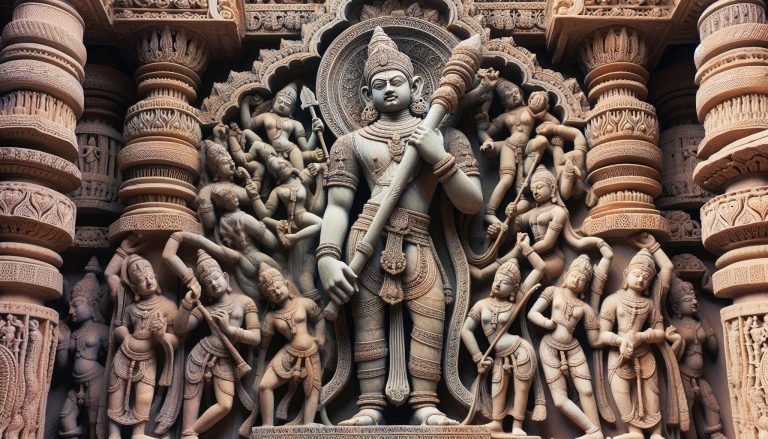
Hindu legends are a treasure trove of archetypal patterns that have captivated minds for centuries. From epic tales like the Mahabharata – The Great Epic and Ramayana – Epic of Hinduism to the rich world of gods and goddesses, these stories are more than just folklore. They offer profound insights into human nature, morality, and … Read more
Perhaps other than Indra, no other Vedic character has undergone so large a transformation by the time of the Puranas as Yama. In the Rig Veda, Yama is described as the son of Saranyu (daughter of Tvashta, the artisan god) and Vivasvant – The Sun God (associated with the sun), establishing his divine lineage. This … Read more
कृष्ण Krishna is also an incarnation of Vishnu, born to restore dharma and rid the world of evil. As the eighth avatar of Vishnu, Krishna exhibits many traits seen in other incarnations. These divine attributes, discussed in detail in the post on Vishnu’s avatars and their characteristics, showcase the multifaceted role of the Preserver in Hindu … Read more
Parjanya is the god of rain in Hindu mythology, responsible for nourishing the earth and sustaining life through the showers he bestows. Associated with the vital elements of nature, Parjanya symbolizes fertility, abundance, and the life-giving power of rain, which nurtures crops and sustains all living beings. His role is central to agrarian societies, where … Read more
ब्रह्मण The Brahmanas: The Highest Class of Priests and Scholars In the Varna – The Caste System system, the Brahmanas are the highest class of priests and scholars. They are considered to be the most sacred and revered class, and are said to have sprang forth from the face of the primordial man Purusha – … Read more
बन्दि Bandy, the brilliant son of Varuna – The Waters by a mortal woman, was renowned as the royal scholar in the court of the learned King Janaka – The King of Videha of Mithila. His reputation for unmatched intelligence and eloquence in Vedic knowledge was known throughout the land, and he took great pride … Read more
Kahoda: The Devoted Disciple and Father of Ashtavakra Kahoda was a devoted disciple of the renowned sage Uddalaka – Grandfather of Ashtavakra. Through his dedication and devotion to his guru, he won the hand of Uddalaka’s daughter, Sujata, in marriage. This marriage was not only a reward but also an initiation into Uddalaka’s lineage of … Read more
Ever wondered what your true purpose in life is? The ancient wisdom of the Vedas offers profound insights into this timeless question. Rooted in the spiritual traditions of India, the Vedas provide a roadmap to understanding one’s dharma, or life purpose, through a harmonious balance of duty, righteousness, and personal fulfillment. As I delved into … Read more
Mitra-Indra – The King of Heaven is the form in which Indra is invoked in association with Mitra in the Rig Veda. In Vedic tradition, Indra, the god of rain, thunder, and warfare, is often invoked in conjunction with other deities, reflecting his multifaceted role in the cosmic order. When invoked alongside Mitra, Indra takes … Read more
रुद्र Rudra, a complex and multifaceted deity in Hindu mythology, is a god who belongs to the atmospheric group of gods, which includes Indra – The King of Heaven, ApamNapat – Agni, The Son-of-waters, the Maruts, Vayu, Parjanya, and the ocean. In the Rig Veda, Rudra is described as a subordinate deity, with negative qualities … Read more
We use cookies to improve your experience and to understand how the encyclopedia is used. You can accept all cookies, or reject non-essential ones. See our Privacy Policy for details.