
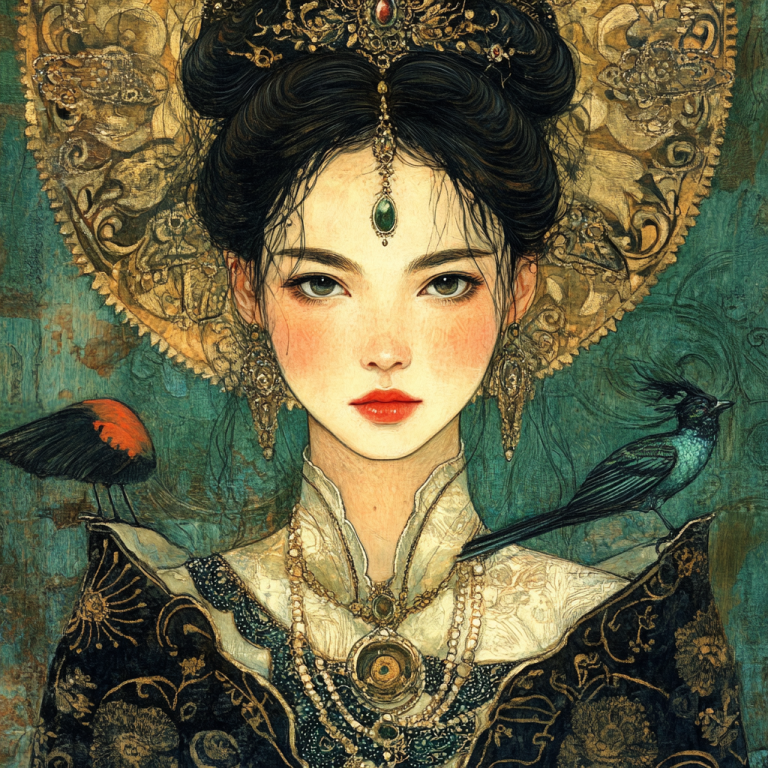
Tilottama: The Divine Apsara of Exceptional Beauty
Tilottama is an extraordinary Apsara residing in Indra’s celestial court, celebrated for her unparalleled beauty and grace. Her name is derived from the Sanskrit word “Tila”, meaning sesame seed, as she was created from sesame seeds by the celestial architect Vishwakarma – The Architect of the Devas, following the advice of Lord Brahma – The Creator. Her story intertwines with some of the most intriguing narratives in Hindu mythology, showcasing themes of divine creation, cosmic justice, and celestial artistry.
Creation of Tilottama
Tilottama’s creation is an example of how divine intervention often manifests in extraordinary circumstances in Hindu mythology. According to legend, the Asura brothers Sunda and Upasunda, having received boons of invincibility, began wreaking havoc across the universe. Their strength and unity were unmatched, as they had vowed never to harm one another. The gods, unable to withstand their tyranny, turned to Brahma for help.
Brahma suggested creating a being of such exceptional beauty that her presence alone would sow discord between the brothers. Acting on this advice, Vishwakarma, the celestial craftsman, meticulously fashioned Tilottama by gathering the finest qualities from the universe. Her beauty was so divine and radiant that even the gods were captivated.
Role in the Demise of Sunda and Upasunda
Tilottama was sent to the mortal world to distract the Asura brothers and break their unity. When Sunda and Upasunda encountered her, they were immediately spellbound by her allure. Each desired to possess her, and a fierce argument erupted between them. Bound by their earlier vow, they could not resolve the matter amicably.
The quarrel escalated into a deadly battle, where the brothers, who were otherwise invincible, ended up killing each other. Thus, Tilottama fulfilled her divine purpose, restoring cosmic balance and ensuring the safety of the gods and the universe.
Tilottama in Indra’s Court
After completing her mission, Tilottama was welcomed into Indra’s court, where she became one of the celestial Apsaras. Her presence was not merely ornamental but also symbolic, representing the gods’ ability to overcome even the most dire threats through divine wisdom and beauty. As an Apsara, Tilottama engaged in dance, music, and other forms of celestial entertainment, much like other mythical performers such as Tumburu – A Gandharva Chief, who filled the heavens with song and devotion.
Symbolism of Tilottama
Tilottama’s story is rich with symbolic undertones:
| Aspect | Symbolism |
|---|---|
| Beauty and Divine Power | Tilottama represents the divine power of beauty as a tool for achieving cosmic balance. |
| Celestial Craftsmanship | Her creation by Vishwakarma underscores the role of divine artisanship in mythology. |
| Restoration of Dharma | By causing the downfall of Sunda and Upasunda, Tilottama serves as an instrument of Dharma (cosmic law). |
| Temptation and Conflict | Her allure highlights how desires and attachments can lead to discord and destruction. |
Connections to Other Figures in Mythology
Tilottama’s story connects to various elements and figures in Hindu mythology:
| Entity | Connection |
|---|---|
| Vishwakarma | The celestial architect who created Tilottama from sesame seeds. |
| Brahma | Advised the creation of Tilottama to resolve the problem of Sunda and Upasunda. |
| Sunda and Upasunda | The Asura brothers whose demise was orchestrated through Tilottama’s beauty. |
| Indra | Welcomed Tilottama into his celestial court, where she became one of the divine Apsaras. |
| Other Apsaras | Like Tilottama, Apsaras such as Menaka – An Apsara, Urvashi – An Apsara, and Rambha often play pivotal roles in cosmic narratives. These divine beings, detailed in the Apsara entity overview, were often instruments of both seduction and spiritual trial, shaping destinies of kings, sages, and demons alike. |
Tilottama’s Impact on Mythological Themes
Tilottama’s story reflects several recurring themes in Hindu mythology:
- Divine Intervention: Her creation and mission illustrate the proactive role of the gods in maintaining cosmic order.
- Beauty as a Double-Edged Sword: Tilottama’s beauty is both a gift and a tool, capable of inspiring awe and provoking destructive desires.
- The Role of Apsaras: Like other Apsaras, Tilottama bridges the realms of mortals and gods, influencing events in both through her charm and actions. Their recurring presence in myth reflects the deeper symbolism explored in the full Apsara mythological profiles, where beauty and artistry serve cosmic functions.
Tilottama in Modern Interpretations
Tilottama’s narrative is often cited as an example of how intelligence and strategy can triumph over brute force. In artistic and literary traditions, she is portrayed as a symbol of divine grace and the power of beauty to effect profound change.
Her story remains a timeless reminder of the interconnectedness of all elements in the universe and the divine wisdom that governs them. Through her extraordinary tale, Tilottama continues to captivate and inspire, embodying the eternal allure and purpose of the celestial Apsaras.
Sources & further reading
These themes are explored in greater depth across the following authoritative resources:
- Britannica, Asura
- Britannica, Naga
- Mythopedia, Hindu Mythology
- Internet Sacred Text Archive, Mahabharata
- Wendy Doniger, Hindu Myths (Penguin Classics, 1975)
External resources for further reading. Apam Napat is not affiliated with these publishers; citation does not imply endorsement.
Frequently asked questions
Who is Tilottama in Hindu mythology?
Who created Tilottama?
Why was Tilottama created?
What did Tilottama do to Sunda and Upasunda?
Based on the classical texts of Hindu mythology, see our sources.