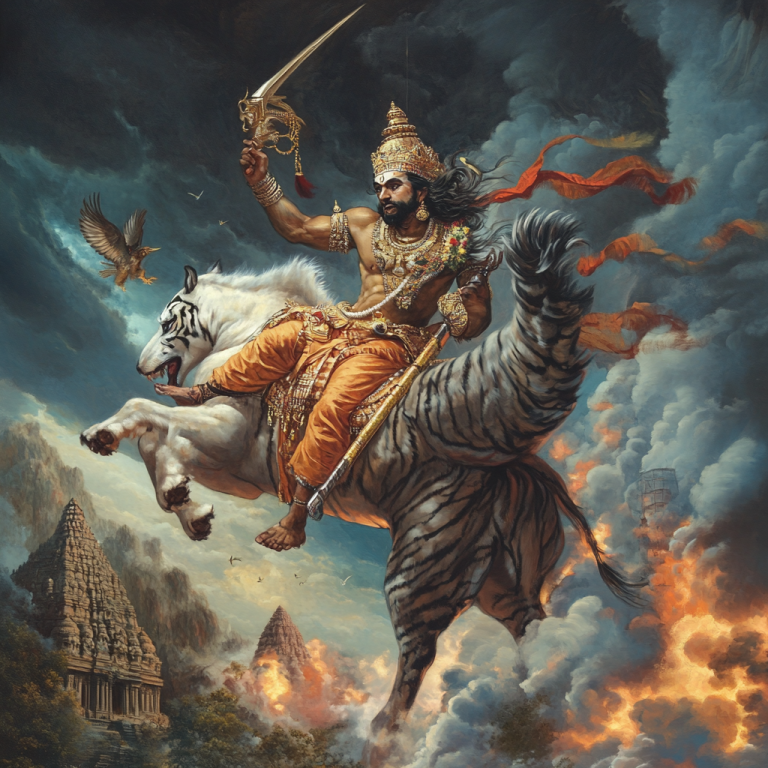
Uchaishravas: The Celestial Winged Horse
Uchaishravas, a magnificent divine winged horse, is one of the treasures that emerged during the churning of the ocean-of-milk (Samudra Manthan) by the Devas and Asuras. This horse, said to be the fastest in the world, is a symbol of purity and grace, its color a brilliant white that rivals the luminosity of the heavens. Belonging to Indra, the king of the gods, Uchaishravas is revered for its unmatched speed, capable of traveling as fast as human thought.
The Origin of Uchaishravas
The story of Uchaishravas begins with the Samudra Manthan, a cosmic event undertaken by the Devas and Asuras in their quest for Amrita, the nectar of immortality. The churning, conducted using Mount Mandara as the churning rod and Vasuki, the king of serpents, as the churning rope, brought forth several divine treasures. Among them was Uchaishravas, often referred to as the king of horses. This celestial being not only symbolized divine excellence but also reflected the regal attributes associated with Indra, to whom the horse ultimately belonged. For a broader look at the mythological scope of Indra’s role and divine associations, explore the entities surrounding Indra in Hindu mythology.
This event connects Uchaishravas to other divine entities and treasures that emerged during the churning, such as Lakshmi, the goddess of wealth and prosperity, and Dhanvantari, the divine physician with the nectar of immortality. The horse’s emergence symbolizes the purity and transcendence that were the fruits of this divine endeavor.
The Tale of Kadru and Vinata
Uchaishravas is central to a well-known story involving Kadru and Vinata, the two wives of the sage Kashyapa – Father of the Devas and Asuras. The sisters, both mothers to significant beings in Hindu mythology, played a pivotal role in shaping the dynamics between the Nagas (serpents) and Garuda, the celestial eagle.
The Bet on Uchaishravas’s Tail
One day, Kadru and Vinata saw Uchaishravas and were captivated by its unparalleled beauty. Kadru bet Vinata that the horse’s tail was black, while Vinata believed it to be pure white, like the rest of its body. The loser of the bet would become the slave of the other.
Kadru, determined to win, resorted to deceit. She commanded her sons, the Nagas, to coil around Uchaishravas’s tail, making it appear black. When Vinata observed the horse’s tail the next day, she was devastated to find it black, not knowing that Kadru had cheated. As a result, Vinata became Kadru’s slave.
Consequences of the Bet
This incident sets the stage for a long-standing enmity between Garuda, Vinata’s son, and the Nagas, Kadru’s sons. To free his mother from servitude, Garuda undertakes a perilous journey to retrieve the Amrita from the heavens. His actions further intertwine with the larger cosmic order, including his role as the mount of Vishnu.
Connections in Hindu Mythology
Uchaishravas’s story intertwines with several key elements of Hindu mythology:
| Entity/Theme | Connection |
|---|---|
| Indra | Uchaishravas belongs to Indra and symbolizes his regal authority over the heavens. This connection is further illustrated in various legends involving Indra’s celestial domain, including tales of his interactions with sages and deities such as in the legend of Indra and Ahalya, which reflects his complex moral and divine persona. |
| Samudra Manthan | Emerged as a treasure during the cosmic churning, alongside other significant entities like Lakshmi. The emergence of treasures like Uchaishravas in the myth reflects the intricate cooperation between celestial forces like the Maruts and Indra in cosmic undertakings. |
| Kadru and Vinata | The bet involving Uchaishravas catalyzed the enmity between Nagas and Garuda. |
| Vishnu’s Mount (Garuda) | Uchaishravas indirectly influenced the events that led to Garuda’s rise as Vishnu’s celestial eagle. |
| Nagas | Kadru’s sons played a crucial role in deceiving Vinata, marking their centrality in the tale. |
Symbolism of Uchaishravas
Uchaishravas represents purity, speed, and transcendence. As a divine horse, it is often seen as a symbol of the ultimate pursuit of perfection and divine grace. Its emergence during the churning of the ocean underscores the idea that beauty and excellence are born from immense effort and collaboration, even amidst conflict.
- As the Mount of Indra: Uchaishravas signifies Indra’s divine power and his dominion over the heavens. In many scriptures, Indra’s role is often seen in tandem with other deities like Mitra, with whom he shares cosmic responsibilities. Their dynamic is detailed in explorations such as the Mitra–Indra relationship, which showcases the collaborative essence of Vedic deities.
- As a Catalyst for Conflict: The horse plays a pivotal role in the story of Kadru and Vinata, serving as a reminder of how deceit and ambition can lead to discord.
Cultural Legacy
The tale of Uchaishravas has been narrated in several scriptures, including the Mahabharata – The Great Epic and Puranas, highlighting its importance in Hindu mythology. The horse’s unmatched qualities make it a recurring symbol of divine excellence and the fruits of cosmic effort.
In this way, Uchaishravas stands not just as a celestial steed but as a cornerstone of myths that explore themes of rivalry, deception, redemption, and the eternal pursuit of divine grace.
Sources & further reading
These themes are explored in greater depth across the following authoritative resources:
- Britannica, Asura
- Britannica, Naga
- Mythopedia, Hindu Mythology
- Internet Sacred Text Archive, Mahabharata
- Wendy Doniger, Hindu Myths (Penguin Classics, 1975)
External resources for further reading. Apam Napat is not affiliated with these publishers; citation does not imply endorsement.
Based on the classical texts of Hindu mythology, see our sources.