
As I investigate into the intricate details of these divine beings, you’ll discover how their stories interweave with moral lessons and cultural practices. Whether you’re a curious learner or someone deepening their spiritual knowledge, exploring these outlines will provide you with a deeper appreciation for the profound wisdom embedded in Hindu mythology.
Overview of Hindu God Outlines
Major Gods and Goddesses
- Brahma: Brahma is the creator god, often shown with four heads. Each head represents one of the four Vedas, symbolizing his role in creating the world and imparting cosmic knowledge.
- Vishnu: Vishnu is known as the preserver god. He has ten avatars, including the well-known Rama and Krishna. Each incarnation addresses different cosmic challenges, maintaining the balance of good and evil.
- Shiva: Shiva is the destroyer god, often depicted with a third eye on his forehead. This third eye symbolizes his powerful energy and ability to destroy illusions and old, worn-out structures, paving the way for new creation.
- Shakti: Shakti represents the supreme goddess and symbolizes feminine power and energy in the universe. As the embodiment of dynamic forces, she is often associated with various forms, such as Durga and Kali.
- Ganesha: Ganesha is recognized as the remover of obstacles. He is depicted with an elephant head and a large belly. Ganesha is invoked at the beginning of new ventures or important tasks.
- Krishna: Krishna is an avatar of Vishnu and is celebrated as a divine prince. Known for his teachings in the Bhagavad Gita, Krishna represents love, compassion, and wisdom.
- Rama: Rama, another avatar of Vishnu, is revered for his bravery and adherence to duty. As the divine king, he exemplifies the principles of righteousness and justice, with his story being central to the Ramayana – Epic of Hinduism.
- Hanuman: Hanuman is the monkey god and a devoted follower of Rama. His extraordinary strength and unwavering loyalty make him a symbol of devotion and courage.
Major Hindu Gods
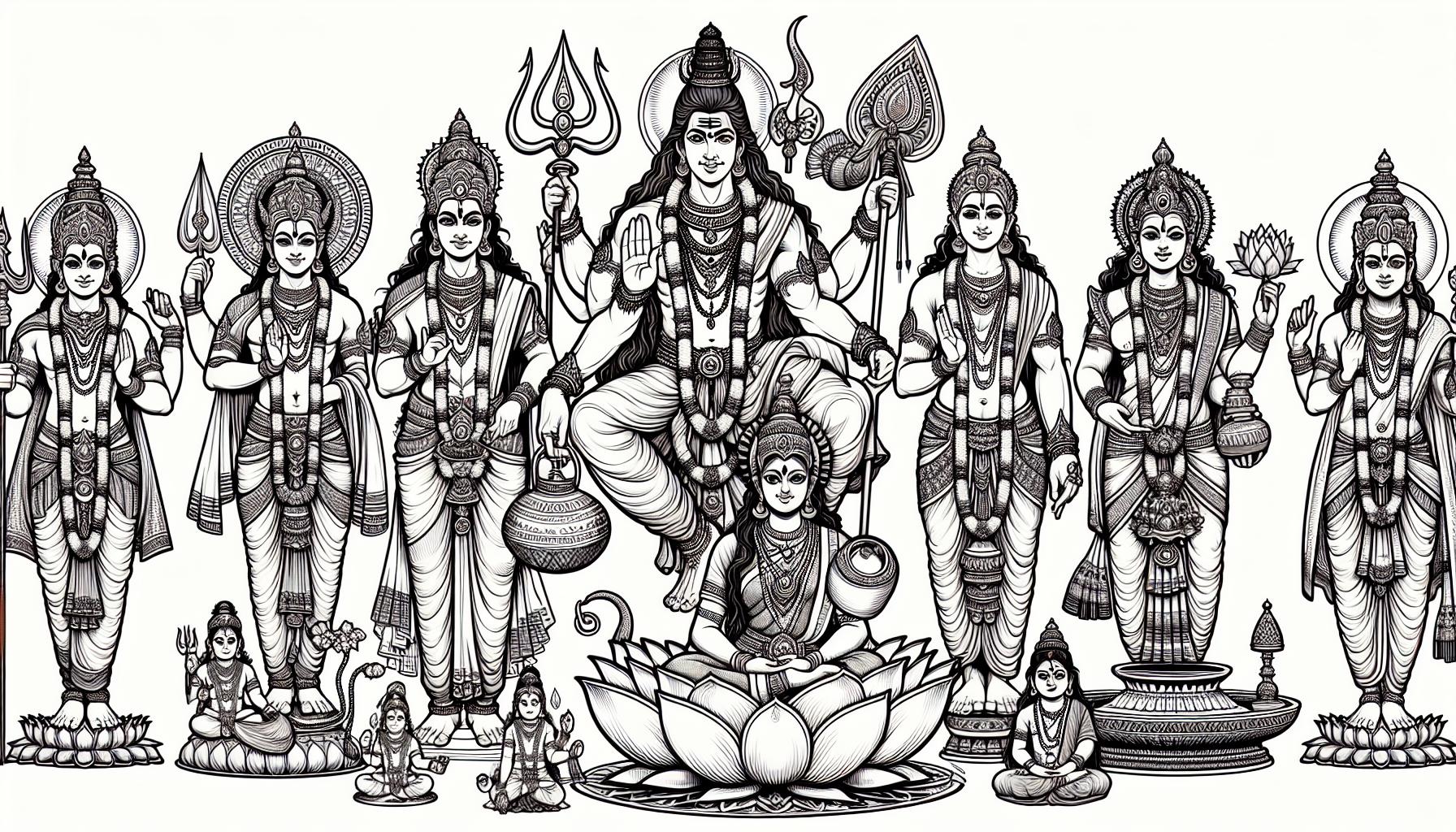
Hinduism features a rich world of deities, each fulfilling distinct roles within the cosmic framework. Here are the major Hindu gods and their unique attributes.
Brahma
Brahma is the god of creation. He is often depicted with four heads, each symbolizing one of the four Vedas – the ancient Hindu scriptures. Even though his pivotal role in creation, Brahma isn’t widely worshiped, with few temples dedicated to him alone. His infrequent worship is due to mythology, which often places greater emphasis on the roles of Vishnu and Shiva.
Vishnu
Vishnu, the god of preservation, maintains the balance and order of the universe. He is typically shown with four arms, holding a mace, disc, lotus, and conch. These objects symbolize power, mind, love, and sound respectively. Vishnu’s importance is further highlighted by his ten incarnations known as avatars, including well-known figures like Rama and Krishna. These avatars appear whenever cosmic balance is disturbed, reinforcing his role as the preserver.
Shiva
Shiva, the god of destruction, plays a crucial role in the cyclical nature of creation and destruction. His iconography often includes a third eye, signifying his ability to see beyond the ordinary, and a trident, symbolizing his role in cosmic balance. Shiva is depicted in various forms, such as the meditative yogi or the fierce Nataraja, the lord of dance, emphasizing his multifaceted nature.
Saraswati – The Goddess of Learning and Wisdom
Saraswati is the goddess of knowledge, music, art, and wisdom. She is typically depicted holding a veena (a musical instrument), a book, and prayer beads, symbolizing knowledge, arts, and spirituality. Saraswati is especially venerated by students and academics, seeking her blessings for success in education and intellectual pursuits.
Lakshmi
Lakshmi, the goddess of wealth and prosperity, is often shown seated or standing on a lotus flower, symbolizing purity and spiritual power. She holds lotus flowers in two of her hands, representing material and spiritual prosperity, while her other two hands bestow blessings and protection. Lakshmi is widely worshiped during Diwali, the festival of lights, marking her importance in bringing fortune and abundance.
Parvati
Parvati, the goddess of love, fertility, and devotion, is often depicted alongside her consort Shiva and their sons Ganesha and Kartikeya. She embodies nurturing qualities and is revered for her role in maintaining family welfare and marital harmony. Parvati’s different aspects, such as the fierce Durga and Kali or the benevolent Annapurna, represent her diverse attributes and the dynamic nature of her personality.
Depiction and Symbolism

Hindu gods are depicted through various forms, each carrying deep symbolic meanings that convey aspects of divinity and the universe.
Common Symbols
Symbols are integral in Hindu depictions and carry rich meanings:
- Lotus: Representing purity and beauty, the lotus often seen in the hands of deities like Vishnu and Lakshmi symbolizes spiritual awakening and cosmic renewal.
- Conch Shell (Shankha): Used by Vishnu and other gods, the conch shell signifies the primordial sound of creation and serves as a call to prayer.
- Trident (Trishul): Associated with Shiva, the trident symbolizes the three fundamental aspects of existence: creation, preservation, and destruction.
- Discus (Chakra): Seen with Vishnu, the discus represents the mind and the power to cut through obstacles and ignorance.
- Crescent Moon: Featured in depictions of Shiva, symbolizes the cyclical nature of time and cosmic rhythms.
- Elephant: Ganesha is depicted with the head of an elephant, symbolizing wisdom, memory, and the overcoming of obstacles.
Each of these symbols illustrates core beliefs and principles central to Hindu philosophy.
Iconography in Temples
Hindu temples abound with intricate iconography that tells stories and conveys messages:
Murti Worship: Temples house murtis—sacred statues crafted from stone, wood, or metal. These representations serve as focal points for devotion and spiritual connection.
Lingam Presence: Shiva temples often feature the lingam, symbolizing the union of male and female principles and divine generative power.
Sacred Marks (Tilaka): Devotees wear tilaka on the forehead, with distinct shapes representing allegiance to particular deities. For instance, a vertical mark denotes devotion to Vishnu, while a tripundra (three horizontal lines) signifies dedication to Shiva.
Hindu temple iconography reveals the deep connection between divine symbolism and daily worship practices.
Ancient Texts and References
Ancient Hindu texts are rich in mythology and philosophy, shaping the understanding of the divine. Each text offers unique perspectives on the gods and their significance.
Vedas and Upanishads
The Vedas, considered the oldest sacred texts of Hinduism, were composed between 1500 BCE and 500 BCE. They include hymns, rituals, and incantations, describing a pantheon of gods known as devas. The term ‘deva’ comes from the Sanskrit ‘div,’ meaning brightness. Key gods in the Vedas include Agni, the fire god; Indra, the warrior deity; and Varuna, the god of cosmic order.
The Upanishads, composed between 700 BCE and 500 BCE, offer a more philosophical outlook. They focus on the interconnectedness of all things, discussing the ultimate identity of the self (atman) and the Absolute (brahman). These texts emphasize spiritual understanding over ritualistic practices, profoundly influencing Hindu thought.
Puranas and Epics
The Puranas, composed between the 3rd century BCE and 1000 CE, contain a vast collection of myths, legends, and genealogies of gods, heroes, and ancient sages. They serve as key sources of stories about major deities and cosmic events. For example, the Vishnu Purana details the ten avatars of Vishnu, including Krishna and Rama, while the Shiva Purana focuses on the deeds of Shiva.
The Hindu epics, Mahabharata – The Great Epic and Ramayana, offer narrative poems filled with divine and heroic tales. The Mahabharata, attributed to Vyasa, includes the Bhagavad Gita, a crucial dialogue between Krishna and Arjuna. The Ramayana, attributed to Valmiki, recounts the life and adventures of Rama, depicting ideals of duty and righteousness.
Cultural and Religious Significance
Hinduism stands as a cornerstone of spiritual practice and cultural expression, being the oldest living religion on Earth. Originating on the Indian subcontinent, it dates back to the 2nd millennium BCE or possibly earlier.
Festivals and Rituals
Hindu festivals and rituals emphasize spiritual renewal and the triumph of good over evil. For instance, Holi, known as the Festival of Colors, celebrates the arrival of spring and the victory of good over evil. Diwali, the Festival of Lights, marks the triumph of light over darkness and good over evil. These festivals often involve elaborate rituals, community gatherings, and vibrant traditions.
Influence on Art and Literature
Hindu gods have profoundly influenced art and literature, inspiring countless works across various mediums. Traditional Indian art often depicts deities like Shiva performing the cosmic dance or Vishnu in his many avatars. Epics such as the Mahabharata and Ramayana not only enrich literature but have also shaped performing arts like dance and theater. Renowned texts like the Vedas and Upanishads also offer deep philosophical insights that continue to inspire thinkers and artists worldwide.
Conclusion
Exploring the intricate world of Hindu gods offers profound insights into one of the world’s oldest religions. The rich symbolism and diverse deities reflect the depth of Hindu philosophy and its timeless relevance. From ancient texts to vibrant festivals, Hinduism’s influence permeates art, literature, and daily life. Understanding these divine figures not only enriches our knowledge but also connects us to a broader cultural and spiritual heritage.
Frequently asked questions
Who is Brahma in Hinduism?
Who is Saraswati, the goddess of knowledge?
Who is Hanuman in Hindu mythology?
What is the lingam in Hindu temples?
Sources & further reading
These themes are explored in greater depth across the following authoritative resources:
- Internet Sacred Text Archive, Rig Veda (Griffith translation)
- Internet Sacred Text Archive, Upanishads
- Britannica, Veda
- Britannica, Upanishad
- Patrick Olivelle, The Early Upanishads (Oxford University Press, 1998)
External resources for further reading. Apam Napat is not affiliated with these publishers; citation does not imply endorsement.
Based on the classical texts of Hindu mythology, see our sources.