From ancient scriptures like the Vedas and Upanishads to modern interpretations, the Hindu perspective on Brahman has evolved but remains deeply rooted in the idea of an all-encompassing, infinite presence. Understanding Brahman offers a glimpse into the rich world of Hindu thought, where spirituality and philosophy intertwine seamlessly.
Understanding Brahman
Brahman, in Hinduism, represents the ultimate reality and universal principle. It’s a Vedic Sanskrit term with shades of meaning that convey profound concepts. Brahman is labeled as the “creative principle realized in the whole world,” making it the essence of the universe.
Brahman’s conceptualization extends beyond a singular definition. It’s often described as the “essence of the self (Atman – The Soul),” symbolizing the deeper foundation of all phenomena. In Hindu metaphysics, Atman and Brahman are interconnected, emphasizing that understanding one leads to insights about the other.
Historically, the idea of Brahman shaped Brahmanism, a philosophical movement from ancient India. This movement laid the groundwork for Hinduism. As the Vedas were integrated and the caste system formed, the understanding of Brahman evolved but remained central to spiritual and philosophical discourse. Brahman’s role underscores its importance in exploring life’s deeper aspects and the universe.
Hindu Scriptures on Brahman

Hindu scriptures extensively discuss the concept of Brahman, defining it as the ultimate reality and cosmic principle. These texts form the foundation of Hindu philosophical thought.
Vedas
The Vedas are the oldest and most revered texts in Hinduism, considered divine revelations. These scriptures describe Brahman as the creator, sustainer, and destroyer of the universe. The Rigveda, one of the four Vedas, frequently mentions Brahman, detailing it as the single unifying essence behind all existence. In the Yajurveda, Brahman is identified with the cosmic order and divine law that governs everything.
Upanishads
The Upanishads, part of the Vedic corpus, investigate deeper into the philosophical aspects of Brahman. These texts offer esoteric insights, presenting Brahman as beyond human comprehension and devoid of attributes. The Chandogya Upanishad, for instance, introduces the concept of Tat Tvam Asi (“That Thou Art”), indicating the identity of the self (Atman) with Brahman. The Brihadaranyaka Upanishad emphasizes that realizing Brahman leads to liberation and ultimate knowledge, illustrating Brahman’s role in spiritual enlightenment.
Brahman in Different Hindu Philosophies

Hindu philosophies offer varied perspectives on Brahman, each presenting unique viewpoints on the ultimate reality and its relationship with the individual self (Atman).
Advaita Vedanta
Advaita Vedanta, a non-dualistic tradition, asserts that Brahman is identical to the individual self (Atman). Adi Shankara’s teachings emphasize this oneness, encapsulated in the Upanishadic statement “Tat tvam asi” (That art thou). The philosophy posits that through negating misconceptions and false ego-identities rooted in Maya, one can realize this unity, attaining an immediate intuition of Brahman.
Vishishtadvaita
Vishishtadvaita, a qualified non-dualistic tradition, views Brahman as the ultimate reality, yet maintains a distinction between Brahman and Atman. Unlike Advaita, it doesn’t equate the individual self entirely with Brahman, recognizing the unique qualities and attributes of each while still affirming their intrinsic connection.
Dvaita
Dvaita, a dualistic tradition, presents Brahman and the individual self (Atman) as fundamentally distinct. This philosophy stresses the eternal separation between the two, with Brahman being the supreme entity and individual selves being finite and dependent on Brahman. The relationship is one of devotion and servitude, highlighting the differences rather than the oneness seen in Advaita Vedanta.
Spiritual Practices and Realization of Brahman
Hinduism offers diverse spiritual practices for realizing Brahman. These practices include meditation, yoga, and bhakti, each fostering a deep connection with the ultimate reality.
Meditation
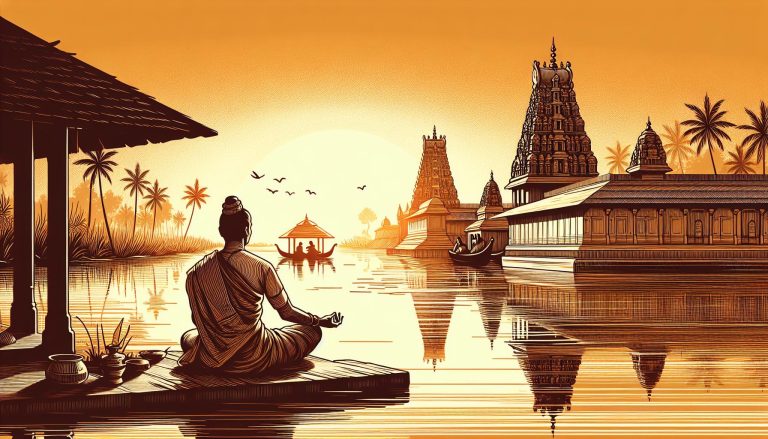
Meditation focuses the mind to deepen the understanding of the self and, eventually, Brahman. It serves as a vital component of Yoga, aiming to unite the individual self (Atman) with the cosmic essence. Focusing on breath and mantra, meditation aids in transcending the ego, revealing the unchanging reality of Brahman.
Yoga
Yoga encompasses physical postures, breathing techniques, and meditation for spiritual growth. It aims to harmonize the individual self with Brahman, paving the way for liberation (moksha). Practices such as Hatha Yoga emphasize physical discipline, while Raja Yoga focuses on meditative control. Both paths seek the union of Atman and Brahman.
Bhakti
Bhakti yoga promotes devotion, cultivating love and attachment to a personal deity or Brahman. Through acts of worship, singing hymns, and prayer, devotional practices create an intimate bond with the divine. The Bhagavad Gita highlights Bhakti as a powerful path for connecting with Brahman, emphasizing surrender and unwavering faith.
This section has provided a detailed understanding of how meditation, yoga, and bhakti serve as key spiritual practices for achieving realization of Brahman in Hindu philosophy.
Brahman and Its Role in the Modern World
Brahman, as the ultimate reality, continues to hold significance even in today’s rapid world. People seek peace and understanding in their lives amid chaos, and Brahman’s philosophy provides that much-needed grounding. The concept offers a timeless perspective on existence, urging individuals to look beyond materialistic pursuits.
Spiritual Practices and Inner Peace
Meditation and yoga remain powerful tools to connect with Brahman. For example, in yoga sessions, practitioners strive to harmonize their bodies and minds, leading to a deeper connection with Brahman. Similarly, meditation practices enable individuals to transcend the ego, offering glimpses of the ultimate reality.
Ethical Foundations and Social Harmony
The principles rooted in Brahman promote ethical living and harmony. People who embrace these teachings often engage in compassionate actions, fostering a sense of community and interconnectedness. For instance, the idea that Brahman is present in all beings encourages altruism and respect for life.
Science and Consciousness
Modern science is increasingly exploring the nature of consciousness, sometimes aligning with the insights about Brahman. Researchers investigate how consciousness might be a fundamental aspect of reality, resonating with Brahman’s description as the divine consciousness pervading the universe.
Global Influence and Integration
Brahman’s philosophy extends beyond Hinduism, influencing global spiritual and philosophical discussions. Many modern thinkers draw from these ancient teachings to argue for a more holistic, interconnected view of the world. This cross-cultural exchange enriches global perspectives on spirituality and existence.
Technological Advancements and Inner Growth
While technology shapes the external world, Brahman’s teachings emphasize inner growth. Balancing technological advancement with spiritual depth can lead to a more fulfilled and harmonious life. Individuals who integrate these teachings into their daily routines often report enhanced well-being.
In essence, Brahman’s timeless wisdom continues to resonate, offering pathways to inner peace, ethical living, and a deeper understanding of the universe in our contemporary world.
Conclusion
Brahman’s timeless wisdom continues to offer profound insights into the nature of reality and existence. By exploring the concept through various Hindu philosophies and spiritual practices, we uncover pathways to inner peace and liberation. Modern science’s alignment with Brahman’s views on consciousness further underscores its relevance today. Embracing Brahman’s principles can foster ethical living and social harmony, enriching our lives in meaningful ways.
Sources & further reading
These themes are explored in greater depth across the following authoritative resources:
- Stanford Encyclopedia of Philosophy, Hindu Philosophy
- Britannica, Moksha
- Britannica, Brahman
- Internet Sacred Text Archive, Upanishads
- Sarvepalli Radhakrishnan, Indian Philosophy (2 vols., Oxford University Press, 1923)
External resources for further reading. Apam Napat is not affiliated with these publishers; citation does not imply endorsement.
Frequently asked questions
What is Brahman in Hinduism?
How is Brahman connected to Atman?
What is Brahmanism?
How do the Vedas describe Brahman?
Why is Brahman central to Hindu philosophy?
Based on the classical texts of Hindu mythology, see our sources.