
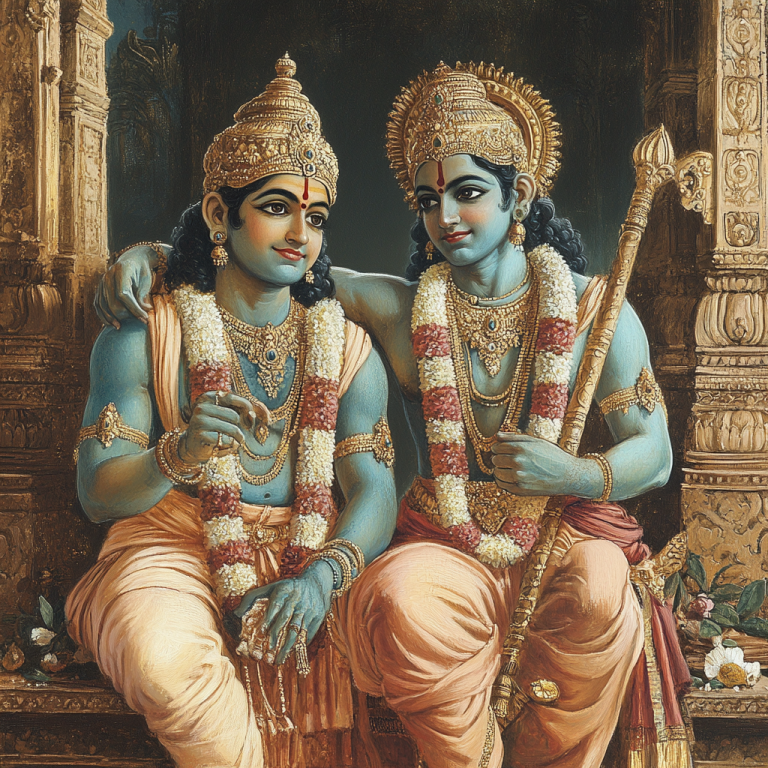
The Journey of Rama and Lakshmana: Confronting Evil Under Sage Vishwamitra – The King Who Became a Great Sage’s Guidance
Dasharatha’s Blessing and the Departure
After the wise counsel of Vasishta – Perceptor of the Ishvahu Clan, King Dasharatha, though reluctant, agreed to send his beloved sons with Vishwamitra. Dasharatha, himself descended from illustrious ancestors like Aja, recognized the importance of fulfilling divine obligations despite personal anguish. He summoned the princes, blessed them, and said:
“Dear children, consider this an honor, for Sage Vishwamitra himself has requested your aid. Obey him as you would me or your Guru. He shall be your guide and protector, and you must treat his words as commands.”
Queen Kausalya – Mother of Rama, though anxious, blessed her sons with prayers for their safety. As the two princes left the palace, their cheerful demeanor and resolute stride belied their youth. Their departure was marked by auspicious omens-trees shed blossoms, birds sang melodiously, and a cool breeze arose from the east, promising success on their journey. Rama, born of Queen Kausalya and revered in texts tracing the mythological origins of the Ramayana, stood at the threshold of his first great trial.
The Teachings of Bala and Atibala Hymns
After traveling a short distance, the party reached the southern banks of the Sarayu River. Vishwamitra instructed the princes to purify themselves in the waters. He then taught them the sacred hymns of Bala and Atibala, which would grant them immunity from hunger, fatigue, disease, and demonic assaults, even in moments of vulnerability.
This teaching marked the beginning of the prince’s tutelage under the great sage. From that day forward, Rama and Lakshmana not only acted as protectors but also dutiful students, preparing food, setting up camp, and ensuring their teacher’s comfort before resting on beds of Kusa grass.
Vishwamitra’s Wake-Up Call: Kausalya’s Fortunate Son
At dawn, Vishwamitra awoke the young princes with a verse that has since been immortalized:
“Kausalya supraja Rama, purva sandhya pravartate |
Uttistha narashardula kartavyam daivam ahnikam ||”
(Translation: “O Rama, Kausalya’s fortunate son, the eastern horizon heralds the dawn. Arise, O tiger among men, for the divine morning duties await.”)
This verse, found in Ramayana:1.23.2, is still recited in Vaishnava temples during morning rituals to awaken Lord Vishnu.
Rama and Lakshmana rose, performed their ablutions, and offered their morning prayers. Sumitra, the wise queen and mother of Shatrughna – Twin of Laxmana and Lakshmana, is often remembered for her teachings on duty and resilience, as seen in her portrayal among other notable entities like Sumitra in sacred lore.
The Hermitage of Shiva and the Legend of Kama
As they reached the confluence of the Sarayu and Ganga, the trio encountered a serene hermitage. Curious, Rama inquired about its history. Vishwamitra narrated:
“Long ago, Lord Shiva performed intense penance here after losing his consort, Sati. To awaken his heart again, the Devas sent Kama, the God of Love. Kama’s arrows succeeded, but Shiva, enraged at being disturbed, burned Kama’s corporeal form to ashes. Since then, Kama is known as Ananga (bodiless). The kingdom of Anga, named in his honor, stands as a testament to this tale. The sages who dwell here are descendants of Shiva’s disciples, and their ascetic power keeps this land holy.”
The group purified themselves with evening rituals and was warmly welcomed by the hermits. That night, Vishwamitra regaled the princes with tales of ancient heroes and divine legends.
The Story of Malada and Karusha
The next day, their journey brought them to a desolate forest, devoid of life. Lakshmana asked, “Why does this place feel so foreboding? Where are the birds, beasts, and the beauty of nature?”
Vishwamitra explained:
“This forest lies near the provinces of Malada and Karusha. When Indra slew Vritra, he incurred the sin of Brahminicide. To purify himself, sages performed rituals here, extracting the impurities from his body. Indra blessed these lands to be fertile and prosperous. However, this peace was destroyed when a fearsome Yakshi named Tataka settled here, turning it into a wasteland. Such accounts not only highlight the dangers of demonic forces but also emphasize the importance of protectors like Rama-and by extension his brother Shatrughna – Twin of Laxmana, who would later confront similar threats in his own quests.
The Story of Tataka
Rama hesitated, questioning the propriety of killing a woman, even one as evil as Tataka. Vishwamitra clarified:
“Dharma requires kings to protect their people, even if it means punishing a woman. Evil knows no gender. When the wife of Bhrigu threatened the world, Lord Vishnu himself slew her. Tataka, born with immense strength, misused her power. Cursed by Agastya to become a Rakshasi, she has murdered innocents and laid waste to these lands. She deserves death. A true Kshatriya does not waver in the face of such duty.”
Resolving his dilemma, Rama prepared to confront Tataka.
The Battle with Tataka
Rama’s war cry echoed through the forest, drawing Tataka out of her lair. The demoness, a grotesque figure with fiery eyes and sharp claws, roared in rage and attacked. She conjured a dust storm and unleashed a rain of stones, hoping to overwhelm the young princes.
Rama and Lakshmana countered with arrows, breaking the stones mid-air. Rama incapacitated Tataka by severing her arms, while Lakshmana cut off her ears and nose. Enraged, she shape-shifted into terrifying forms, continuing her assault.
Seeing Rama’s hesitation to deliver the final blow, Vishwamitra urged:
“Do not delay, Rama. Darkness empowers Rakshasas. End her evil now, before the night grants her more strength.”
Heeding the sage, Rama shot a divine arrow into Tataka’s chest, killing her instantly. The Devas, watching from above, showered flowers and sang praises of Rama’s valor. Tataka’s soul, freed from Agastya’s curse, ascended to the Yaksha realm in her original, beautiful form.
Aftermath and Preparation
Vishwamitra commended Rama and Lakshmana for their courage and skill. That night, they camped in the forest, preparing for the challenges ahead. The slaying of Tataka marked the first significant trial of Rama’s journey, showcasing his ability to balance compassion with duty, and foreshadowing his destiny as the upholder of Dharma.
Themes and Connections in Hindu Mythology
- Tataka’s Redemption:
- Like many cursed figures in Hindu mythology, Tataka’s death is not mere punishment but liberation. Her soul’s ascent mirrors tales such as Ahalya’s redemption by Rama or Ravana’s liberation by the same divine hand.
- Rama’s Growth as a Protector:
- This episode highlights Rama’s evolution from a dutiful son to a protector of Dharma, embodying the qualities of Maryada Purushottama (the perfect man).
- The Role of the Guru:
- Vishwamitra’s guidance reflects the pivotal role of the Guru in shaping the hero’s destiny. Similar to Krishna’s counsel to Arjuna, Vishwamitra imparts wisdom that transcends mere instruction, aligning Rama’s actions with cosmic order.
- The Nature of Dharma:
- The conflict between personal ethics and societal duty is a recurring theme, seen in Rama’s hesitation to kill Tataka. This mirrors dilemmas faced by other epic heroes, like Arjuna on the battlefield of Kurukshetra.
Legacy of Tataka’s Slaying
The defeat of Tataka is a turning point in the Ramayana, affirming Rama’s role as a warrior of Dharma. This act, witnessed by the Devas, strengthens Vishwamitra’s faith in Rama, setting the stage for the prince’s subsequent trials, including his encounters with Maricha, Subahu, and the breaking of Shiva’s bow at Mithila. Through these trials, Rama – An Incarnation of Vishnu‘s journey from prince to protector of the cosmic order unfolds, embodying the eternal principles of righteousness that define his legacy throughout Hindu mythology.
Sources & further reading
These themes are explored in greater depth across the following authoritative resources:
- Britannica, Yoga in Hinduism
- Britannica, Puja
- Harvard Pluralism Project, Hindu Practice
- Internet Sacred Text Archive, Yoga Sutras of Patanjali
- Diana L. Eck, Banaras: City of Light (Princeton University Press, 1982)
External resources for further reading. Apam Napat is not affiliated with these publishers; citation does not imply endorsement.
Based on the classical texts of Hindu mythology, see our sources.