
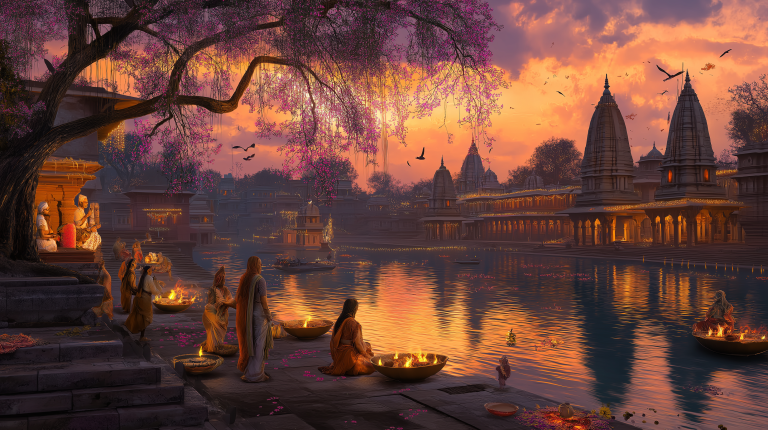
The Splendor of Ayodhya and King Dasharatha’s Rule
| Attribute | Details |
|---|---|
| Ayodhya’s Grandeur | Prosperous, free from hunger, no beggars, and filled with flourishing merchants. |
| Military Strength | Well-fortified, with a disciplined army led by valiant generals, ensuring peace and safety. |
| Cultural Flourishing | Patronage of arts, thriving musicians, and reverent Vedic scholars worshiping the ritual fire. |
| Dasharatha’s Virtues | A learned king, protector of dharma, and a just ruler who cared for his people as a father cares for his children. |
Dasharatha’s court was filled with wise ministers and learned sages who assisted him in governance and rituals. His ministers, including Sumantra, Dhristi, and Surashtra, provided astute counsel. The revered sages Vasishta and Vamadeva guided him spiritually, assisted by other eminent Brahmanas like Kashyapa, Markandeya, and Jabali.
The King’s Sorrow: A Desire for Heirs
Despite his unmatched rule and wealth, Dasharatha’s heart was weighed down by a profound sorrow-he had no children to continue his lineage. According to the scriptures, a man without progeny could not hope to ascend to the blessed realms of his ancestors, and the King yearned for sons to secure his spiritual and royal legacy.
| Theme | Parallels in Mythology |
|---|---|
| Childlessness | Similar to King Janaka, who found Sita during a yagna to overcome his own childlessness. |
| Heirs and Dharma | Reflects the Vedic importance of progeny for continuing dharma and securing liberation (moksha). |
In solitude, Dasharatha resolved to perform the Ashwamedha – The Horse Sacrifice Yagna, a grand Vedic horse-sacrifice, to seek divine blessings for children. Calling his council of ministers, he shared his decision.
Dasharatha’s Address to His Council
Gathering his trusted advisors, Dasharatha spoke:
“I am growing old, and the one wish of my heart remains unfulfilled-I have no son to succeed me. Despite daily prayers, my queens remain childless. I have resolved to perform the Ashwamedha Yagna to seek blessings for progeny. What are your thoughts on this?”
The council unanimously approved. Sage Vasishta assured him:
“This is an auspicious decision, O King. Let the ritual begin without delay. A suitable horse shall be chosen and released as the sacrificial horse. The ritual hall shall be built on the northern bank of the sacred Sarayu River, ensuring divine blessings.”
Dasharatha expressed concern over the complexities of the ritual:
“This Yagna is no ordinary undertaking. The Brahma Rakshasas, ever vigilant for errors, will seek to disrupt it. Even the smallest irregularity could result in my ruin as the Yajaman (sacrificer). Let utmost care be taken to ensure its flawless execution.”
Sumantra’s Counsel: The Prophecy of Rishyashringa – Deer born Sage
Minister Sumantra rose and said:
“Sire, with Sage Vasishta’s guidance, the Yagna’s success is certain. However, I must recount a prophecy by Sanat Kumara, the divine sage. He foretold that you would have sons when Rishyashringa, son of Sage Vibhandaka – Father of Rishyashringa, conducts the Ashwamedha sacrifice. Rishyashringa currently resides in the kingdom of Anga, as a guest of its king, his father-in-law. If you invite him as your Ritwik (chief priest), your wish for progeny will surely be fulfilled.”
Curious, Dasharatha asked:
“Who is Rishyashringa? How was he born, and how did he become the son-in-law of the King of Anga?”
The Legend of Rishyashringa
Sumantra narrated the tale:
Long ago, the great sage Vibhandaka, immersed in penance, was momentarily distracted by the celestial Apsara Urvashi. Their union resulted in the birth of Rishyashringa, who was born with a deer-like horn on his forehead, signifying his divine origins.
Determined to shield his son from worldly distractions, Vibhandaka raised Rishyashringa in isolation, far from society and especially women. Rishyashringa grew up unaware of human civilization, immersed in meditation and ascetic practices.
Meanwhile, in the neighboring kingdom of Anga, a severe drought afflicted the land due to King Lomapada’s neglect of dharma. The sages advised that the presence of a pure ascetic like Rishyashringa would bring rain to the parched kingdom.
| Aspect of Legend | Details |
|---|---|
| Vibhandaka’s Asceticism | Mirrors the dedication of sages like Vishwamitra – The King Who Became a Great Sage and Vasishta. |
| Rishyashringa’s Purity | Parallels the transformative power of Parvati’s penance in restoring balance to creation. |
To bring Rishyashringa to Anga, Lomapada sent skilled courtesans to his hermitage. Using charm and wit, they introduced him to worldly pleasures and eventually brought him to Anga, where his presence ended the drought. Grateful, Lomapada offered his daughter Shanta in marriage to Rishyashringa.
Dasharatha’s Resolve
Though peace reigned in Ayodhya, fate would soon take a turn through the scheming of palace attendants like Manthara – Evil Hench-woman of Kaikeyi, whose actions would later change the course of the royal lineage.
Hearing the tale, Dasharatha declared:
“I shall personally visit Anga to invite Rishyashringa as the Ritwik for my Ashwamedha Yagna. It will also be an opportunity to strengthen bonds with King Lomapada, my relative.”
Preparations began immediately for Dasharatha’s journey to Anga. The royal entourage was readied, and the kingdom buzzed with anticipation.
Connections to Hindu Mythology
The Ashwamedha Yagna and the legend of Rishyashringa are deeply interwoven with the themes of cosmic balance, divine intervention, and the cyclical nature of dharma.
| Aspect | Connections |
|---|---|
| Ashwamedha Yagna | A symbol of sovereignty, performed by Rama after defeating Ravana to restore cosmic order. |
| Rishyashringa’s Legend | Highlights the power of penance, akin to the austerities of sages like Vishwamitra and Parvati. |
| Dasharatha’s Childlessness | Parallels King Janaka, who found Sita while performing a ritual to overcome his own childlessness. |
Themes and Legacy
- Dharma and Cosmic Order: Dasharatha’s desire for progeny aligns with the Vedic emphasis on lineage and the continuation of dharma.
- Penance and Purity: The story of Rishyashringa underscores the transformative power of asceticism, a recurring theme in Hindu mythology.
- Divine Intervention: The prophecy and involvement of Rishyashringa reflect the constant interplay of divine forces in mortal affairs.
Dasharatha’s journey to Anga marks the beginning of a series of events that would lead to the birth of Rama, the seventh avatar of Vishnu, destined to restore balance to the world and uphold dharma.
Dasharatha’s journey to Anga marks the beginning of a series of events that would lead to the birth of Rama, the seventh avatar of Vishnu. These events are richly detailed in the epic narrative of the Ramayana, a cornerstone of Hindu mythology that chronicles Rama’s divine mission to restore dharma.
Next Chapter: Dasharatha meets Rishyashringa and begins the preparations for the grand Ashwamedha Yagna.
These themes are explored in greater depth across the following authoritative resources: External resources for further reading. Apam Napat is not affiliated with these publishers; citation does not imply endorsement.Sources & further reading
Frequently asked questions
Who was King Dasharatha?
Why was Ayodhya considered grand under Dasharatha?
Why was Dasharatha sorrowful despite his great rule?
What ritual did Dasharatha decide to perform for sons?
Which sages guided King Dasharatha?
Based on the classical texts of Hindu mythology, see our sources.