
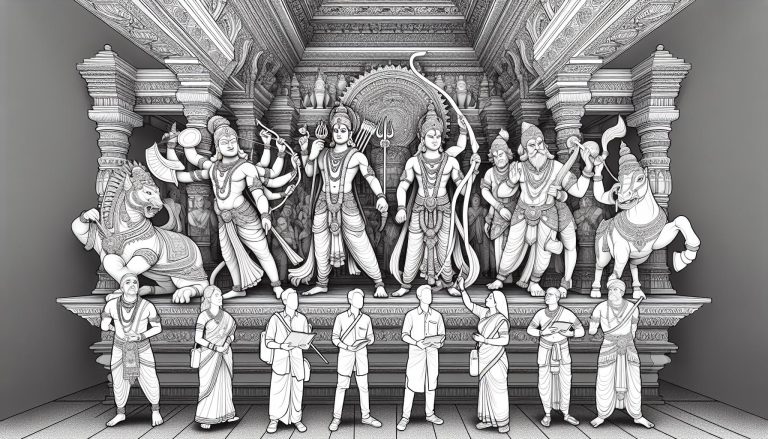
I find it fascinating how these stories not only entertain but also offer profound lessons on duty, righteousness, and the eternal struggle between good and evil. Understanding the purpose behind Vishnu’s avatars can give us deeper insights into Hindu philosophy and the timeless values that continue to resonate today.
The Concept Of Vishnu’s Avatars
In Hinduism, particularly Vaishnavism, Vishnu’s avatars play a crucial role in maintaining cosmic balance. Each avatar, from the mighty Rama to the wise Krishna, embodies specific qualities and missions. These incarnations of Vishnu come to Earth to address various forms of imbalance or evil.
Restoring Dharma: Vishnu’s primary goal is to restore Dharma, or righteousness. When chaos and evil threaten to overpower goodness, Vishnu incarnates to set things right. As stated in the Bhagavad Gita, Vishnu promises to protect the virtuous and annihilate the wicked, ensuring that righteousness prevails.
Combating Evil Forces: Many avatars directly engage with and defeat evil forces. Rama’s epic battle with Ravana and Krishna’s pivotal role in the Mahabharata – The Great Epic’s Kurukshetra battle are prime examples. These stories highlight how Vishnu’s avatars combat and dismantle malicious entities, ensuring peace and order.
Protection Of The Earth: Vishnu’s incarnations also focus on safeguarding the Earth and its denizens. By intervening during critical moments of history, these avatars prevent the destruction of the world. This protective aspect is integral to Vishnu’s role as the preserver deity, as seen in stories like Krishna’s lifting of Govardhan Hill to protect villagers from torrential rains.
By understanding the concept of Vishnu’s avatars, we gain deeper insights into Hindu philosophy. These divine manifestations teach us the importance of righteousness, the necessity to combat evil, and the commitment to protecting all living beings.
The Dashavatara: Vishnu’s Ten Principal Avatars
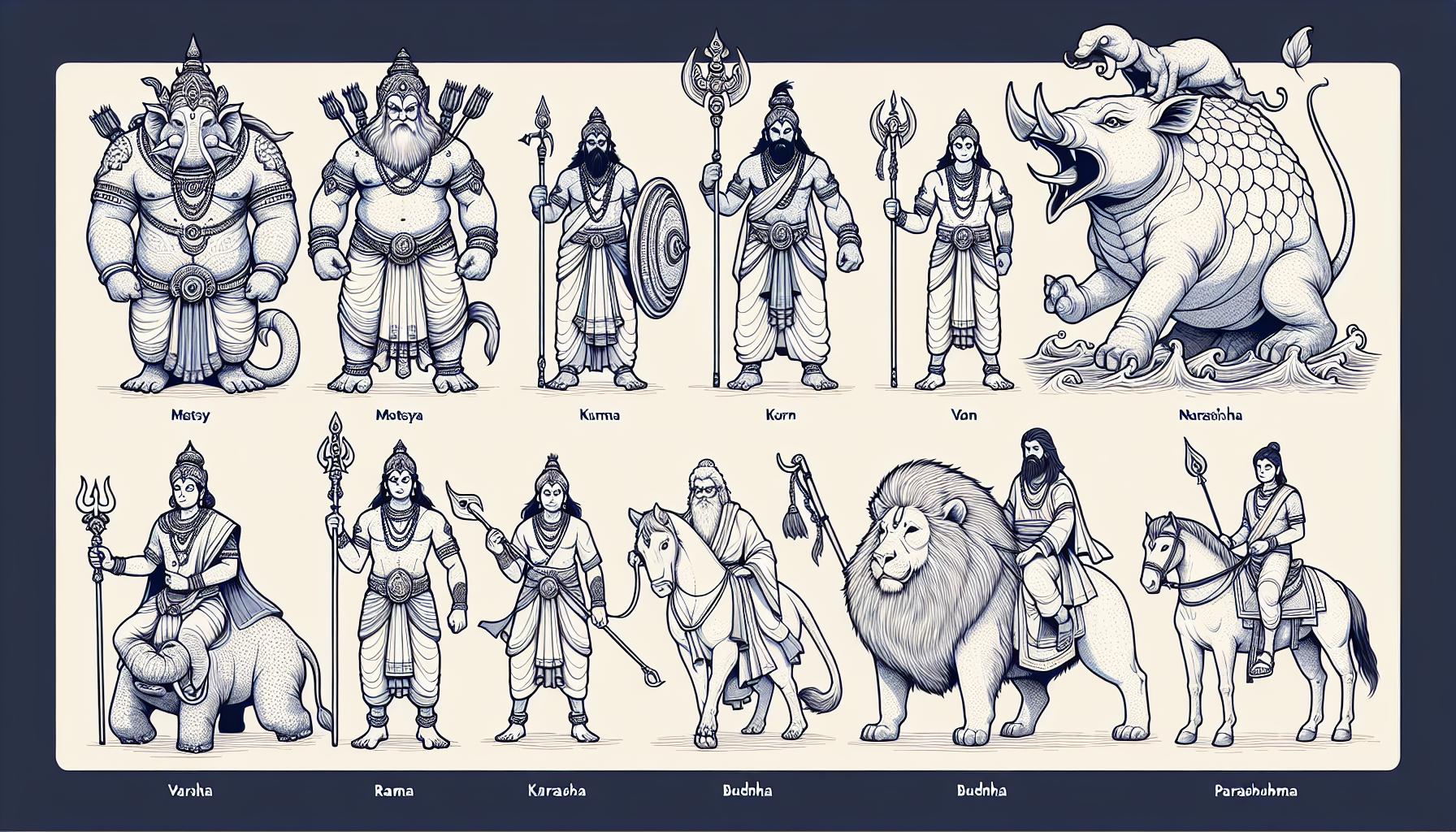
Vishnu’s ten principal avatars, collectively known as the Dashavatara, play crucial roles in restoring cosmic order. Each avatar appears at pivotal moments to protect righteousness and combat evil.
Matsya: The Fish
The first avatar, Matsya, rescued Manu, the first man, from a great deluge. Depicted as a giant fish or a half-human, half-fish figure, Matsya saves the sacred texts and helps re-establish life on Earth.
Kurma: The Tortoise
Kurma, the second avatar, supports Mount Mandara during the churning of the Ocean of Milk, enabling the gods to obtain the nectar of immortality. Kurma’s stability ensures the continuation of divine and cosmic balance.
Varaha: The Boar
Varaha, the third avatar, battles the demon Hiranyaksha to restore the Earth to her rightful place. Taking the form of a boar, Varaha’s victory secures the planet’s safety, demonstrating Vishnu’s protective nature.
Narasimha: The Man-Lion
Narasimha, the fourth avatar, combines human and lion features to defeat the demon Hiranyakashipu. This form, neither entirely human nor animal, bypasses the boon protecting the demon, ensuring justice’s triumph.
Vamana: The Dwarf
The fifth avatar, Vamana, appears as a dwarf brahmin to subdue the demon-king Bali. By expanding his form to cover the universe in three strides, Vamana reclaims celestial realms for the gods, illustrating strategic wisdom.
Parashurama – Rama of the Axe: The Warrior With An Axe
Parashurama, the sixth avatar, wields an axe to eliminate corrupt kshatriyas (warriors). As a brahmin warrior, Parashurama’s actions renew ethical governance, emphasizing the importance of righteousness in leadership.
Rama: The Prince Of Ayodhya
The seventh avatar, Rama, embodies virtue and honor. His epic battle against the demon king Ravana, recounted in the Ramayana, underscores the victory of good over evil and the importance of dharma (duty).
Krishna: The Divine Statesman
Krishna, the eighth avatar, is pivotal in the Mahabharata. With roles as a charioteer, guide, and divine diplomat, Krishna’s teachings in the Bhagavad Gita highlight devotion, duty, and the path to spiritual liberation.
Buddha: The Enlightened One
In the ninth avatar, Vishnu incarnates as Buddha to promote non-violence and compassion. Buddha’s teachings reform spiritual practices, steering beings towards enlightenment and ethical living.
Kalki: The Future Warrior
Kalki, the prophesied tenth avatar, is expected to appear at the end of the current age (Kali Yuga). Riding a white horse and wielding a sword, Kalki will eradicate evil and restore global harmony and virtue.
Common Themes And Purposes Among The Avatars

Vishnu’s avatars share common themes and purposes that emphasize the preservation of cosmic balance and the protection of devotees. These divine incarnations of Vishnu reveal purposeful actions in guiding the universe towards righteousness.
Preservation Of Dharma
The primary role of Vishnu’s avatars is to restore dharma when it’s threatened by evil forces. Each avatar embodies specific qualities and actions to counteract chaos and reinstate cosmic order. For instance, Krishna, the eighth avatar, played a key role in the Mahabharata by guiding Arjuna and ensuring the victory of righteousness over injustice. These avatars emerge when evil forces disrupt harmony, ensuring the universe continues to exist in balance.
Protection Of Devotees
Vishnu’s avatars also focus on protecting and guiding devotees. They often intervene directly to save them from danger or injustice. Narasimha, the fourth avatar, demonstrates this by protecting his devotee Prahlada from the demon king Hiranyakashipu. Such interventions signify the divine commitment to safeguarding those who uphold righteousness and display unwavering devotion.
Restoration Of Cosmic Order
Vishnu’s avatars work tirelessly to restore the natural order disturbed by malevolent forces. By addressing threats to cosmic balance, they ensure the universe remains in harmony. For example, Rama, the seventh avatar, defeated the demon king Ravana to restore peace and moral order. Each avatar thus contributes uniquely to maintaining the equilibrium of the cosmos.
The Symbolic Interpretation Of Vishnu’s Avatars
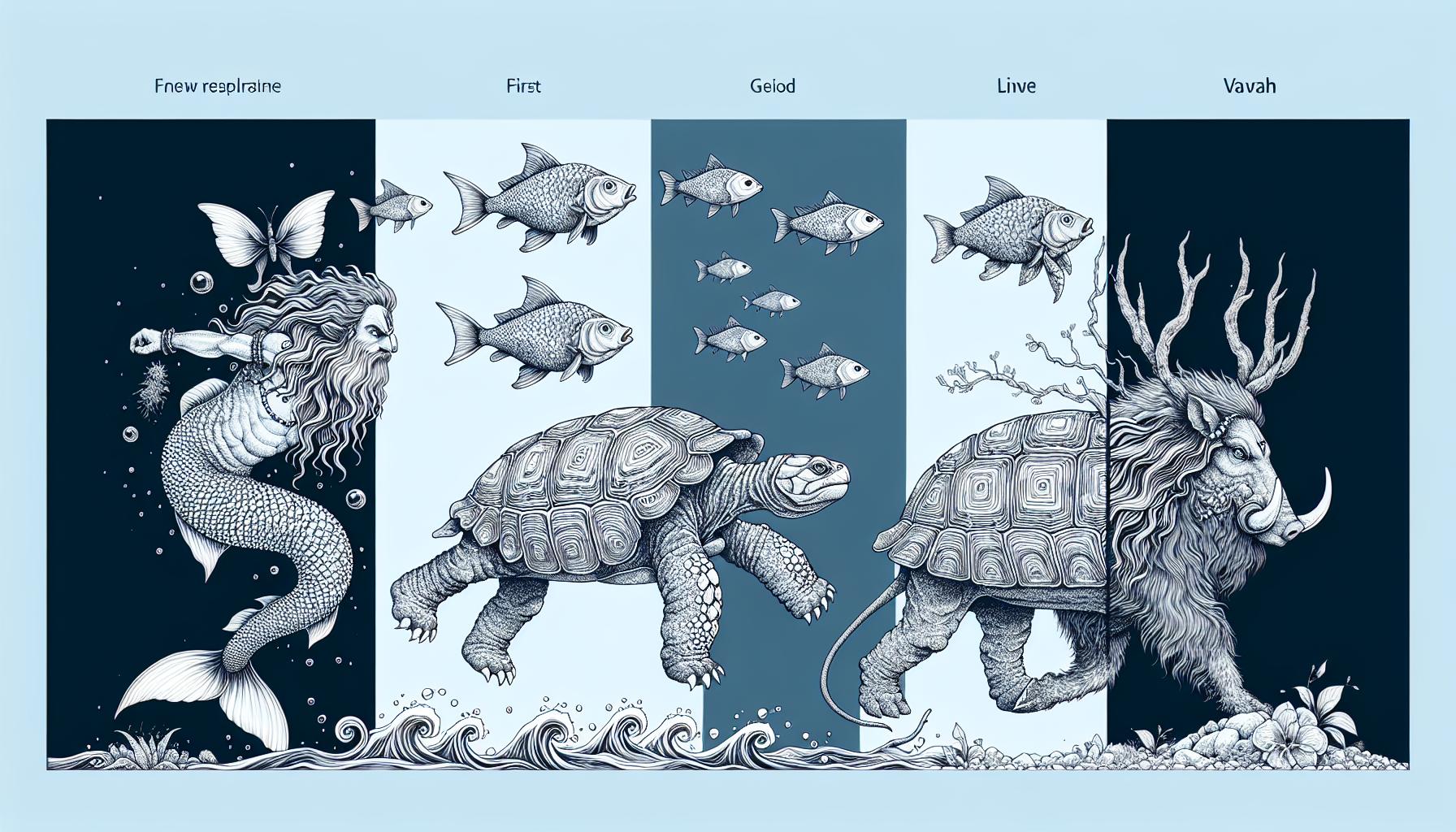
Vishnu’s avatars symbolize deep, multi-layered meanings in Hindu mythology. Each manifestation carries evolutionary, spiritual, and moral significance.
Representation Of Evolution And Progress
Vishnu’s avatars follow an evolutionary path reflecting the progression of life forms. Matsya, the fish, represents the dawn of life in water. Koorma, the tortoise, marks humanity’s move from aquatic to terrestrial life. Varaha, the boar, embodies the development of surface-dwelling creatures. This sequence shows the continuous advancement in the evolutionary scale, mirroring natural history.
Spiritual And Moral Lessons
Every avatar also imparts crucial spiritual and moral teachings. Matsya’s rescue of Manu from the great flood underscores the duty to preserve life and order. In Koorma’s narrative, the churning of the ocean for divine nectar highlights the eternal struggle between good and evil forces. Varaha’s act of saving the Earth from submersion emphasizes the fight against chaos. These stories promote righteousness, the battle against injustice, and the need to protect cosmic harmony.
Cultural And Religious Significance
Vishnu’s avatars hold immense cultural and religious significance within Hinduism. They embody divine intervention, symbolizing the eternal fight between good and evil. Each avatar represents Vishnu’s commitment to restoring cosmic balance and upholding Dharma.
Festivals and Celebrations
Festivals in honor of Vishnu’s avatars are celebrated with enthusiasm across India. Rama Navami marks the birth of Rama, while Krishna Janmashtami celebrates Krishna’s birth. These festivals highlight the cultural importance of these deities, drawing millions of devotees who engage in rituals, fasts, and prayers.
Temples and Pilgrimages
Numerous temples across India are dedicated to Vishnu’s various incarnations. The Jagannath Temple in Puri honors Jagannath, an avatar of Vishnu. Pilgrimages to these sacred sites emphasize the reverence of Vishnu’s avatars. Devotees believe visiting these temples strengthens their spiritual connection.
Art and Literature
Vishnu’s avatars inspire rich artistic and literary traditions in Hindu culture. Epic texts like the Mahabharata and Ramayana narrate the adventures and teachings of Krishna and Rama. Sculptures, paintings, and dance forms frequently depict scenes from these epics, illustrating their enduring influence on Indian art.
Moral and Ethical Guidance
The teachings by avatars like Krishna and Rama provide moral and ethical guidance to followers. Krishna’s discourse in the Bhagavad Gita and Rama’s adherence to Dharma in the Ramayana offer lessons in righteousness and duty. These teachings continue to shape the values and conduct of millions of Hindus.
Symbolism in Modern Context
Vishnu’s avatars also find relevance in contemporary times. They symbolize the timeless struggle for justice and the need for righteous leadership. Figures in modern movements often draw parallels to Vishnu’s avatars, embodying principles of sacrifice, wisdom, and moral integrity.
The roles performed by Vishnu’s avatars in Hindu mythology extend beyond religious beliefs, permeating various aspects of cultural, ethical, and societal structures. From festivals to modern symbolism, they maintain their integral position in Hindu cultural heritage.
Conclusion
Exploring Vishnu’s avatars reveals their timeless relevance and profound impact on Hindu culture and spirituality. These divine manifestations serve as powerful symbols of righteousness and moral integrity, guiding us through life’s complexities. By understanding the virtues and lessons each avatar embodies, we gain valuable insights into maintaining balance and justice in our own lives. Vishnu’s avatars not only enrich our cultural heritage but also offer enduring wisdom that resonates across generations.
Sources & further reading
These themes are explored in greater depth across the following authoritative resources:
- Encyclopaedia Britannica, Hindu Mythology
- Internet Sacred Text Archive, Hinduism
- Mythopedia, Hindu Mythology
- Harvard Pluralism Project, Hindu Tradition
- Wendy Doniger, The Hindus: An Alternative History (Penguin, 2009), ISBN 978-0143116691
External resources for further reading. Apam Napat is not affiliated with these publishers; citation does not imply endorsement.
Based on the classical texts of Hindu mythology, see our sources.