
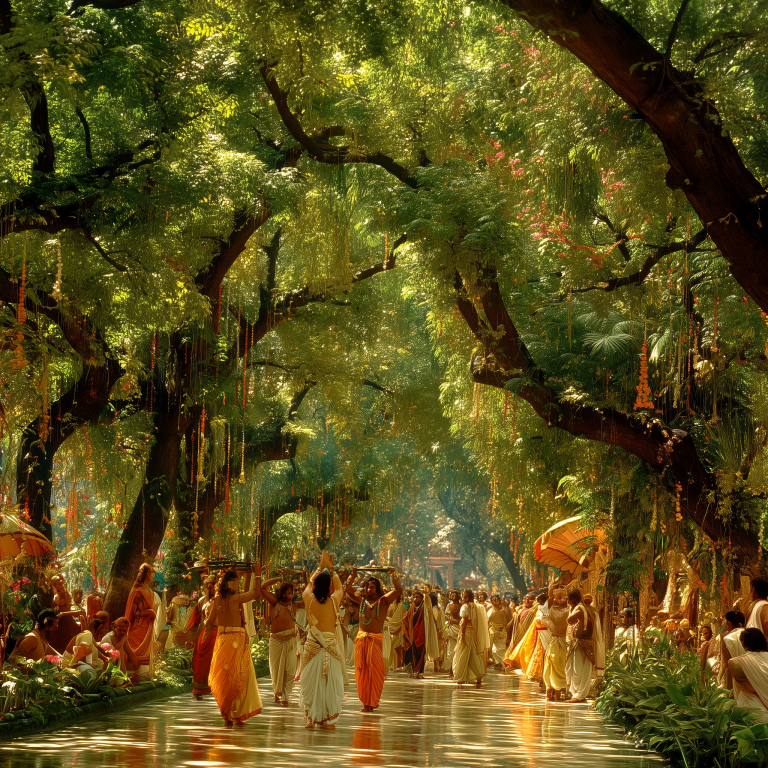
The Hall of Maya and the Path to the Rajasuya Yagna
The Debt of Maya to Arjuna and Krishna
The story begins in the aftermath of the burning of the Khandava forest, where Maya, the Asura architect, was saved by Arjuna – The Peerless Archer and Krishna (Vasudeva) from being consumed in the inferno. Arjuna, the embodiment of Kshatriya dharma, and Krishna, often guiding destiny through his divine form, acted in selfless harmony. Maya expressed his gratitude with an offer of gifts and services:
| Maya’s Offer | Arjuna’s Response |
|---|---|
| Wealth, weapons, or Rakshasa magical knowledge | Arjuna declined all offers for personal gain, stating it was his duty as a Kshatriya to protect those seeking refuge. He asked Maya to serve Krishna instead. |
Krishna, recognizing an opportunity to enhance the grandeur of Indraprastha, requested Maya to construct a magnificent hall for Yudhishthira. This hall would later symbolize both the Pandavas’ ascent and the seeds of rivalry with the Kauravas.
Maya’s Journey and the Construction of the Hall
Maya embarked on a journey to the Mainaka Mountains, a site rich with treasures accumulated by the Danavas. His artistic mastery echoes the divine architecture of Vishwakarma – The Architect of the Devas and the celestial creativity tied to many of Vishnu’s avatars and their unique characteristics, where divine power manifests through form and function. He retrieved precious materials and celestial artifacts, including:
| Artifact | Significance |
|---|---|
| Devadatta (Conch) | A celestial conch, gifted to Arjuna, symbolizing his martial prowess and divine favor. |
| A Mighty Club | A weapon for Bhima, befitting his unparalleled strength and valor. |
| Gems and Precious Materials | Used to construct the hall, creating a marvel that surpassed even the palaces of the celestials. |
On an auspicious day, Maya commenced construction with the prescribed Vedic rites, using a plot measuring five thousand cubits square. The hall, completed in fourteen months, featured:
- Golden Columns: A reflection of wealth and divine artistry.
- Rakshasa Guards: Maya appointed 8,000 Kinkaras to protect the palace.
- Ingenious Devices: Intricate mechanisms and illusions designed to amaze visitors.
The Hall’s Inauguration
The hall’s completion was marked with a grand ceremony. Yudhishthira, accompanied by his brothers, entered the palace amidst Vedic hymns led by their chief priest Dhaumya. Gifts were distributed to the Brahmanas, and allied kings gathered to witness the spectacle. Seated on his throne, Yudhishthira radiated a divine aura, reminiscent of Indra in his celestial court at Amravati.
Narada’s Visit and Counsel
The celestial sage Narada arrived at Indraprastha to see the famed hall and offer counsel to Yudhishthira. After receiving hospitality befitting his stature, Narada shared:
Statecraft and Governance
The sage Narada’s role as a cosmic guide is central not only in the Mahabharata but also across Puranic stories, where he helps shape destiny through wisdom, provocation, and divine intervention:
| Topic | Key Insights |
|---|---|
| Taxation | Taxes must be just and used for the welfare of the subjects. |
| Appointing Officials | Competent and trustworthy officials are essential for the smooth functioning of a kingdom. |
| Arts and Sciences | Patronizing arts and sciences ensures cultural and intellectual growth. |
| Guarding Against Coups | A king must remain vigilant against internal conspiracies and external threats. |
| Spies and Intelligence | Employing skilled spies is crucial to preempt and neutralize disturbances before they escalate. |
Praise for the Hall
Narada declared Yudhishthira’s hall unparalleled, comparing it to the celestial assembly halls:
| Hall | Description |
|---|---|
| Indra’s Hall (Amravati) | Grand but lacked the artistic mastery of Maya’s creation. |
| Yama’s Hall | Shone with golden splendor but was less intricate. |
| Varuna’s Hall | The floating Pushakaramalini, though grand, was not as exquisite. |
| Kubera’s Hall | Reflected immense wealth but lacked the harmonious beauty of Maya’s hall. |
| Brahma’s Hall | Majestic, with the presence of the Prajapatis, but could not rival the craftsmanship of the Pandavas’ hall. |
Narada’s Prophecy and the Rajasuya Yagna
Yudhishthira, humbled by Narada’s praise, inquired about his father Pandu. Narada revealed:
- Pandu’s Location: He resided in the hall of Yama rather than Indra’s court.
- Reason: Kings who die in battle or perform the Rajasuya Yagna earn a place in Indra’s court.
Narada advised Yudhishthira to perform the Rajasuya Yagna to elevate his father’s status and solidify his own as the Emperor. However, he warned:
- The ritual would be exceedingly challenging.
- Brahma Rakshasas (malevolent spirits) would likely attempt to disrupt it.
Foreshadowing of Conflict
The hall, a symbol of the Pandavas’ glory, would later become a site of humiliation during the dice game orchestrated by Shakuni. Its magnificence stoked Duryodhana’s jealousy, contributing to the enmity that led to the Kurukshetra war.
Connections to Hindu Mythology
| Theme | Related Stories |
|---|---|
| Divine Architecture | Vishwakarma’s construction of celestial palaces parallels Maya’s craftsmanship for the Pandavas. |
| Rajasuya Yagna | Echoes the yagnas performed by kings like Harishchandra and Rama as depicted in Valmiki’s Ramayana, symbolizing dharma and sovereignty while underlining the sacrificial role of righteous rulers. |
| Narada as a Guide | Narada’s role mirrors his advice to Dhruva, Prahlada, and other devotees seeking spiritual or worldly success. |
| Kshatriya Duty | Arjuna’s selfless protection of Maya aligns with the dharma of warriors in protecting the defenseless. |
Legacy of Maya’s Hall
The hall’s construction marked the zenith of the Pandavas’ power, symbolizing their dharma and glory. It also foreshadowed the tragedy of their exile and the war that would engulf Bharatavarsha.
This chapter serves as a reminder of the impermanence of material grandeur and the enduring relevance of dharma, statecraft, and humility in navigating the trials of life.
Sources & further reading
These themes are explored in greater depth across the following authoritative resources:
- Britannica, Asura
- Britannica, Naga
- Mythopedia, Hindu Mythology
- Internet Sacred Text Archive, Mahabharata
- Wendy Doniger, Hindu Myths (Penguin Classics, 1975)
External resources for further reading. Apam Napat is not affiliated with these publishers; citation does not imply endorsement.
Based on the classical texts of Hindu mythology, see our sources.