
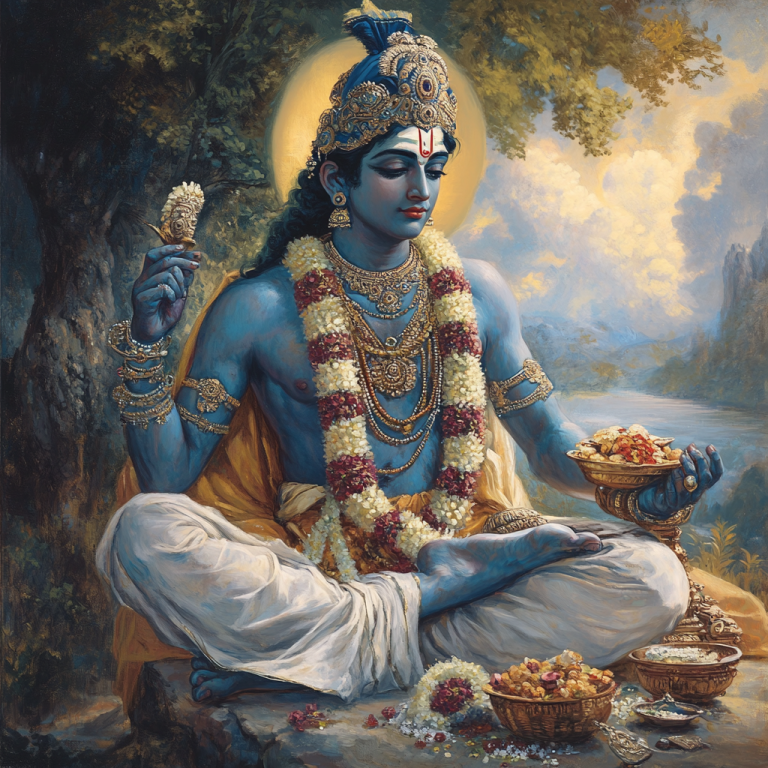
Expanded Proclamation: The Burning of Khandava Forest
While Krishna was staying in Indraprastha, a Brahmana approached Arjuna and Krishna. This Brahmana radiated an otherworldly appearance-his body glowed like molten gold, his tawny beard shimmered, and his bright eyes emitted a fiery intensity. Addressing the two companions, he said, “No matter what I do, my hunger remains unquenched. I feel only you two can provide the sustenance I need to be satiated.”
The Brahmana’s Request Revealed
| Character | Role/Significance | Mythological Connections |
|---|---|---|
| The Brahmana | Disguised form of Agni, the Fire God | Agni is one of the five elements (Pancha Mahabhuta), representing energy and transformation. |
| Krishna | Incarnation of Vishnu, the preserver | Central figure in the Mahabharata – The Great Epic and a guide to Arjuna. |
| Arjuna | A Pandava prince, known as Nara | Nara-Narayana are incarnations of Vishnu to protect dharma. |
Arjuna, the embodiment of the ideal Kshatriya warrior, bound by honor and duty, responded immediately, “I have sworn to help anyone with a legitimate request. Tell me what sustenance you seek, and I shall arrange it. You shall not go hungry any longer.” The Brahmana revealed himself to be Agni, stating, “It is my nature to burn, but Indra’s protection of Takshaka, the serpent king, prevents me from consuming the Khandava Forest, my apportioned food. Indra commands rainclouds like Pushkala and Avartaka to quench my flames, leaving me weakened and in anguish.”
Agni’s Hunger and Arjuna’s Preparation
Agni’s predicament mirrored earlier tales of his vulnerability, such as his sickness after consuming excessive offerings during King Swetaki’s yagna. His ailment, described in the Mahabharata, symbolized the balance needed in cosmic duties. Agni’s request tested Arjuna and Krishna’s resolve against celestial forces.
When Krishna is preparing:
Krishna, also known as Vasudeva – The Father of Krishna, assumed his Sudarshana – Ancestor of Rama Chakra, the divine discus used by Vishnu in battles against cosmic forces like Madhu and Kaitabha.
Arjuna pledged, “With Krishna by my side, I will protect you. However, to contend with Indra, I require weapons of divine origin. Provide me a bow that matches the speed of my arrows and a swift chariot. Krishna too will need weapons befitting his divine stature.”
Agni sought help from Varuna, who presented the Gandiva bow and a divine chariot to Arjuna. Krishna assumed his Sudarshana Chakra, a weapon once wielded by Vishnu to annihilate demons like Madhu-Kaitabha.
The Battle and Divine Resistance
When Agni set the forest ablaze, chaos ensued. The Khandava Forest, home to myriad creatures, became a battleground. Birds and animals tried to escape the flames, but Arjuna’s arrows and Krishna’s precision ensured none could flee. This gory scene echoes the Samudra Manthan (churning of the ocean), where cosmic balance required destruction to extract nectar.
News reached Indra, who summoned his allies:
| Deity | Weapon | Role in Mythology |
|---|---|---|
| Indra | Vajra (thunderbolt) | King of the Devas, protector of dharma. |
| Yama | Mace | God of death and dharma. |
| Varuna | Noose | God of water, connected to universal law (Rta). |
| Kubera | Club | God of wealth, guardian of the north. |
| Rudra (Shiva) | Trident (Trishula) | The destroyer, embodying cosmic dissolution. |
Despite their collective power, Krishna and Arjuna prevailed. Arjuna’s mastery of divine Astras countered Indra’s might, while Krishna, the Supreme Being, outmatched every celestial strategy. Wielding the mighty Gandiva bow, Arjuna unleashed a volley of arrows that countered the might of the Devas, standing unshaken amidst the storm of divine weapons.
Takshaka’s Escape and Maya’s Survival
Among the few survivors, Asvasena, Takshaka’s son, escaped with his mother. Arjuna, angered by their evasion, killed Takshaka’s wife with his arrows. Meanwhile, the Asura architect Maya, seeking sanctuary, was spared under Arjuna’s protection. Maya’s gratitude culminated in the construction of the Maya Sabha, the grand assembly hall of the Pandavas.
Mandapala and the Saranga Birds
The survival of the Saranga birds is a poignant subplot tied to themes of dharma and karma:
| Entity | Role/Significance |
|---|---|
| Mandapala | Sage who reincarnated as a Saranga bird to achieve progeny and salvation. |
| Jaritha and Lapitha | His wives; represent devotion, conflict, and maternal sacrifice. |
| Agni | Spared the young birds in response to their devotion and hymns. |
The Saranga chicks, unable to fly, meditated upon Agni, offering hymns of praise. This act mirrors ancient Vedic traditions where devotion and clarity of thought appeased even the most destructive deities.
Conclusion and Broader Connections
Agni, now satiated, blessed Arjuna and Krishna, allowing them to keep the divine weapons and chariot. This episode highlights the interconnectedness of dharma, cosmic duties, and divine intervention. Their hymns reflected deep devotion and wisdom, akin to the philosophical insights found in the story of Nachiketa – The Boy Who Obtained the Secrets of Death, who confronted Yama to understand the secrets of life and death. The burning of Khandava parallels events like:
- The burning of Lanka by Hanuman, which marked the turning point in the Ramayana.
- The destruction of Tripura (Tripurantaka) by Shiva, symbolizing the balance between creation and destruction.
The Adhi Parva concludes with lessons on devotion, sacrifice, and the inevitability of change, setting the stage for the Pandavas’ rise in the Mahabharata.
Prev | Next
Sources & further reading
These themes are explored in greater depth across the following authoritative resources:
- Internet Sacred Text Archive, Rig Veda (Griffith translation)
- Internet Sacred Text Archive, Upanishads
- Britannica, Veda
- Britannica, Upanishad
- Patrick Olivelle, The Early Upanishads (Oxford University Press, 1998)
External resources for further reading. Apam Napat is not affiliated with these publishers; citation does not imply endorsement.
Based on the classical texts of Hindu mythology, see our sources.