
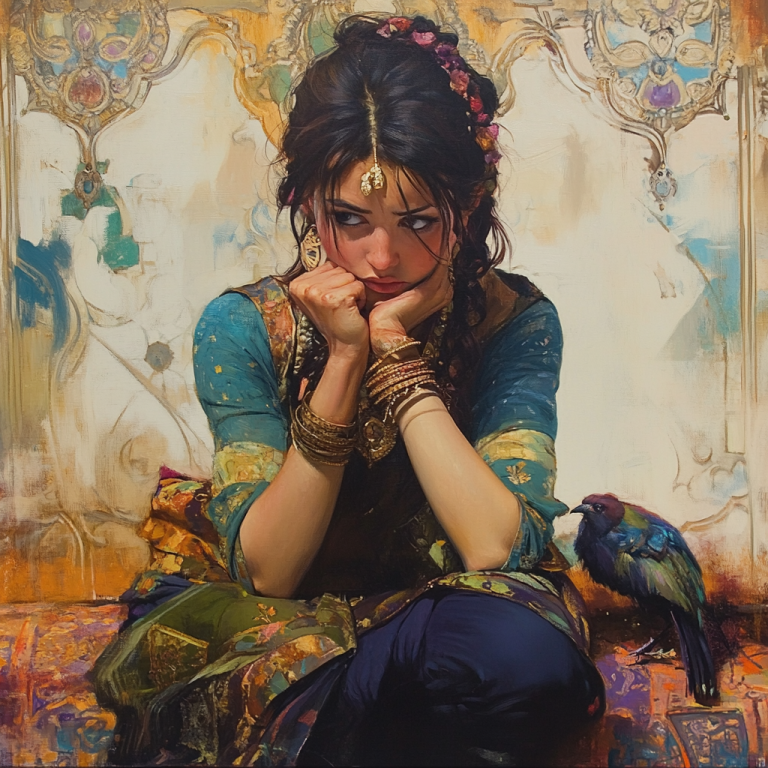
Tara – The Wife of Brihaspati – The Guru of the Devas and Her Role in Hindu Mythology
Tara, the celestial consort of Brihaspati, the guru of the Devas, occupies a pivotal and controversial place in Hindu mythology. Known for her intelligence and beauty, she bore Brihaspati seven sons and a daughter, contributing to the spiritual and cosmic lineage of the Devas. However, her life took a tumultuous turn when she became involved with Chandra – The Moon, the radiant moon god. This relationship, while fraught with conflict, resulted in the birth of Budha, a significant figure in Vedic astrology and Hindu mythology.
Tara and Brihaspati: A Divine Partnership
As the wife of Brihaspati, Tara held a revered position in the celestial hierarchy. Brihaspati, the preceptor of the Devas, symbolizes wisdom, discipline, and spiritual authority-traits reflected in the structure of cosmic law and sacred counsel.
Children of Tara and Brihaspati
Tara bore Brihaspati seven sons and one daughter, each of whom contributed to the divine order in various ways. While their names are less emphasized in mythology, their existence highlights the importance of Tara’s role as a progenitor of the celestial lineage.
| Role | Significance |
|---|---|
| Consort of Brihaspati | Symbolized the union of wisdom (Brihaspati) and intelligence (Tara). |
| Mother of Celestial Beings | Ensured continuity of the divine lineage through her offspring. |
Adultery with Chandra
Tara’s involvement with Chandra (Soma), the moon god, forms one of the most debated and dramatic episodes in Hindu mythology. Known for his luminous beauty and charm, Chandra’s actions challenged the boundaries of divine decorum. This act led to a major celestial conflict, as Brihaspati demanded her return. Chandra, however, refused to relinquish her, asserting his love for her and her consent to stay with him.
This dispute escalated into a battle between the Devas, with factions forming in support of Brihaspati and Chandra. The turmoil highlighted the tensions and interpersonal dynamics among the celestial beings.
Intervention of Brahma – The Creator
The conflict reached its zenith when Lord Brahma, the creator of the universe, intervened. As the arbiter of cosmic order, Brahma admonished Chandra for disrupting the harmony of the celestial realm. He commanded Chandra to return Tara to Brihaspati, thereby restoring order.
However, during the resolution, it was revealed that Tara was pregnant. When pressed to reveal the father of her child, Tara initially hesitated but eventually confessed that the child was Chandra’s. The child, named Budha, was acknowledged as Chandra’s son and became a significant figure in his own right.
| Event | Significance |
|---|---|
| Abduction of Tara | Represents the tension between desire and duty among celestial beings. |
| Brahma’s Intervention | Ensured the restoration of cosmic balance and resolved the dispute. |
Budha: The Child of Tara and Chandra
The son of Tara and Chandra, Budha, grew to become an important deity in Hindu mythology and Vedic astrology. Known for his intelligence, eloquence, and wisdom, Budha symbolizes the union of intellect and charm inherited from his parents. He is revered as the deity of the planet Mercury in Hindu astrology and governs aspects such as communication, logic, and commerce.
Budha’s Marriage to Ila
Budha’s marriage to Ila, a unique figure in mythology who alternated between male and female forms, adds further depth to his story. This union gave rise to the Chandra Vamsha (Lunar Dynasty), an important lineage in Hindu mythology that includes notable figures such as Pururava, Yayati – Ancestor of the Pandavas, and Krishna – An Incarnation of Vishnu.
Themes and Symbolism in Tara’s Story
| Theme | Symbolism |
|---|---|
| Desire and Consequences | Tara’s relationship with Chandra illustrates the tension between personal desire and cosmic duty. |
| Divine Justice | Brahma’s intervention underscores the importance of maintaining balance and dharma in celestial affairs. |
| Legacy through Budha | Budha’s rise to prominence reflects the transformative potential of even controversial unions. |
Connections to Other Entities and Stories
Tara’s story intersects with various prominent figures and themes in Hindu mythology, creating a rich tapestry of relationships and consequences:
| Entity/Story | Connection to Tara |
|---|---|
| Brihaspati | Tara’s husband, representing wisdom and spiritual authority, who demanded her return from Chandra. |
| Chandra (Moon God) | Tara’s lover, whose actions disrupted celestial harmony. |
| Budha | The son of Tara and Chandra, a prominent planetary deity. |
| Brahma | The mediator who resolved the conflict and restored order. |
| Ila | Budha’s spouse, whose story connects Tara’s lineage to the Chandra Vamsha. |
Broader Mythological Context
Tara’s story exemplifies the complexity of relationships and moral dilemmas in Hindu mythology. Her tale is not just a personal drama but a reflection of larger cosmic principles:
- Conflict Among Celestial Beings: The battle between Brihaspati and Chandra reveals the vulnerabilities and human-like emotions of divine figures.
- Astrological Significance: Budha’s role as Mercury connects this story to Hindu astrology, emphasizing the influence of celestial events on human destiny.
- Dharma vs. Desire: Tara’s tale highlights the eternal struggle between following one’s duty (dharma) and succumbing to personal desires.
The tale of Tara and the celestial battle it sparked echoes later epics, such as those found in the Mahabharata, where moral duty, desire, and divine intervention once again intersect to shape destiny.
Legacy of Tara
Despite her controversial role, Tara remains an integral figure in Hindu mythology, contributing to the celestial lineage and the larger narrative of cosmic order. Through her story, we see the interplay of love, duty, and divine intervention, and her legacy continues through Budha, whose influence is felt both in mythology and astrology. Tara’s tale underscores the complexities of relationships, the consequences of actions, and the enduring power of reconciliation and balance in the universe.
Sources & further reading
These themes are explored in greater depth across the following authoritative resources:
- Internet Sacred Text Archive, Rig Veda (Griffith translation)
- Internet Sacred Text Archive, Upanishads
- Britannica, Veda
- Britannica, Upanishad
- Patrick Olivelle, The Early Upanishads (Oxford University Press, 1998)
External resources for further reading. Apam Napat is not affiliated with these publishers; citation does not imply endorsement.
Based on the classical texts of Hindu mythology, see our sources.