
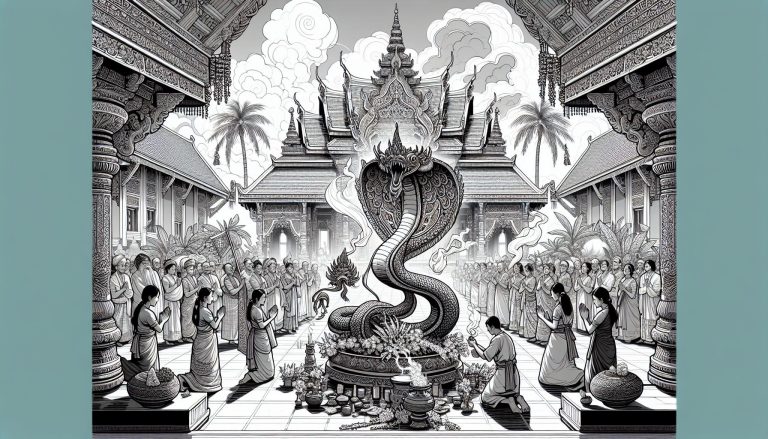
From the intricate dances to the elaborate offerings, every element of a Naga ritual holds deep significance. As I investigate into these captivating ceremonies, I’ll explore how they connect communities to their ancestral roots and the natural world. Join me on this journey to uncover the secrets and spiritual essence behind the enigmatic Naga serpent rituals.
Historical Roots Of Naga Serpent Rituals
India
Hindu mythology describes Nāgas as semidivine beings, half human and half cobra, linked to waters, treasures, and rebirth. Female Nāgas, Nāginīs, are known for their striking beauty. In Buddhism, Nāgas often serve as door guardians or minor deities. The Nāga king Muchalinda famously sheltered the Buddha from rain during meditation. Jainism’s Tirthankara Parshvanatha is frequently depicted with a canopy of Nāga hoods above his head.
Southeast Asia
In Cambodian mythology, Nāgas play a crucial role in the origin of the Khmer people. This connection embeds the serpent rituals deeply in the region’s cultural fabric.
Cultural Significance

Naga serpent rituals hold profound cultural importance across various Asian traditions. These rituals symbolize spiritual protection, transformation, and ancestor reverence.
Symbolism Of The Naga Serpent
The Naga serpent carries multiple symbolic meanings. In Hinduism, the Naga signifies protection and fertility. It is often depicted guarding treasures or temples, embodying security and prosperity. In Buddhism, the Naga symbolizes wisdom and protection, notably shielding the Buddha during meditation. Cambodian mythology sees the Naga as the progenitor of the Khmer people, symbolizing origins and continuity.
Regional Variations In Rituals
Naga serpent rituals vary widely across regions. In India, annual festivals like Nag Panchami pay homage to the Naga, involving offerings of milk and flowers. In Thailand, the Naga Fireball Festival features glowing orbs rising from the Mekong River, believed to be manifestations of the Naga’s presence. In Cambodia, ceremonies often include dance dramas that narrate the Naga’s role in the creation of the land and its people, highlighting the depth of cultural integration.
Key Ritual Practices

Naga serpent rituals are deeply rooted in various cultural traditions, symbolizing protection, fertility, and wisdom. Key practices include Naga Panchami, Nagula Chavithi, and Manasa Puja.
Naga Panchami
Naga Panchami, a major Hindu festival, honors serpent gods. Celebrated on the fifth day of the lunar month of Shravan (July-August), participants perform rituals to seek protection and blessings. Devotees offer milk, flowers, and turmeric to snake idols or live cobras, believed to appease Naga deities. In Maharashtra, women draw images of Nagas on house walls and doors using cow dung, symbolizing reverence.
Nagula Chavithi
Nagula Chavithi, another significant serpent-worship festival, primarily takes place in Andhra Pradesh and Telangana. Celebrated in the lunar month of Kartik (October-November), devotees pray to Nagas for family well-being and protection from snakebites. Rituals include fasting, and offerings of eggs and milk to snake burrows. Women, in particular, participate in this festival to ensure their children’s safety and prosperity.
Manasa Puja
Manasa Puja, dedicated to the snake goddess Manasa in Bengal and Assam, specifically involves practices seeking fertility and prosperity. Celebrated during the monsoon season, devotees recite hymns and create clay images of Manasa and her snake entourage. Offerings include milk, fruits, and flowers set near ponds or rivers believed to be abodes of the Nagas. Folk performances and storytelling sessions depict Manasa’s legends, highlighting her significance in local folklore.
Modern Interpretations And Practices

Ancient Naga serpent rituals have evolved, finding relevance in urban settings and global contexts.
Urban Adaptations
Urban adaptations have led to the reinterpretation of Naga serpent rituals in modern cities. Rituals often integrate technology and social media, enabling virtual participation and wide outreach. For example, live streaming of rituals on social platforms allows diaspora communities to stay connected to their cultural heritage. Also, urban temples host abbreviated rituals accommodating busy city schedules without losing their essence. These practices help maintain continuity in rapidly changing environments.
Influence Of Globalization
Globalization has profoundly shaped the practice and perception of Naga serpent rituals. Exposure to diverse cultures and beliefs has fostered cross-cultural exchanges. In some cases, fusion rituals blend elements from different traditions, creating hybrid practices. For instance, Naga worship might incorporate motifs from Buddhist or local beliefs found in multicultural urban centers. Also, scholars and spiritual leaders often document and share these practices, promoting a broader understanding and appreciation of the rituals beyond their original cultural context.
Conclusion
Naga serpent rituals continue to captivate and inspire across cultures and eras. Their deep-rooted symbolism and adaptability ensure they remain relevant in modern society. As these rituals evolve they bridge ancient traditions with contemporary practices creating a rich world of cultural and spiritual expression. By embracing both historical and modern interpretations we can appreciate the enduring power and significance of the Naga serpent in our lives today.
Sources & further reading
These themes are explored in greater depth across the following authoritative resources:
- Britannica, Asura
- Britannica, Naga
- Mythopedia, Hindu Mythology
- Internet Sacred Text Archive, Mahabharata
- Wendy Doniger, Hindu Myths (Penguin Classics, 1975)
External resources for further reading. Apam Napat is not affiliated with these publishers; citation does not imply endorsement.
Frequently asked questions
Who are the Nagas in Hindu mythology?
What is Naga Panchami?
What is Nagula Chavithi?
What does the Naga symbolize in different Asian traditions?
How is the Naga connected to the Buddha?
Based on the classical texts of Hindu mythology, see our sources.