
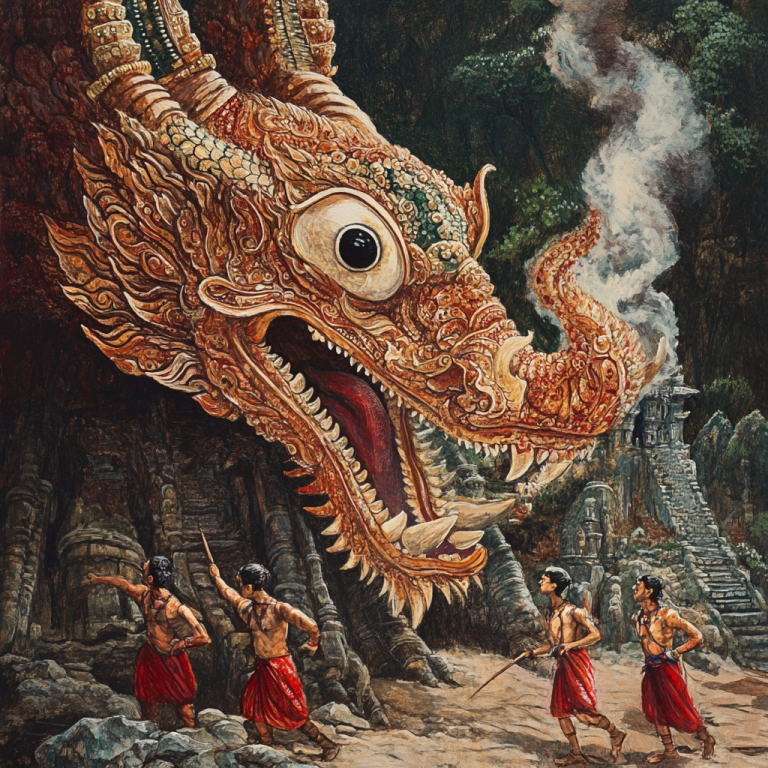
The Nagas – The Serpent Race of Hindu Mythology
The Nagas, or the serpent race, hold a prominent place in Hindu mythology and are deeply intertwined with the cosmic narrative of creation, preservation, and destruction. They are the offspring of Sage Kashyapa, a revered Prajapati – The Creators (progenitor), and Kadru, one of the daughters of Daksha Prajapati. The Nagas are known to reside in Nagaloka, an ethereal realm beneath the earth, and are associated with power, wisdom, and duality as both protectors and destroyers.
Origins and Lineage
Kashyapa, a progenitor of various life forms, had multiple wives, each representing a unique lineage of beings. Kadru, one of his wives, gave birth to the Nagas, while her sister Vinata, another wife of Kashyapa, bore Garuda, the eagle who became the mount of Lord Vishnu. This familial connection explains the deep-seated enmity between the Nagas and Garuda, as Garuda is said to have been enslaved by Kadru through a curse.
The Nagas inherited their mother’s cunning nature and their father’s divine essence, making them beings of immense power and spiritual significance.
Key Figures Among the Nagas
| Name | Role and Significance |
|---|---|
| Vasuki | A king of the Nagas, known for his pivotal role in the Samudra Manthan (Churning of the Ocean of Milk), where he served as the rope to churn Mount Mandara. |
| Takshaka | A powerful Naga who appears in the Mahabharata – The Great Epic; infamous for biting and killing Parikshit – Son of Abhimanyu, the Kuru king and grandson of Arjuna. |
| Adisesha – The Thousand Headed Serpent | The primordial serpent and the couch of Lord Vishnu, believed to hold the universe on his coils. |
| Manasa Devi | A goddess and daughter of Kashyapa and Kadru, worshipped for protection from snakebites and for fertility. |
| Ulupi | A Naga princess who married Arjuna during his exile; her son, Iravan, played a role in the Kurukshetra War. These mythological snake deities not only held power but were also revered for their divine roles across various epics. Learn more about the The Fascinating World of Naga Divine Beings: Mythology, Culture, and Modern Influence and their mythological importance. |
Nagaloka: The Realm of the Nagas
Nagaloka, also referred to as Patalaloka, is depicted as a realm beneath the earth filled with unimaginable wealth and beauty. It is said to be illuminated by the radiant gems on the Nagas’ hoods and is ruled by the Naga kings like Vasuki and Takshaka. Despite its allure, Nagaloka is also a place of exile for those who defy the divine order. It is closely associated with the domain of the Exploring Naga Snake Deities: Symbolism and Cultural Significance in Asia, who rule over its riches and spiritual mysteries.
The Nagas are known to guard vast treasures, including gems and divine secrets. Their association with both material wealth and spiritual wisdom underscores their dual nature.
The Enmity Between Garuda and the Nagas
The enmity between the Nagas and Garuda, their half-brother, stems from a curse and familial rivalry. According to mythology, Kadru tricked her sister Vinata into servitude by cursing her after winning a wager about the color of Uchchaihshravas, the divine horse. As a result, Garuda became a slave to the Nagas to fulfill his mother’s servitude.
Despite this enmity, Garuda’s connection to the Nagas is significant in cosmic events. For instance:
- Amrita Retrieval
Garuda was tasked with retrieving Amrita (the nectar of immortality) from the Devas to free his mother from Kadru’s curse. This event deepened the rivalry, as the Nagas sought Amrita for their immortality, but Garuda outsmarted them. - Role as Vishnu’s Mount
As Vishnu’s mount, Garuda often confronts the Nagas, symbolizing the eternal struggle between dharma (Garuda) and adharma (often associated with the Nagas, though not always).
Role of the Nagas in Hindu Mythology
| Epic/Text | Role of the Nagas |
|---|---|
| Mahabharata | The Nagas play a crucial role in several stories, including Takshaka’s enmity with the Pandavas and Ulupi’s marriage to Arjuna. |
| Samudra Manthan | Vasuki serves as the churning rope, enduring immense pain but playing a pivotal role in the creation of Amrita. |
| Ramayana | The Nagas’ wisdom and loyalty are highlighted; Adisesha serves as Rama’s resting place during his exile as Vishnu’s incarnation. |
| Puranas | Nagas are depicted as protectors of treasures, including sacred texts and powerful weapons. |
Connections to Other Entities and Stories
| Entity/Character | Role and Story | Connection to the Nagas |
|---|---|---|
| Kashyapa | Progenitor of the Nagas and Garuda. | Father of the Nagas through Kadru. |
| Vinata | Mother of Garuda, who becomes the Nagas’ natural enemy. | Kadru’s sister and rival; her actions set the stage for the enmity between the Nagas and Garuda. |
| Garuda | Vishnu’s mount, tasked with opposing the Nagas. | Half-brother and eternal adversary of the Nagas. |
| Parikshit | Kuru king who was killed by Takshaka, initiating Janamejaya – Son of Parikshit’s snake sacrifice. | His death highlights the destructive power of the Nagas and their role in maintaining cosmic balance. |
| Arjuna | Pandava prince who married the Naga princess Ulupi. | His alliance with Ulupi shows the Nagas’ connection to the Pandavas and their complex relationships with humans. |
Symbolism of the Nagas
The Nagas embody both protective and destructive aspects, symbolizing the duality inherent in nature and the cosmos:
| Aspect | Symbolism |
|---|---|
| Wisdom and Immortality | The Nagas are keepers of divine secrets and are often associated with immortality through their pursuit of Amrita. |
| Guardianship | As protectors of treasures and sacred spaces, they symbolize vigilance and duty. |
| Destruction and Fear | Their venom and association with death signify the inevitability of destruction as part of the cosmic cycle-yet they are also bearers of Naga Snake Wisdom: Ancient Secrets and Modern Mysteries Explained and secret knowledge passed through generations. |
Comparative Analysis: Nagas and Other Mythological Beings
| Aspect | Nagas | Comparable Beings |
|---|---|---|
| Role as Guardians | Protect treasures and secrets in Nagaloka. | Yakshas, who guard treasures and sacred spaces in Hindu and Buddhist traditions. |
| Connection to the Divine | Serve Vishnu as Adisesha; connected to Shiva. | Gandharvas, celestial beings associated with music and divine service. |
| Dual Nature | Represent wisdom and destruction. | Rakshasas, who often embody both protective and malevolent qualities, similar to the Nagas. |
Legacy of the Nagas
The Nagas remain an enduring symbol in Hindu mythology, representing the interplay of opposites: wisdom and destruction, immortality and mortality, loyalty and enmity. Through their connections to Vishnu, Shiva, and the cosmic order, the Nagas embody the complex and multifaceted nature of existence. Their stories, spanning epics and Puranas, continue to inspire awe and reverence, making them an integral part of Hindu and Indian mythology.
Sources & further reading
These themes are explored in greater depth across the following authoritative resources:
- Britannica, Asura
- Britannica, Naga
- Mythopedia, Hindu Mythology
- Internet Sacred Text Archive, Mahabharata
- Wendy Doniger, Hindu Myths (Penguin Classics, 1975)
External resources for further reading. Apam Napat is not affiliated with these publishers; citation does not imply endorsement.
Based on the classical texts of Hindu mythology, see our sources.