
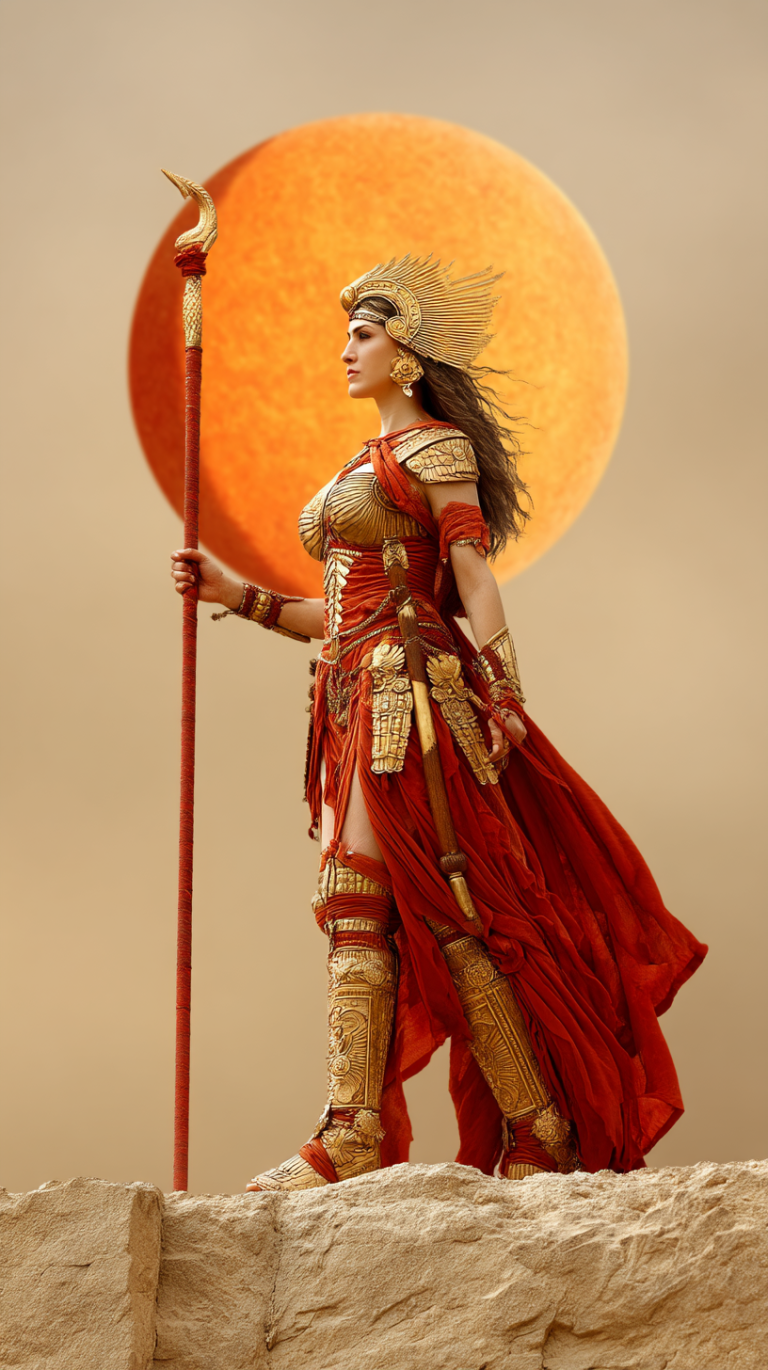
Sage Richika, a descendant of the great Bhrigu, possessed immense ascetic merit. His union with Satyavati, daughter of King Gadhi, would profoundly shape future generations.The Story of Sage Richika, Satyavati, and the Birth of Parashurama – Rama of the Axe
Richika’s Marriage to Satyavati
Sage Richika, a descendant of the great Bhrigu, possessed immense ascetic merit. His union with Satyavati, daughter of King Gadhi, would profoundly shape future generations. His penance and wisdom won him the hand of Satyavati, the virtuous daughter of King Gadhi, a ruler born in the illustrious Bharata lineage. Their marriage was marked by mutual devotion and harmony.
The Sacrificial Offering
Seeking to ensure the prosperity of both his wife and her family, Sage Richika prepared a magical dish of milk and rice infused with the power of sacred mantras and his ascetic energy. Dividing the dish into two portions, he instructed his wife:
“My dear, this portion of the offering is meant for you, and the other is for your mother. By consuming this, you shall be blessed with a son embodying the qualities of a Brahmana. Your mother will have a son with the attributes of a Kshatriya, devoted to valor and strength.”
Satisfied with his arrangements, Richika departed to collect firewood.
The Unintended Switch
While Richika was away, King Gadhi and his queen, Satyavati’s mother, arrived at the ashrama during their pilgrimage. Satyavati, honoring her husband’s instructions, showed her mother the two portions of the sacrificial offering and explained their purpose.
However, the mother and daughter mistakenly consumed the wrong portions. Satyavati ate the dish meant for her mother, while her mother consumed Satyavati’s share. This unintentional mix-up altered the destiny of their progeny.
Richika’s Revelation and Satyavati’s Plea
Upon returning, Richika immediately discerned the mistake through his yogic insight. He said:
“Satyavati, the sacred power infused into the offerings has been disrupted. The son born to you will now embody the attributes of a Kshatriya-warlike, unvanquishable, and inclined to cruelty. Meanwhile, your mother’s son will possess the serene qualities of a Brahmana, devoted to asceticism and scriptural mastery.”
Shocked and distressed, Satyavati fell at her husband’s feet, pleading:
“O Lord, do not let my son be born as a cruel wretch among Brahmanas. Let him instead embody the virtues of a Brahmana. Redirect the curse to my grandson if necessary.”
Moved by her devotion, Richika relented partially, saying:
“What has been decreed by divine will cannot be undone. However, as per your wish, your son will be a Brahmana of great merit, and your grandson shall bear the attributes originally intended for your son.”
The Birth of Jamadagni and Parashurama
In time, Satyavati gave birth to Jamadagni – Father of ParashuRama, a sage of great wisdom whose life and teachings (learn more about Jamadagni’s character) helped anchor the spiritual and ethical frameworks of his era. He married Renuka, the daughter of King Prasenajit, and they had five sons: Rumanvan, Sushena, Vasu, Viswavasu, and Rama.
The youngest, Rama, inherited the Kshatriya traits foretold by Richika. He became known as Parashurama – Rama of the Axe, the warrior-sage destined to cleanse the earth of corrupt rulers. He became a fearsome warrior and chose the Parashu (axe) as his weapon, earning him the name Parashurama-”Rama of the Axe.” Parashurama’s life would be marked by his mission to rid the earth of corrupt Kshatriyas, fulfilling the destiny foretold by his grandfather.
Connections to Other Myths
- The Lineage of Bhrigu and Richika
- Sage Bhrigu, Richika’s ancestor, is one of the seven great sages (Saptarishis) and played a pivotal role in shaping the early mythological and cosmic order. His lineage often intersects with critical events in Hindu mythology.
- Parashurama’s Role in the Dashavatara
- Parashurama, an avatar of Vishnu, bridges the gap between the divine and mortal realms. He is both a warrior and a sage, embodying the qualities of Kshatriyas and Brahmanas.
- Satyavati’s Parallel with Other Women in Mythology
- Satyavati’s plea for her son’s character mirrors Kunti’s prayers to the gods for her sons, each born with unique attributes due to her boons.
- The Sacrificial Dish and Destiny’s Interplay
- The unintended switch in consuming the offering echoes the theme of divine orchestration found in stories such as the birth of the Pandavas, where fate governs outcomes despite human agency.
Thematic Insights
- Interplay of Free Will and Divine Will: The story underscores how human actions, even accidental, align with larger cosmic plans.
- Duality in Roles: Parashurama embodies the reconciliation of opposites-Brahmana by birth but Kshatriya in spirit and action.
- Generational Impacts: Decisions taken in one generation ripple across future ones, a recurring theme in the Mahabharata – The Great Epic.
This story, like many other layered narratives found in Mahabharata-inspired articles, demonstrates how destiny often unfolds through a complex tapestry of devotion, duty, and cosmic will.
Legacy of Parashurama
Parashurama’s eventual mission to eliminate the oppressive Kshatriyas shaped the socio-political fabric of ancient India. His role as an avatar of Vishnu underscores the delicate balance between dharma (righteousness) and karma (action). This story also highlights how even divine plans rely on the actions and choices of mortals, intertwining destiny with devotion and dharma.
Prev | Next
Sources & further reading
These themes are explored in greater depth across the following authoritative resources:
- Internet Sacred Text Archive, Rig Veda (Griffith translation)
- Internet Sacred Text Archive, Upanishads
- Britannica, Veda
- Britannica, Upanishad
- Patrick Olivelle, The Early Upanishads (Oxford University Press, 1998)
External resources for further reading. Apam Napat is not affiliated with these publishers; citation does not imply endorsement.
Based on the classical texts of Hindu mythology, see our sources.