
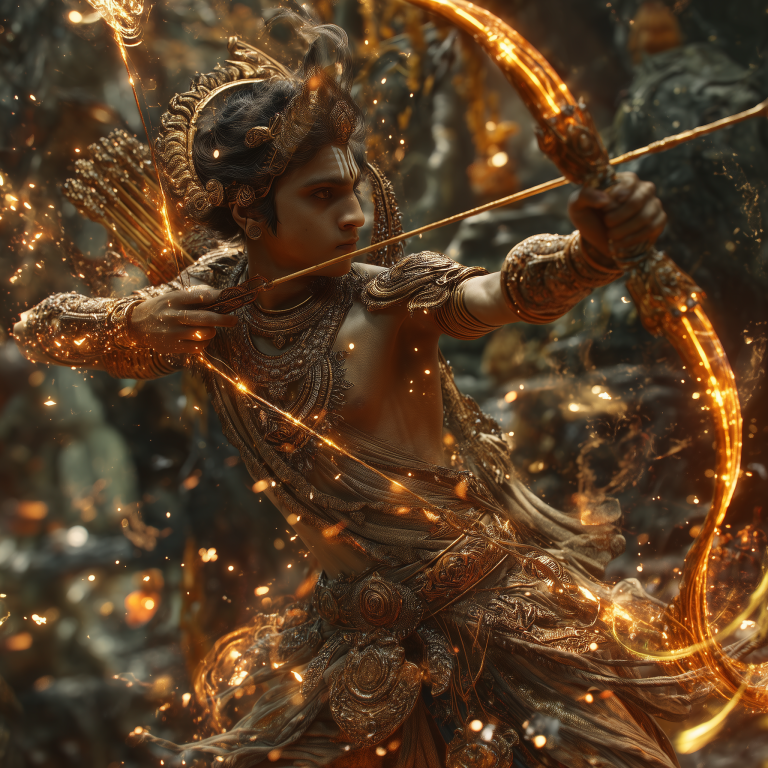
The Graduation of the Kuru Princes
“Let us hold a grand festival where the princes can display their prowess. It will serve to showcase their skills and demonstrate their preparedness to uphold the responsibilities of the kingdom.”
With Bhishma’s approval, an auspicious day was chosen, and a magnificent stadium was built to host the event. The festival attracted the kingdom’s elite and commoners alike, setting the stage for both admiration and rivalry.
The Festival of Skill
The festival was a grand spectacle. Drona began by introducing all the Kuru princes to the audience, and Bhishma inaugurated the festivities. Each prince demonstrated their mastery of weapons, showcasing their individual strengths and talents.
| Event | Details | Connections to Mythology |
|---|---|---|
| Opening Ceremony | Drona’s introduction and Bhishma’s blessings symbolized the lineage’s pride and hope. | Resembles the Svayamvara of Draupadi, where public display of skill was vital. |
| Feats of Strength | Princes showcased their skills with various weapons, delighting the audience. | Similar to Rama’s breaking of Shiva’s bow in the Ramayana to prove his might. |
| Duryodhana vs. Bheema | A friendly mace contest escalated due to their rivalry, nearly leading to chaos. | Foreshadowed their final duel in the Kurukshetra war, ending in Duryodhana’s defeat. |
To prevent unrest among the spectators, Drona sent his son Ashwatthama – Son of Drona to intervene and declared the match a tie, restoring order.
Arjuna’s Dazzling Display
When it was Arjuna’s turn to display his skill, his brilliance left the audience spellbound. His feats with the bow were extraordinary, with each showcasing his divine lineage and mastery:
| Arjuna’s Feat | Significance |
|---|---|
| Agneyastra | Set the arena ablaze, demonstrating mastery over celestial weapons. |
| Varunastra | Extinguished the flames with water, signifying balance and control. |
| Anthardynastra | Made himself invisible, showing his unmatched precision and strategy. |
| Parjanyastra | Summoned clouds and rain, reflecting his connection to Indra, the god of storms. |
The crowd, mesmerized, believed Arjuna to be the greatest archer of all time.
The Arrival of Karna
Just as the crowd celebrated Arjuna’s feats, a commotion erupted at the arena’s entrance. A dazzling youth entered, clad in golden armor and earrings, radiating an aura of nobility. This was Karna – The Ill Fated Elder Son of Kunti, whose divine heritage tied him to Surya, the Sun God, yet whose life journey would be marred by questions of identity, loyalty, and fate.
| Event | Significance | Connections to Mythology |
|---|---|---|
| Karna’s Challenge | He replicated and exceeded Arjuna’s feats, challenging the Pandava prince’s claim to greatness. | Parallels Hanuman’s challenge to Bhima, unknowingly pitting brothers against each other. |
| Karna’s Radiance | His armor and earrings, gifts from Surya, highlighted his celestial origin. | Mirrors the divine endowments of Krishna and Arjuna, setting the stage for cosmic rivalry. |
Karna’s arrival foreshadowed the fateful rivalry between him and Arjuna that would dominate the Mahabharata – The Great Epic.
The Question of Lineage
Karna’s challenge to Arjuna was interrupted by Kripa, who demanded:
“A duel between warriors of equal status is proper. State your lineage, for Arjuna is the son of Pandu and Indra.”
Karna, unable to name his birth parents, stood silent in humiliation. Raised by a charioteer, Adhiratha, and his wife Radha, Karna was unaware that he was actually the eldest son of Kunti, a secret that would haunt the unfolding drama of the Mahabharata.
| Karna’s Struggles | Details | Connections to Mythology |
|---|---|---|
| Rejection by Gurus | Refused by teachers for lack of lineage proof, he turned to deception. | Mirrors Ekalavya’s rejection by Drona for being a tribal. |
| Parashurama – Rama of the Axe’s Curse | Cursed to forget his skills at his critical moment for deceit. | Echoes Shukracharya’s curse to Kacha for betraying the Asuras. |
Duryodhana’s Intervention
Seeing Karna’s disgrace, Duryodhana, the crown prince of the Kaurava dynasty, rose in Karna’s defense, challenging societal prejudices and reshaping Karna’s destiny:
“If lineage is the issue, I shall make him King of Anga. Valor, not birth, defines a warrior.”
Duryodhana’s gesture cemented Karna’s eternal loyalty, marking the beginning of their legendary friendship.
| Duryodhana and Karna | Significance |
|---|---|
| Karna’s Gratitude | Pledged eternal loyalty, paralleling Krishna’s devotion to Arjuna. |
| Duryodhana’s Defense | “A man’s deeds, not his ancestry, determine his worth,” challenging caste-based prejudice. |
The Humiliation of Karna
As Karna prepared for a duel with Arjuna, his foster father Adhiratha appeared and embraced him. Witnessing this, Bheema mocked:
“A dog cannot partake of sacrificial offerings. You are a charioteer’s son, unworthy of combat with a prince.”
Duryodhana countered fiercely, solidifying his support for Karna and challenging the caste-based arrogance of the Pandavas.
Drupada’s Humiliation and Revenge
Following the festival, Drona demanded repayment from his disciples:
“Bring Drupada, King of Panchala, as my prisoner.”
| Event | Significance | Connections |
|---|---|---|
| Defeat of Drupada | Arjuna led the Pandavas to capture Drupada, fulfilling Drona’s request. | Mirrors the recurring theme of vengeance, as seen in Daksha’s insult to Shiva. |
| Drupada’s Revenge | Performed a yagna to beget Dhrishtadyumna, destined to kill Drona. | Reflects cosmic justice, similar to Hiranyakashipu’s death by Narasimha. |
The Birth of Dhrishtadyumna and Draupadi
From the sacrificial fire emerged:
| Character | Role in the Mahabharata |
|---|---|
| Dhrishtadyumna | A warrior destined to kill Drona, symbolizing divine retribution. |
| Draupadi | The dark-hued princess of Panchala, fated to marry the Pandavas and shape their destiny, thus deepening the intricate connections and rivalries already seen in earlier Mahabharata stories. |
Themes and Lessons
| Theme | Explanation | Connections to Mythology |
|---|---|---|
| Fate vs. Free Will | Karna’s struggles reflect the tension between destiny and human effort. Fate, as reflected in Karna’s hidden lineage and Arjuna’s divine favor, echoes the generational struggles stemming from Ambika’s lineage, where blind destiny and imperfect choices continue to influence the Kuru line. | Parallels Ravana’s resistance to his fated death at Rama’s hands. |
| Friendship and Loyalty | Duryodhana’s bond with Karna mirrors Krishna’s unwavering support for Arjuna. | Highlights dharma’s duality in friendships. |
| Justice and Revenge | Drupada’s revenge through his progeny underscores the cyclical nature of karma. | Similar to the cosmic cycle of birth and destruction in Vishnu’s avatars. |
The events of this episode laid the foundation for future conflicts, alliances, and destinies in the Mahabharata, intertwining themes of dharma, fate, and rivalry in a cosmic tapestry.
Prev | Next
Sources & further reading
These themes are explored in greater depth across the following authoritative resources:
- Britannica, Yoga in Hinduism
- Britannica, Puja
- Harvard Pluralism Project, Hindu Practice
- Internet Sacred Text Archive, Yoga Sutras of Patanjali
- Diana L. Eck, Banaras: City of Light (Princeton University Press, 1982)
External resources for further reading. Apam Napat is not affiliated with these publishers; citation does not imply endorsement.
Based on the classical texts of Hindu mythology, see our sources.