
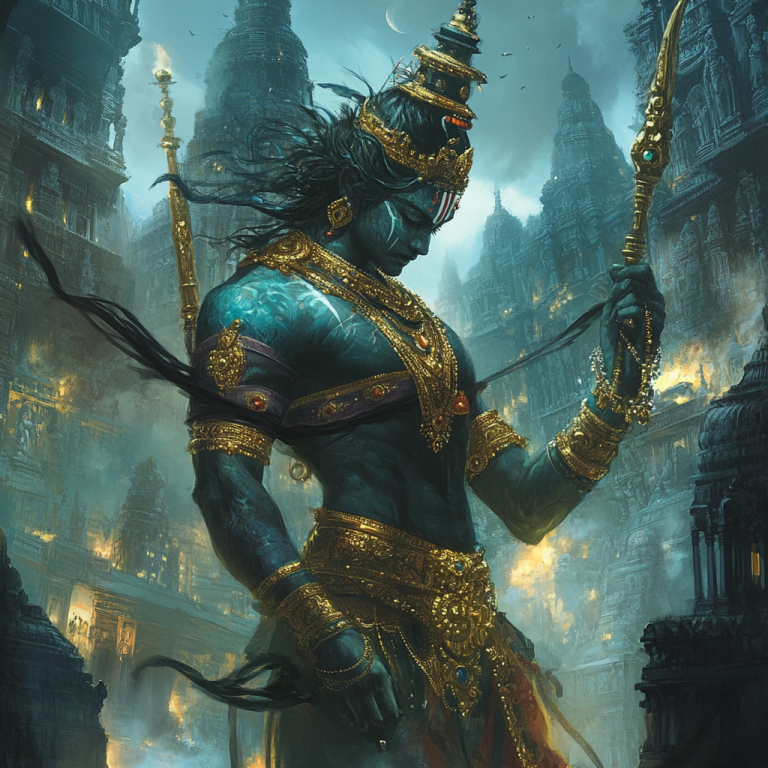
Iyravata’s lineage and story extend even further into Hindu mythology through his connection with the goddess Parvati – The Consort of Shiva and her son Ganapati. When Parvati’s son was beheaded by Shiva – The Destroyer in a moment of misunderstanding, the grief-stricken mother demanded that her son be revived. Shiva, seeking to appease Parvati, ordered his attendants to bring back the head of the first creature they encountered, which happened to be a baby elephant, a descendant of Iyravata. The attendants took the head, and it was used to bring Ganapati back to life, thus creating the elephant-headed deity revered as Ganesha, the remover of obstacles. In some retellings, the baby elephant that sacrificed its head is referred to as a progeny of Iyravata, connecting him to one of the most revered The Fascinating Roles and Rituals of Hindu Celestial Deities.
As the mount of Indra, Iyravata is also believed to bring rains. In Vedic hymns, he is often associated with clouds and thunder, making him a source of life-giving water and sustenance for all beings on earth. Indra, as the rain-god, is often depicted riding Iyravata across the skies, symbolizing the arrival of monsoons and prosperity. In Buddhist and Jain traditions as well, Iyravata is recognized as a celestial elephant, though with some variations in his attributes, signifying the elephant’s presence as a powerful and benevolent force across different spiritual narratives.
The presence of Iyravata in mythology thus intertwines with several iconic events, from the cosmic churning of the ocean to the story of Ganesha’s creation, reflecting the richness and interconnectedness of Hindu mythology.
Sources & further reading
These themes are explored in greater depth across the following authoritative resources:
- Internet Sacred Text Archive, Rig Veda (Griffith translation)
- Internet Sacred Text Archive, Upanishads
- Britannica, Veda
- Britannica, Upanishad
- Patrick Olivelle, The Early Upanishads (Oxford University Press, 1998)
External resources for further reading. Apam Napat is not affiliated with these publishers; citation does not imply endorsement.
Based on the classical texts of Hindu mythology, see our sources.