
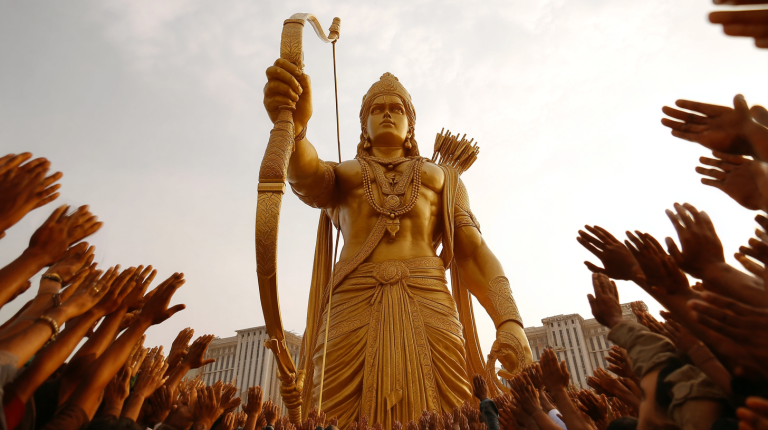
The Churning of the Ocean: A Cosmic Event of Eternal Significance
The Eternal Feud Between the Devas and Asuras
The Devas (gods) and Asuras, though half-brothers born of the same father, Sage Kashyapa, represent opposing cosmic tendencies-spiritual clarity and material ambition-explored in depth through their symbolic attributes.
The Plan to Seek Amrit (Nectar of Immortality)
As the ranks of their dead swelled, both sides realized that their conflict could only be resolved by becoming immortal. This could be achieved by consuming Amrit, the nectar of immortality, which was said to lie hidden at the bottom of the Kshira Sagara (Ocean of Milk) in Vaikuntha, Vishnu’s abode.
At last, an uneasy truce was brokered. Both the Devas and Asuras agreed to cooperate in churning the Ocean of Milk to extract Amrit, while Vishnu, the preserver, oversaw the process.
Preparations for the Churning of the Ocean
- The Churning Rod – Mount Mandara:
- The gods and demons sought a ladle or churning rod and chose the mighty Mount Mandara (sometimes named Meru), the king of all mountains.
- It symbolized stability and cosmic balance, a fitting tool for the monumental task.
- The Rope – Vasuki, King of Serpents:
- For the churning rope, they approached Vasuki, the giant serpent and king of all Nagas. Vasuki agreed to act as the rope, binding himself around Mount Mandara.
- Support for the Mountain – Vishnu’s Kurma Avatar:
- When the churning began, the mountain started sinking into the ocean due to its weight. At this critical moment, Vishnu took the form of a giant turtle (Kurma) and supported Mount Mandara on his back, a pivotal event detailed in the Kurma Purana and related texts that highlight this incarnation’s cosmic significance.
Thus began the great churning of the Ocean of Milk, with millions of Devas and Asuras pulling at Vasuki on either side of the mountain.
The Emergence of the Deadly Halahala Poison
As the churning progressed, instead of treasures, a terrible poison emerged from the depths of the ocean. This poison, called Halahala, was so potent that it began to:
- Suffocate all living beings on earth.
- Darken the skies and taint the oceans.
- Threaten to destroy the entire universe.
Shiva as the Savior – Nilakantha
The gods and sages, terrified, approached Lord Shiva and pleaded for his help. Moved by their plight, Shiva decided to consume the poison to save the universe.
- Shiva held the poison in his throat to prevent it from spreading through his body.
- Parvati, his divine consort, choked his neck with her hands to ensure the poison stayed there, staining it a dark blue hue.
- From that day forward, Shiva was revered as Nilakantha, the “Blue-Throated One.”
The Emergence of Celestial Treasures
With the poison neutralized, the churning continued. From the froth of the ocean, celestial beings and treasures began to emerge, each with a unique role in the cosmic order, these divine manifestations reflect the layered Celestial Hierarchy in Hinduism: Deities, Avatars, and Cosmic Order, where every being and object has a designated function in sustaining universal balance:
| Order of Emergence | Treasures/Beings | Recipient/Significance |
|---|---|---|
| 1. Chandra (The Moon) | The moon emerged first, radiant and luminous. | Chandra adorned the skies and became a symbol of beauty and time cycles. |
| 2. Lakshmi (Goddess of Wealth) | Seated on a lotus, the goddess Lakshmi appeared. | Vishnu, the preserver, claimed her as his divine consort. |
| 3. Kamadhenu (Divine Cow) | The wish-fulfilling cow, Kamadhenu, appeared. | Indra, king of the Devas, claimed her for sacrificial purposes. |
| 4. Uchchaihshravas (Celestial Horse) | The divine white horse, Uchchaihshravas, emerged. | Indra claimed the horse as his vehicle. |
| 5. Kalpavriksha (Wish-Granting Tree) | The celestial tree that granted all desires. | Again, Indra took possession of this divine treasure. |
| 6. Apsaras (Divine Nymphs) | Beautiful celestial maidens emerged from the ocean. | They became residents of Indra’s court in heaven. |
| 7. Dhanvantari | The divine physician carrying a pot of Amrit. | Father of Ayurveda, the science of healing and life. |
| 8. Amrit (Nectar of Immortality) | The nectar of immortality, carried by Dhanvantari. | Both the Devas and Asuras desired it for eternal life. |
The Deception of Mohini and the Birth of Rahu-Ketu
Fearing the Asuras’ strength if they consumed Amrit, the Devas prayed to Vishnu for help. This divine illusion adds another layer to the varied incarnations of Vishnu, where each form serves a unique cosmic function-often involving strategic intervention in times of crisis.
- Mohini took charge of distributing the Amrit. She:
- Made the Devas and Asuras sit in separate rows.
- Began serving the nectar only to the Devas, while the Asuras remained mesmerized by her beauty.
However, one Asura named Rahu saw through Mohini’s deception.
- He disguised himself as a Deva and drank the Amrit.
- Surya (Sun) and Chandra (Moon) noticed the ruse and informed Vishnu.
- Vishnu beheaded Rahu with his Sudarshana Chakra.
Since Rahu had already consumed Amrit, he became immortal, and his severed head (Rahu) and body (Ketu) were transformed into celestial beings.
Rahu and Ketu in Hindu Astrology
- Rahu and Ketu, now part of the Navagrahas (nine celestial bodies), periodically swallow the sun and moon, causing eclipses as an act of vengeance.
The Birth of Lord Ayyappa (Hari-Hara Putra)
During this episode, Shiva became captivated by Mohini’s form.
- Overcome by desire, he chased Mohini across the universe.
- Their union resulted in the birth of Lord Ayyappa, also known as Hari-Hara Putra:
- Hari (Vishnu) + Hara (Shiva) + Putra (Son).
Ayyappa is revered as a divine being who combines the powers of both Vishnu and Shiva. He later became a protector of the world, worshiped extensively in South India.
Conclusion: Cosmic Symbolism
The churning of the ocean, or Samudra Manthan, symbolizes the eternal struggle between good (Devas) and evil (Asuras) and reflects the balance between creation and destruction. Key takeaways include:
- Teamwork: Even sworn enemies must cooperate to achieve higher goals.
- Divine Intervention: Vishnu’s avatars (Kurma and Mohini) and Shiva’s sacrifice highlight their roles as cosmic saviors.
- Symbolism of Amrit: Immortality is often accompanied by challenges, deceit, and sacrifice.
- Balance in the Universe: The emergence of celestial treasures signifies harmony, while the poison represents the ever-present destructive force that must be neutralized.
This epic tale continues to resonate as an allegory for overcoming challenges, maintaining balance, and relying on divine wisdom to restore order in the universe.
Sources & further reading
These themes are explored in greater depth across the following authoritative resources:
- Britannica, Asura
- Britannica, Naga
- Mythopedia, Hindu Mythology
- Internet Sacred Text Archive, Mahabharata
- Wendy Doniger, Hindu Myths (Penguin Classics, 1975)
External resources for further reading. Apam Napat is not affiliated with these publishers; citation does not imply endorsement.
Frequently asked questions
What is the churning of the ocean in Hindu mythology?
What was used to churn the Ocean of Milk?
Why is Shiva called Nilakantha?
What treasures emerged from the Samudra Manthan?
How did Vishnu trick the Asuras with Mohini?
Based on the classical texts of Hindu mythology, see our sources.