
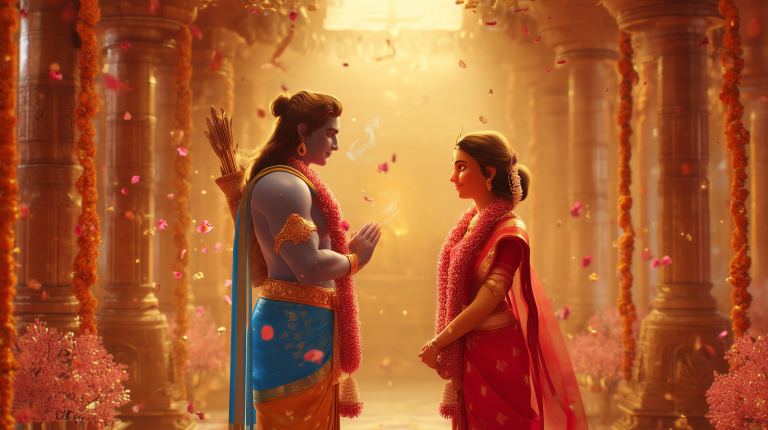
The Legend of Bharata – The King Who Gave His Name to India: The Inception of Bharata Varsha
The Great Lineage of Puru
To contextualize Bharata’s legacy, one must first understand the lineage of Puru, a line blessed by divine favor and destined for greatness. The Puru dynasty forms a critical link between early Vedic kings and the epic traditions of later India.
| Ancestor | Significance |
|---|---|
| King Yayati | Father of Puru, who traded his youth for his father’s curse and inherited his kingdom. |
| King Puru | The founder of the Puru dynasty, symbolizing sacrifice and obedience to Dharma. |
| Dushyanta | A just and handsome warrior king, father of Bharata. |
| Shakuntala – Mother of Bharata | The intelligent and divine daughter of Sage Vishwamitra – The King Who Became a Great Sage and Apsara Menaka – An Apsara. |
| Bharata | The unifier of the world and progenitor of Bharata Varsha. |
The Meeting of Dushyanta and Shakuntala
The tale begins with Dushyanta, a great warrior and ruler of unmatched virtue. One day, while hunting in a forest, the king stumbled upon a grove so tranquil that even the animals seemed to dwell in harmony. Entranced by the fragrance of the air and the peaceful atmosphere, the king wandered further until he saw Shakuntala.
Shakuntala, raised in the hermitage of Sage Kanva, was no ordinary maiden. Her beauty rivaled that of the Apsaras (celestial nymphs), and her intelligence matched her divine lineage. Upon beholding her, Dushyanta was struck with love and said:
“O Maiden, your beauty shines like the full moon. Truly, you are even more radiant than your celestial mother. Please, consent to be my wife!”
Shakuntala’s Divine Origin
Shakuntala’s birth was the result of a celestial scheme orchestrated by Indra, the King of the Devas:
| Parent | Role |
|---|---|
| Sage Vishwamitra | A former king-turned-sage, whose penance shook the heavens. |
| Apsara Menaka | Sent by Indra to disrupt Vishwamitra’s austerities through temptation. |
| Sage Kanva | The foster father of Shakuntala, who raised her in his hermitage. |
The Gandharva Marriage
Dushyanta, overwhelmed by passion, could not wait for Sage Kanva’s return to seek formal approval. He invoked the scriptures, which permitted a Gandharva Vivaha-a simple marriage solemnized by mutual consent and witnessed only by nature. Shakuntala, though hesitant, gave in to her love:
“If this is your wish, O King, let the forest be our witness. However, you must return for me as a king would for his queen.”
The king gave her his signet ring as a token of his promise and left for his kingdom.
Durvasa’s Curse
While Shakuntala eagerly awaited Dushyanta’s return, Sage Durvasa, notorious for his temper, arrived at the hermitage. Lost in thoughts of Dushyanta, Shakuntala failed to greet him properly. Enraged, Durvasa cursed:
“Since you are so lost in your thoughts, may the one you think of forget you!”
Shakuntala, realizing her mistake, begged for mercy. The sage relented and softened the curse:
“He will remember you upon seeing a token of your love.”
The Lost Ring and Dushyanta’s Denial
As fate would have it, when Shakuntala was later sent to Dushyanta’s court, she lost the signet ring in a river. Under the influence of Durvasa’s curse, the king did not recognize her. Angered and humiliated, Shakuntala declared:
“The Gods themselves were witness to our union. You may deny me now, but you cannot escape the wrath of the Devas for breaking your promise!”
Heartbroken, Shakuntala returned to Sage Kanva’s hermitage, where she gave birth to a son, Bharata.
The Signet Ring Returns and Reunion
Years later, the signet ring was found inside a fish caught in Dushyanta’s kingdom. When the king saw the ring, his memories returned, and he was filled with remorse. He set out to find Shakuntala and reached the forest, where he unknowingly encountered his own son.
The Encounter with Bharata
In the forest, Dushyanta saw a young boy of extraordinary valor and strength wrestling with lions and wild boars. The child, Bharata, engaged the king in a fierce argument over a boar they had both hunted. Dushyanta was astonished at the boy’s skill with weapons and combat.
Defeated, the king was taken to Sage Kanva’s hermitage, where he finally reunited with Shakuntala and learned the boy was his son. Filled with joy and repentance, Dushyanta embraced his family and took them back to his kingdom.
Bharata: The Unifier of Lands
Bharata grew to become one of the greatest kings in history. His reign was marked by unity, valor, and prosperity:
| Deed | Significance |
|---|---|
| Unified the World | Conquered all kings and established a united empire. |
| Legacy of Dharma | Ruled with justice, fairness, and adherence to righteousness. |
| Performed a Grand Yagna | A sacrifice that ensured the welfare of his people. |
| Bhumanyu’s Birth | Through divine grace, Bharata gained a worthy heir. |
Despite having many sons, Bharata found none fit to rule after him and performed a Yagna to obtain an heir. His son, Bhumanyu, succeeded him and continued his glorious lineage.
The Legacy of Bharata
Bharata’s reign gave India its ancient name, Bharata Varsha. His story serves as a cornerstone of Indian mythology, tying together the themes of fate, divine intervention, and human endeavor. These descendants and their dramatic fates unfold in the epic battles and moral dilemmas captured in the Mahabharata’s tales of dharma and destiny, where Bharata’s legacy reverberates through the generations.
| Symbol | Representation |
|---|---|
| Bharata Varsha | India, named in honor of King Bharata. |
| The Mahabharata | Chronicles the later lineage of Bharata’s descendants. |
| Unity and Righteousness | Bharata symbolizes the ideal ruler who upholds justice. |
Conclusion
The story of Dushyanta, Shakuntala, and Bharata not only celebrates love and perseverance but also intertwines with many foundational themes in Hindu mythology-from divine destiny and royal dharma to cosmic justice and human devotion.
Sources & further reading
These themes are explored in greater depth across the following authoritative resources:
- Britannica, Asura
- Britannica, Naga
- Mythopedia, Hindu Mythology
- Internet Sacred Text Archive, Mahabharata
- Wendy Doniger, Hindu Myths (Penguin Classics, 1975)
External resources for further reading. Apam Napat is not affiliated with these publishers; citation does not imply endorsement.
Based on the classical texts of Hindu mythology, see our sources.