
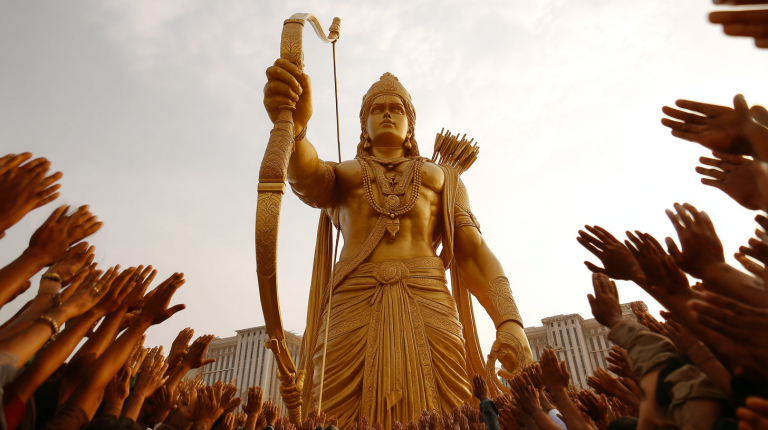
Arjuna in Indra’s Court and the Pandavas’ Pilgrimage
Arjuna’s Seat in Indra’s Court
In the court of Indra, the king of the Devas, Arjuna was seated on the same throne as his divine father. This sight astonished Rishi Lomasa, a sage renowned for his knowledge and austerities. The throne, known to require exceptional merit and spiritual stature, was considered unattainable by mortals. Sensing the sage’s curiosity, Indra explained:
“Arjuna is not seated here merely because he is my son. He is the incarnation of Nara, the great ascetic and companion of Narayana. His merit arises from his intense penance and devotion to Mahadeva (Shiva). Arjuna’s valor is unmatched-he has vanquished the Nivatakavachas, Asuras who tormented Brahmanas, and subdued countless kings to assist his brother Yudhishthira in the Rajasuya Yagna. None is more worthy to share this throne.”
Indra’s words emphasize Arjuna’s dual role as both a mortal hero and a divine essence. This parallels other stories of mortals achieving divine stature through their actions:
- Hanuman’s ascent to divinity through devotion to Rama.
- Karna’s celestial armor and earrings, signifying his divine heritage as Surya’s son.
The Nivatakavachas and Arjuna’s Heroism
Indra’s mention of the Nivatakavachas highlights one of Arjuna’s significant achievements during his sojourn in the heavens. The Nivatakavachas were a race of powerful Asuras who had obtained boons rendering them invincible to ordinary beings. They lived in the Hiranyapuri, a golden city beneath the ocean, and constantly disrupted the sacrificial rituals of sages and Devas.
To eliminate this threat, Indra sent Arjuna to Hiranyapuri, armed with celestial weapons like the Pashupatastra, granted by Shiva after Arjuna’s penance. Arjuna’s victory over the Nivatakavachas is a testament to his prowess, mirroring other divine battles:
- Rama’s defeat of Ravana, who terrorized the three worlds.
- Krishna’s destruction of Narakasura – The Asura Who Gave Us Diwali, who tormented the Devas and mortals.
| Hero | Enemy | Divine Support | Significance |
|---|---|---|---|
| Arjuna | Nivatakavachas | Indra and Shiva | Symbolizes the triumph of Dharma over Adharma. |
| Rama | Ravana | Vishnu’s incarnation | Restores cosmic balance by defeating the demon king. |
| Krishna | Narakasura | Sudarshana – Ancestor of Rama Chakra and Garuda | Frees the celestial realms from Narakasura’s tyranny. |
Arjuna’s Reverence for Rishi Lomasa
After hearing Indra’s praise, Rishi Lomasa was convinced of Arjuna’s merit. Arjuna, however, remained humble and addressed the sage with reverence:
“O venerable one, my brothers are now in the Kamyaka forest, enduring exile with great hardship. They may worry about my absence and fear for my safety. If you pass by them, I beseech you to reassure them of my well-being. They have also expressed a desire to undertake a pilgrimage to holy sites. Your unparalleled knowledge of sacred places makes you the ideal guide for such a journey.”
The sage agreed, marking the beginning of the Pandavas’ spiritual pilgrimage. This act of deference reflects the Pandavas’ unwavering commitment to Dharma, even amidst their tribulations.
Rishi Lomasa’s Guidance and the Pilgrimage of the Pandavas
Rishi Lomasa joined the Pandavas in the Kamyaka forest and conveyed Arjuna’s message, uplifting their spirits. He then proposed a pilgrimage to holy sites, emphasizing its spiritual benefits, especially during times of adversity.
The Pilgrimage and its Spiritual Significance
The Pandavas visited numerous sacred places, each imbued with mythological significance and divine energy. The pilgrimage served to purify their minds, strengthen their resolve, and deepen their connection with the divine.
| Sacred Site | Mythological Significance |
|---|---|
| Prabhasa Kshetra | The site where Krishna would later shed his mortal form, completing his avatar as Vishnu. |
| Gaya | Known for the Pinda Pradana rites, where ancestors are offered salvation. |
| Pushkar | Associated with Brahma’s Yagna, the only temple dedicated to him is located here. |
| Rameshwaram | Where Rama worshiped Shiva to atone for killing Ravana, a Brahmana. |
| Haridwar and Gangotri | The origins of the Ganga, descended to Earth through Shiva’s matted locks, purifying the land. |
Each site visited by the Pandavas is deeply tied to other myths, emphasizing the interconnectedness of Hindu cosmology.
Lomasa’s Role and Connections
Rishi Lomasa’s guidance is not just practical but deeply symbolic. As a sage well-versed in the Puranas and sacred geography, he bridges the gap between the mortal and divine realms. His presence connects the Pandavas to earlier mythological figures and events, creating a continuum of Dharma.
| Other Pilgrimage Narratives | Connection to the Pandavas’ Pilgrimage |
|---|---|
| Rama’s journey to Dandakaranya | Like the Pandavas, Rama undertakes a journey during his exile, encountering sages and sacred sites. |
| Sita’s visit to Ganga during exile | Sita’s reverence for sacred rivers parallels the Pandavas’ visit to Gangotri and Haridwar. |
| Shiva’s penance at Kedarnath | The Pandavas later visit Kedarnath, where Shiva retreats after being angered by their pursuit. |
Arjuna as Nara and His Cosmic Role
Indra’s statement that Arjuna embodies Nara, the eternal companion of Narayana (Krishna), places him within the grand cosmic narrative of Hindu mythology. Together, Nara and Narayana incarnate repeatedly to restore Dharma.
| Incarnation | Role |
|---|---|
| Nara-Narayana | Meditating ascetics who maintain cosmic balance through penance. |
| Krishna-Arjuna | Warrior and strategist who restore Dharma in the Mahabharata – The Great Epic. |
| Rama-Lakshmana | Brothers who uphold righteousness in the Ramayana. |
Arjuna’s connection to Nara also explains his unique relationship with Krishna, who serves as his charioteer, guide, and divine protector during the Kurukshetra War.
Symbolism and Connections
| Theme | Significance in the Tale |
|---|---|
| Penance and Merit | Arjuna’s asceticism mirrors other great penances, such as Shiva’s meditation and Vishwamitra – The King Who Became a Great Sage’s tapas. |
| Divine Recognition | Indra’s acknowledgment of Arjuna echoes Vishnu’s praise of Hanuman after the Ramayana. |
| Pilgrimage as Purification | The Pandavas’ pilgrimage highlights the redemptive power of sacred journeys, a theme seen in many epics. |
Conclusion
This episode from the Mahabharata intertwines themes of devotion, divine purpose, and spiritual purification. Arjuna’s exalted status in Indra’s court underscores his cosmic role as Nara, while Rishi Lomasa’s guidance connects the Pandavas to the sacred geography of India and the timeless principles of Dharma. Through their pilgrimage, the Pandavas reaffirm their resilience, preparing for the trials yet to come in their journey. This tale exemplifies the Mahabharata’s ability to weave personal struggles with universal truths, creating a tapestry that resonates across time and space.
Sources & further reading
These themes are explored in greater depth across the following authoritative resources:
- Britannica, Asura
- Britannica, Naga
- Mythopedia, Hindu Mythology
- Internet Sacred Text Archive, Mahabharata
- Wendy Doniger, Hindu Myths (Penguin Classics, 1975)
External resources for further reading. Apam Napat is not affiliated with these publishers; citation does not imply endorsement.
Based on the classical texts of Hindu mythology, see our sources.