
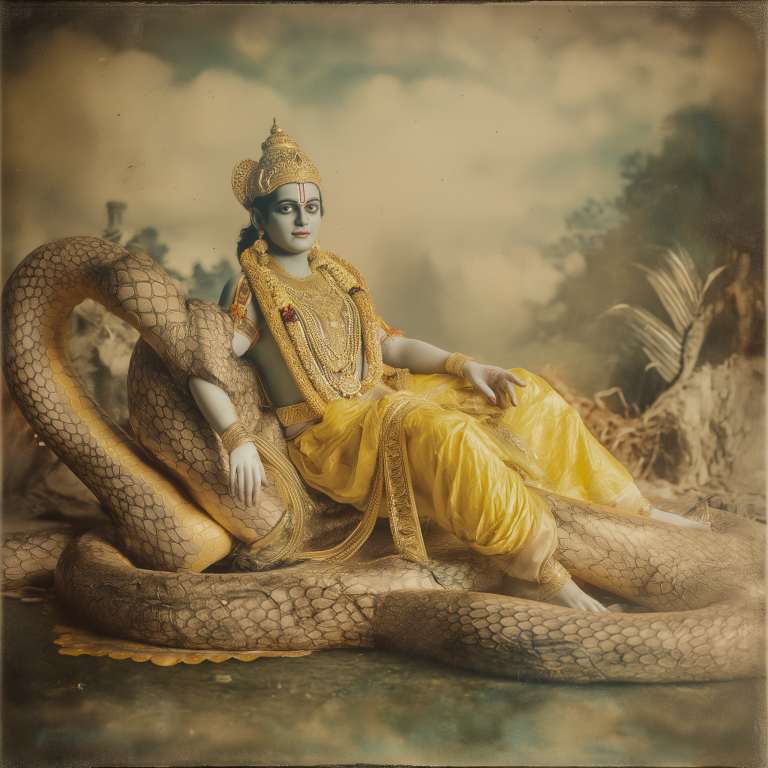
The Matsya Avatar and the Great Deluge
Manu’s Penance and Vishnu’s Appearance
King Swayambhuva Manu, the progenitor of mankind, was performing rigorous penance on the banks of a sacred river. Known for his unwavering devotion and adherence to dharma, Manu embodied the ideal ruler tasked with upholding righteousness on Earth. His Manu Smriti would later serve as the cornerstone of moral and societal law in ancient India, and his story finds detailed elaboration in the Matsya Purana’s early cosmology and flood narratives.
One day, as Manu collected water for his rituals in his kamandal (sacred water vessel), a small fish appeared within it. As he prepared to release the fish into the river, it spoke:
“O King, do not cast me back into the waters! I am small and vulnerable, and larger fish will surely devour me. Protect me, and I shall repay your kindness.”
Moved by compassion, Manu took the fish home, placing it in a small vessel. Astonishingly, the fish began to grow at an extraordinary rate. It soon outgrew the vessel, prompting Manu to transfer it to a larger one, then to a pond, a lake, and finally, the ocean. Its size and majesty were beyond comprehension, and Manu realized it was no ordinary fish.
The fish then revealed its divine nature:
“O Manu, I am Vishnu, the preserver of creation. Soon, the Earth will be submerged by a great deluge. Build a large ship and gather within it the seeds of life-virtuous men and women, animals, and plants-to preserve creation. When the flood comes, I shall guide you to safety in my form as Matsya.”
The Cosmic Flood and the Ship of Life
As foretold, dark clouds enveloped the sky, and torrential rains began. Rivers overflowed, merging with the seas, submerging the Earth under an endless expanse of water. Towering waves lashed at the heavens as chaos reigned.
Manu, following Vishnu’s instructions, had built a massive ship. Onboard were righteous beings, animals, and the seeds of plants-symbols of life’s continuity. As the ship was tossed by the raging waters, Vishnu, in his Matsya Avatar, appeared as a colossal fish and said:
“Tie the ship to my horn with the serpent Vasuki as a rope. I shall guide you to safety.”
Thus, for seven days and nights, Vishnu led the ship across the vast ocean. During this time, he imparted profound knowledge to Manu, teaching him the principles of creation, governance, and the responsibilities of mankind in the new world.
The Receding Waters and a New Era
When the floodwaters receded, the ship rested on the Malaya Mountains (interpreted as either the Western Ghats or the Himalayas). Vishnu instructed Manu to begin the task of repopulating the Earth, laying the foundation for the next Manvantara (epoch).
This marked the beginning of Swayambhuva Manu’s rule, symbolizing the preservation of life, dharma, and the cyclical renewal of creation.
Connections to Other Myths and Stories
| Aspect | Details | Connections |
|---|---|---|
| Manu’s Role | The first Manu, progenitor of mankind and lawgiver. | Tied to the lineage of Ikshvaku – An Ancestor of Rama and the preservation of dharma in the cosmic cycles. |
| The Fish as a Symbol | Represents guidance, salvation, and adaptability. | A motif seen across Vishnu’s Dashavatara, emphasizing adaptability in crises. |
| Vasuki’s Role | The serpent Vasuki used to tie the ship to Matsya’s horn. | Also featured in the Samudra Manthan (churning of the ocean), symbolizing energy and cosmic balance. |
| Cosmic Flood | The deluge symbolizes purification and renewal, concepts echoed across ancient Hindu cosmology and even referenced indirectly in the lineage stories of figures like Shweta Manu, who also presided over a cosmic age. | Similar myths in Mesopotamian, Greek, and Abrahamic traditions, such as Noah’s Ark. |
Parallels with Other Vishnu Avatars
The Matsya Avatar sets the stage for Vishnu’s subsequent incarnations, each reflecting his role as the preserver of dharma:
| Avatar | Connection to Matsya |
|---|---|
| Kurma (Tortoise) | Both involve water and preservation-Kurma supports the Samudra Manthan, while Matsya guides through the flood. |
| Varaha (Boar) | Varaha retrieves Earth from the cosmic ocean, echoing Matsya’s role in saving life during the deluge. |
| Krishna – An Incarnation of Vishnu | The continuity of divine guidance is also seen in the narrative arcs of Vishnu’s later interactions with key figures such as Virata during the Pandavas’ exile and Sudeshna, where dharma preservation remains the focus. |
Cosmic Significance of the Matsya Avatar
- Yugas and Manvantaras
- The flood marks a transition between cycles of creation. Each Manvantara (epoch) is presided over by a Manu, with Swayambhuva Manu being the first.
- The Cycle of Pralaya
- The deluge symbolizes Pralaya (cosmic dissolution), a recurring theme where the world is destroyed and renewed. Vishnu ensures continuity, guiding life through each cycle.
- Primordial Waters
- The ocean represents the chaotic, primal waters from which creation emerges. Vishnu as Matsya becomes the savior and guide through this chaos.
Global Parallels: Flood Myths Across Cultures
| Civilization | Flood Myth | Similarities to Matsya |
|---|---|---|
| Mesopotamian | Utnapishtim survives a flood in the Epic of Gilgamesh. | Both involve divine warning, construction of a vessel, and the preservation of life. |
| Greek | Deucalion and Pyrrha survive a flood sent by Zeus to cleanse Earth. | Divine intervention and the rebirth of humanity after the deluge. |
| Abrahamic (Noah) | Noah builds an ark to save humanity and animals from the flood. | Construction of a vessel, saving life, and divine promise of renewal. |
Themes and Lessons
- Dharma and Divine Guidance
Vishnu’s role as Matsya underscores his eternal promise to guide humanity during crises, ensuring dharma’s preservation. - Compassion and Duty
Manu’s care for the fish reflects the dharmic principle of compassion, rewarded by divine intervention. - Interconnectedness of Life
The preservation of all species aboard the ship highlights the unity and interdependence of life in creation. - Faith and Preparedness
Manu’s unwavering faith and meticulous preparation symbolize the balance of trust in divine wisdom and proactive effort.
A Timeless Allegory
The story of the Matsya Avatar serves as a powerful metaphor for renewal, resilience, and the enduring bond between humanity and the divine. It underscores that even in the face of cosmic upheaval, faith, dharma, and divine guidance ensure the preservation of life and righteousness.
Prev | Next
Sources & further reading
These themes are explored in greater depth across the following authoritative resources:
- Stanford Encyclopedia of Philosophy, Hindu Philosophy
- Britannica, Dharma
- Britannica, Karma
- Internet Sacred Text Archive, Bhagavad Gita
- A. K. Ramanujan, Speaking of Siva (Penguin Classics, 1973)
External resources for further reading. Apam Napat is not affiliated with these publishers; citation does not imply endorsement.
Frequently asked questions
What is the Matsya Avatar of Vishnu?
Who was Manu in the Matsya Avatar story?
How did Vishnu save mankind during the great deluge?
Where did Manu's ship come to rest?
What does the Matsya Avatar symbolize?
Based on the classical texts of Hindu mythology, see our sources.