
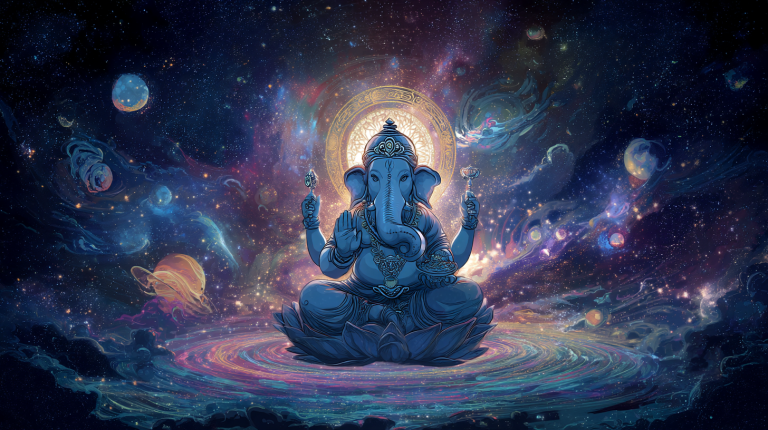
The Story of the Chandra Vamsha (Moon Dynasty)
The Divine Roots of the Chandra Vamsha
The origins of this illustrious dynasty lie in the celestial realms. It begins in the hermitage of Brihaspati – The Guru of the Devas (Jupiter), the revered Guru of the Devas (Gods), who was among the greatest Rishis of all time. The Devas, subordinate only to the trinity of Brahma (Creator), Vishnu (Protector), and Shiva (Destroyer), inhabited Swargaloka – The Heavens (heavens) under the reign of Indra, the king of gods. Their immortality stemmed from consuming Amrit (nectar), obtained during the churning of the ocean of milk (Samudra Manthan). The Devas derived strength from Havis (oblations) offered by mortals, carried to the heavens by Agni (Fire).
The Devas were in perpetual conflict with the Asuras (Demons), also called Daityas (sons of Diti) or Danavas (sons of Danu). Key figures among the Asuras, like the wise yet antagonistic Shukracharya, played crucial roles in the cosmic battles, guiding the Daityas with wisdom and divine boons. The Asuras, who inhabited the netherworld, frequently disrupted cosmic order with boons granted by the Trinity. In such crises, the Devas sought refuge in Vishnu, leading to his many Avatars (incarnations), including Rama, Krishna, and Narasimha, who restored balance.
Chandra’s Downfall and Redemption
Chandra, one of Brihaspati’s disciples, was renowned for his beauty. Unfortunately, this beauty led to his downfall. Tara, Brihaspati’s wife, fell in love with Chandra, and the two fled together. This act of betrayal incited a war between the Devas and Asuras, as Chandra sought refuge with the Asuras. After a prolonged conflict, peace was brokered, and Tara was returned to her husband. However, during her time with Chandra, she bore a son, Budha (Mercury), whose parentage became a source of contention.
When Budha grew older, his sense of justice led him to reject both his parents for their moral failings. His eloquence impressed the Devas, and after years of penance, he was granted a place among the Navagrahas (Nine Planets). Yet, the enmity between Budha and Chandra persists, reflected in their astrological rivalry.
The Birth of Puroorava – First King of Chandra Dynasty
Budha’s life intersected with the mortal world through the story of King Sudyumna, later known as Ila, who was transformed into a woman after entering an enchanted pond sacred to Shiva and Parvati. During Ila’s year as a woman, she married Budha, and their union produced Puroorava, the first mortal king of the Chandra Vamsha. His romance with the celestial nymph Urvashi is one of the earliest love stories in Hindu mythology, blending divine beauty with human vulnerability.
Connections to Broader Indian Mythology
| Entity/Story | Connection to Chandra Vamsha |
|---|---|
| Kurukshetra War | The Kurukshetra War marked the climax of the Chandra Vamsha’s mortal lineage, drawing in nearly all great houses of Bharata. |
| Samudra Manthan | The event that granted the Devas immortality, indirectly influencing the perpetual war between Devas and Asuras. |
| Brihaspati and Tara | Central to Chandra’s moral fall, leading to the birth of Budha and the dynasty’s astrological significance. |
| Navagrahas | Chandra and Budha’s enmity is symbolized in astrology; they represent conflicting forces in celestial lore. |
| Shiva and Parvati | The enchantment of the pond connecting the divine with mortal lineage through the story of Ila. |
| Yayati and Nahusha | Later kings of the Chandra Vamsha, whose stories reflect the dynasty’s blend of divine and mortal struggles. |
Divine and Mortal Lineage of the Moon Dynasty
| Ancestor | Role | Significance |
|---|---|---|
| Chandra | Progenitor | Represents beauty, desire, and moral fallibility. |
| Budha | Son of Chandra and Tara | Represents wisdom, penance, and redemption; joins the Navagrahas. |
| Puroorava | Son of Budha and Ila | First mortal king of the dynasty; sets the stage for its mortal history. |
| Yayati | Descendant of Puroorava | Known for the curse of old age and his teachings on desire and renunciation. |
| Pandavas/Kauravas | Final heirs of the dynasty | Their war signifies the climax of the dynasty’s story and the transition to the Kali Yuga. |
Themes in the Chandra Vamsha’s Story
- Conflict Between Desire and Duty: Seen in Chandra’s betrayal of Brihaspati and the Pandavas’ struggles in Kurukshetra.
- Divine Intervention in Mortal Affairs: Evident in Vishnu’s Avatars and Shiva’s role in Budha’s elevation.
- Astrological Symbolism: The Navagrahas reflect the moral and cosmic conflicts within the dynasty.
This tale of the Chandra Vamsha weaves together celestial drama, human struggles, and the eternal quest for redemption, forming a cornerstone of Hindu mythology.
Frequently asked questions
What is the Chandra Vamsha?
How did the conflict between Chandra and Brihaspati begin?
Who is Budha in the Chandra Vamsha story?
Who is Puroorava in the Moon Dynasty?
Sources & further reading
These themes are explored in greater depth across the following authoritative resources:
- Britannica, Asura
- Britannica, Naga
- Mythopedia, Hindu Mythology
- Internet Sacred Text Archive, Mahabharata
- Wendy Doniger, Hindu Myths (Penguin Classics, 1975)
External resources for further reading. Apam Napat is not affiliated with these publishers; citation does not imply endorsement.
Based on the classical texts of Hindu mythology, see our sources.