
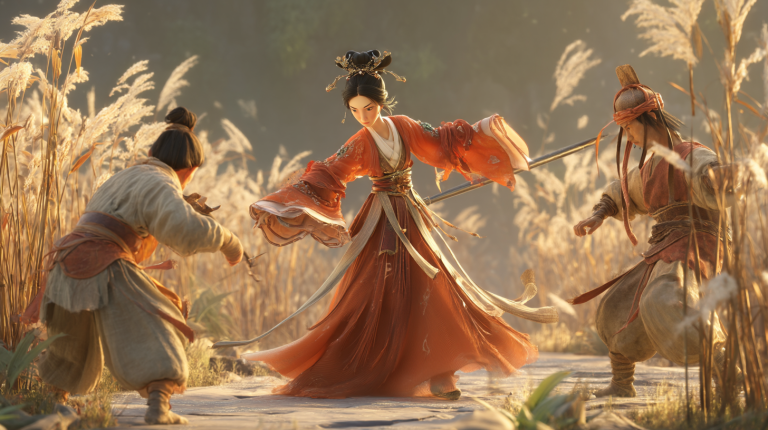
Drona’s Life, the Kuru Princes, and the Seeds of Conflict
Drona’s Birth and Early Life
The life of Drona begins as an unusual tale:
Once, the vitality of Sage Bharadwaja – Father of Drona spontaneously emerged from his body. He stored it in a container. The son born from that container was named Drona (In Sanskrit, ‘Drona’ means container).
From the very beginning, Drona’s existence was steeped in the miraculous, aligning him with divine and mystical origins, much like other great sages and warriors. This unique birth reflects parallels with other miraculous births in mythology:
| Character | Parentage/Origin | Significance |
|---|---|---|
| Drona | Born from Bharadwaja’s vitality (stored in a container) | Foremost teacher of martial arts |
| Kripa | Son of Saradhwan; born spontaneously | Drona’s brother-in-law, mentor of war |
| Ashwatthama – Son of Drona | Ashwatthama – Son of Drona, born with divine qualities and famed for his equine cry at birth, would carry the weight of his father’s legacy into the Kurukshetra war as one of its most feared and fated warriors. | Drona’s son, symbol of immortality |
| Karna | Born of Kunti through Surya | Destined to rival Arjuna in warfare |
Young Drona was sent to the hermitage of Agniveshya, where he mastered the scriptures and weapons. Here he befriended Drupada, the prince of Panchala, forming an oath of eternal friendship.
Drupada’s Insult and Drona’s Humiliation
Years later, when poverty struck Drona’s household, his son Ashwatthama lamented their condition. The incident where Ashwatthama cried for milk, but was tricked into drinking rice flour mixed in water, deeply moved Drona. Determined to change his family’s fortunes, he remembered his childhood friend, Drupada.
Drona approached Drupada in the Panchala court and said:
“O King, do you remember our vow as students-that we would share everything equally? I have come to you as a friend to seek your assistance in my hour of need.”
However, Drupada, consumed by pride and the arrogance of kingship, scorned Drona:
“Friendship exists only between equals. I am the ruler of Panchala, and you are a poor Brahmana. If you need alms, I shall give it, but do not speak of friendship. That is a pact of the past, forgotten by me.”
This humiliation was a turning point. Drona left the court silently but swore to avenge this insult. It mirrored other instances in mythology where broken promises and pride brought disastrous consequences:
- Karna’s rejection by Draupadi during the swayamvara led to his eternal enmity with the Pandavas.
- Sage Parashurama – Rama of the Axe’s curse on Karna, after being deceived, became a crucial factor in Karna’s fate.
Humiliated and burning with resolve, Drona sought the mighty sage Parashurama, who was distributing his wealth. Parashurama, having given away all material possessions, this passing of divine knowledge from Parashurama to Drona is a key moment in Drona’s transformation, which echoes the broader spiritual lineage and conflicts detailed in Mahabharata Episode 8, where vengeance and vows shape the fates of warriors:
“Drona, I possess no gold or land to give you. But I offer you the supreme knowledge of the Astras (divine weapons), which can render you invincible.”
Drona accepted Parashurama’s gift and became the greatest master of arms on earth.
Drona’s Arrival in Hastinapura
Drona then traveled to Hastinapura, where his brother-in-law Kripacharya served as a royal tutor. Upon his arrival, an incident occurred that marked his first encounter with the Kuru princes.
The princes, led by Yudhishthira, had lost their ball and ring in a deep well. Drona, observing their helplessness, demonstrated his astonishing prowess:
- He used blades of grass like arrows to form a chain and retrieve the ball.
- With a single arrow, he retrieved Yudhishthira’s ring by striking it underwater and causing it to fly back.
The princes marveled at Drona’s skills. Yudhishthira said:
“O masterful Brahmana, your feats reveal that you are no ordinary man. Please come with us to our grandsire Bhishma, who will reward your talents.”
Upon hearing of Drona’s identity, Bhishma immediately recognized his potential as the ideal preceptor for the Kuru princes. This recognition marks Drona’s entry into the larger saga of the Mahabharata, where his presence would alter the trajectory of both the Pandavas and the Kauravas. Drona accepted Bhishma’s offer and established his hermitage outside Hastinapura, where the training of the Pandavas and Kauravas began.
Drona’s Disciples and Their Training
Under Drona’s tutelage, the young princes flourished in their respective skills:
| Prince | Skill | Special Achievement |
|---|---|---|
| Arjuna | Archery | Became the unrivaled master of the bow |
| Bheema | Mace Fighting | Outshone all in physical strength |
| Duryodhana | Mace Fighting | Second only to Bheema in skill |
| Yudhishthira | Charioteering & morality | Known for his dharma and steady charioteering |
| Ashwatthama | Knowledge of Astras (Weapons) | Inherited Drona’s celestial weaponry |
Arjuna emerged as Drona’s favorite disciple due to his dedication and single-minded focus. One day, when asked by Drona to shoot a bird on a tree, Arjuna declared that he could see only the bird’s eye. Impressed by his focus, Drona proclaimed:
“Arjuna, you shall be the greatest archer in the world. None shall rival you.”
This declaration sowed the seeds of jealousy in the hearts of others, particularly Karna and Duryodhana.
Drona’s Guru-Dakshina: The Task Assigned
As their education neared completion, Drona called his students and said:
“It is time for you to repay your guru with the Guru-Dakshina. I will set a task that will test your loyalty and courage. Who among you will promise to fulfill it?”
The assembly fell silent. Only Arjuna, with unwavering determination, rose and declared:
“O Acharya, no matter how difficult the task, I shall fulfill it, or die trying.”
Drona’s heart swelled with pride.
The Foreshadowing of Conflict
Drona’s growing bond with the Pandavas and his favoritism towards Arjuna stoked the flames of envy in Duryodhana and Karna. While his professional life centered around warfare and instruction, Drona’s personal sphere was deeply intertwined with Kripi – Wife of Drona, his wife and the sister of Kripacharya-one of the few characters who survived the war and bore witness to its legacy. Meanwhile, Drona’s humiliation at Drupada’s hands still festered in his heart. These two threads-the brewing conflict between the Pandavas and Kauravas, and Drona’s desire for vengeance against Drupada-would converge in the future, setting the stage for further strife and bloodshed.
This tale not only illustrates Drona’s rise to greatness but also reflects deeper themes:
- The burden of humiliation, which drove even the most learned to vengeance.
- The importance of discipline and dedication, as seen in Arjuna’s devotion.
- The seeds of jealousy and rivalry that would one day destroy the Kuru dynasty.
As the Mahabharata progresses, Drona’s complex role as a teacher, warrior, and a man torn between loyalty and personal vendetta would make him one of its most tragic figures.
Sources & further reading
These themes are explored in greater depth across the following authoritative resources:
- Internet Sacred Text Archive, Mahabharata (Ganguli translation)
- Internet Sacred Text Archive, Ramayana of Valmiki
- Britannica, Mahabharata
- Britannica, Ramayana
- Bibek Debroy, The Mahabharata (10 vols., Penguin, 2010 to 2014)
External resources for further reading. Apam Napat is not affiliated with these publishers; citation does not imply endorsement.
Based on the classical texts of Hindu mythology, see our sources.