
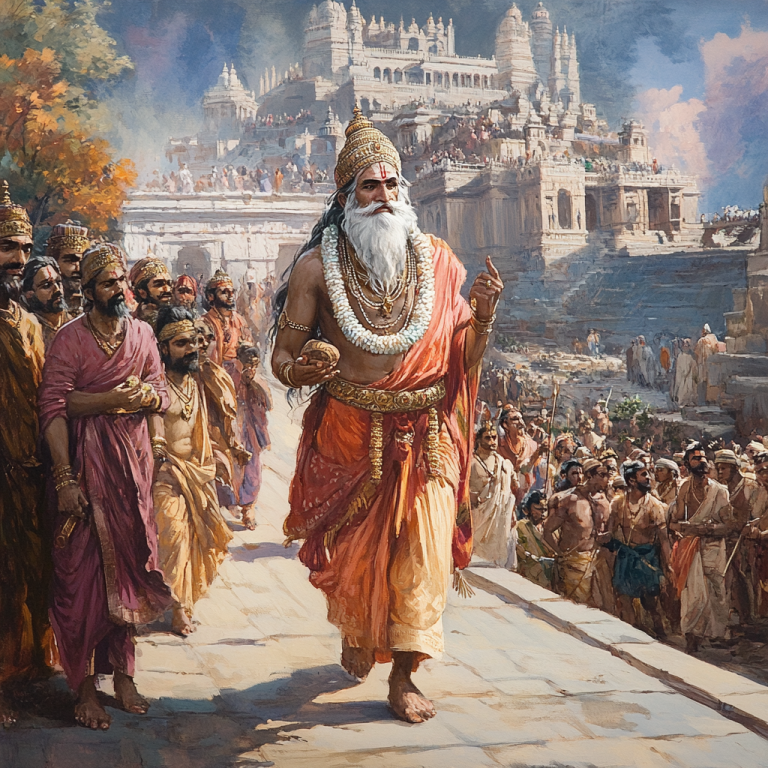
Rama and Lakshmana’s Journey with Vishwamitra – The King Who Became a Great Sage
The Childhood and Training of the Princes
The four sons of Dasharatha–Rama, Lakshmana, Bharata, and Shatrughna – Twin of Laxmana-were raised in the luxurious palace of Ayodhya under the tender care of their parents, King Dasharatha and his three queens. As they grew, they displayed exceptional qualities befitting the royal lineage of the Ikshvaku dynasty.
When the time came for their formal education, the sacred thread ceremony was performed, marking their initiation into Vedic learning. Under the guidance of the sage Vasishta, the princes mastered the Vedas, Upanishads, and the scriptures. Their education, reflective of archetypal hero preparation found throughout Hindu mythological archetypes, laid the foundation for their later epic journeys.
Brotherly Bonds
The bond between the brothers was unbreakable. Rama and Lakshmana were like two halves of the same soul, inseparable in both spirit and action. Similarly, Bharata and Shatrughna shared a deep camaraderie, their mutual affection and loyalty matching that of Rama and Lakshmana. Observing this harmony among their sons, King Dasharatha and his queens-Kausalya, Kaikeyi, and Sumitra-rejoiced, feeling that their lineage had been blessed. Trusted aides like Sumantra – Charioteer of Dasharatha, the loyal minister of Ayodhya, also witnessed and supported the nurturing of these princely virtues.
The Arrival of Vishwamitra
As the princes matured into young men, King Dasharatha began contemplating suitable matrimonial alliances for them. However, fate had other plans. One day, the revered sage Vishwamitra, a former Kshatriya king turned Brahmarishi, arrived at Dasharatha’s court. His arrival was heralded with great respect, as the sage’s spiritual power and ascetic merit were well known.
Dasharatha received him with due honors, saying, “O great Rishi, your arrival is like rain in a drought, the birth of a son to a barren man, or nectar to the parched lips of mortals. Command me, and I shall fulfill your desire without hesitation.”
Vishwamitra smiled and replied, “Your words are befitting of the illustrious Ikshvaku dynasty. I have undertaken a great Vedic ritual (yagna) that will benefit the entire world. However, two Rakshasas-Maricha and Subahu, emissaries of the mighty Ravana-have been desecrating the sacrificial fire by hurling unclean meat and blood into it. My ascetic duties prevent me from engaging them in combat. I seek the aid of your sons, Rama and Lakshmana, to protect the ritual. In return, I shall teach them the use of celestial weapons.”
Dasharatha’s Dilemma
Dasharatha was horrified by the sage’s request. Swooning with fear, he recovered and exclaimed, “O revered one, you ask for my eldest son, Rama, who is dearer to me than my own life! He is but a child, untested in battle. How can I send him against powerful Rakshasas skilled in sorcery? Let me accompany you with my army instead.”
Vishwamitra’s face darkened. “O King, it is not for you to question my wisdom. You underestimate your sons. Rama was born to exterminate the Rakshasas. If you doubt my words, consult your perceptor Vasishta.”
Seeing Vishwamitra’s growing anger, Vasishta intervened. “O King, Vishwamitra seeks not to endanger your sons but to bestow upon them divine gifts. The sage possesses celestial weapons, bestowed upon him by Lord Shiva and the sons of Krishasva Prajapati, who were born of the daughters of Daksha, Jaya and Suprabha. These weapons, including the Brahmastra and the Agneyastra, will ensure Rama and Lakshmana’s safety. Moreover, Vishwamitra’s ascetic merit is a greater shield than any army. Send your sons with him, for this is their destiny.”
Reassured by Vasishta, Dasharatha reluctantly agreed. He summoned Rama and Lakshmana and bade them to accompany the sage, though his heart was heavy with fear for their safety.
The Divine Mission
Rama and Lakshmana set forth with Vishwamitra, leaving the comforts of the palace behind. Their journey, chronicled against the backdrop of the historical context of the Ramayana, represents the transition from princely innocence to the sacred duty of cosmic restoration.
Their first challenge came when they reached the dense Dandaka forest, where the sacrificial ritual was to take place. The forest was infested with Rakshasas who terrorized ascetics and disrupted their penances. Under Vishwamitra’s guidance, the young princes confronted their first adversaries, Maricha and Subahu.
The Defeat of Maricha and Subahu
As the yagna commenced, the Rakshasas appeared, hurling blood and flesh into the sacred fire. Rama, armed with the divine weapons given by Vishwamitra, stood resolutely before the fire. With the Manavastra, he struck down Subahu, reducing the demon to ashes. Maricha, struck by the force of the Agneyastra, was hurled a thousand leagues into the ocean, his life spared as a warning to others.
The ascetics and sages rejoiced at the victory, praising Rama as a savior. Vishwamitra, pleased with the young prince’s valor, blessed him, saying, “O Rama, your deeds foreshadow the great destiny that awaits you. You shall bring glory to the Ikshvaku dynasty and uphold dharma across the three worlds.”
Connections to Broader Mythology
| Element | Mythological Connection |
|---|---|
| Vishwamitra’s Divine Weapons | The celestial weapons link this tale to other epics, including stories from the Mahabharata, where divine arms similarly play a critical role in shaping the fates of heroes like Arjuna. |
| Maricha and Ravana | Maricha later aids Ravana in abducting Sita by disguising himself as the golden deer. |
| Brahmastra | The Brahmastra, taught to Rama, appears in many myths as the ultimate divine weapon. |
| Vasishta and Vishwamitra Rivalry | Their rivalry is a recurring theme, showcasing the tension between Kshatriya and Brahmana values. |
Legacy
This episode marks the beginning of Rama’s journey as the upholder of dharma, foreshadowing his future battles against Ravana and the Rakshasas. It also reflects the role of divine intervention in guiding mortals toward their destinies, with sages like Vishwamitra acting as instruments of fate. The training and experiences gained here prepare Rama and Lakshmana for the epic trials that lie ahead in the Ramayana.
Sources & further reading
These themes are explored in greater depth across the following authoritative resources:
- Internet Sacred Text Archive, Rig Veda (Griffith translation)
- Internet Sacred Text Archive, Upanishads
- Britannica, Veda
- Britannica, Upanishad
- Patrick Olivelle, The Early Upanishads (Oxford University Press, 1998)
External resources for further reading. Apam Napat is not affiliated with these publishers; citation does not imply endorsement.
Based on the classical texts of Hindu mythology, see our sources.