
Expanded Story: Vishwamitra – The King Who Became a Great Sage’s Transformation, Vasishta’s Trials, and the Lineage of Sage Parasara
The Rivalry of Vishwamitra and Vasishta
The Lavish Feast and Kamadhenu – The Bountiful Cow’s Calf
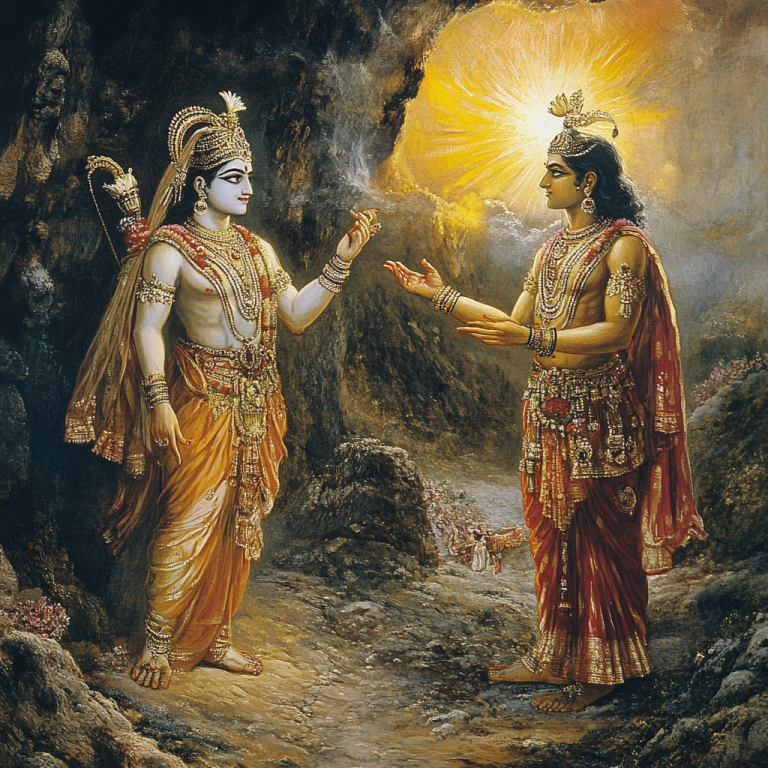
Once, King Vishwamitra, son of King Gadhi of the Kusika dynasty, went hunting in the forests near Mount Meru. Exhausted and accompanied by his retinue, he stumbled upon the hermitage of the great sage Vasishta – Perceptor of the Ishvahu Clan, known for his ascetic powers and spiritual wisdom.
The sage welcomed the king and his soldiers, offering them a lavish feast. Vishwamitra was astounded by the variety and richness of the food, especially considering the simplicity of the hermitage. Curious, he asked, “O revered sage, how have you managed to conjure such a magnificent feast in this secluded forest? Is this some celestial power bestowed upon you?”
Vasishta replied, “King, this bounty is not of my doing. It is the work of Nandini, the divine calf of Kamadhenu, gifted to me by the gods. She can produce all manner of riches and sustenance at my command.”
Enchanted by Nandini’s powers, Vishwamitra thought of how the calf could feed his vast army. He proposed, “O sage, give me this calf in exchange for ten thousand heads of cattle, or even my entire kingdom. It will be put to better use serving the needs of my soldiers and people.”
Vasishta refused. “This sacred cow is essential for my sacrifices and for the sustenance of my hermitage. She is not for sale, even for all the wealth in the world.”
The Abduction of Nandini
Angered by the sage’s refusal, Vishwamitra ordered his men to seize Nandini. As the soldiers tied a rope around her neck, the divine calf pleaded with Vasishta, “O revered one, why do you allow me to be taken away? Have I failed to serve you?”
Vasishta responded calmly, “It is not my will that you are taken. If you do not wish to go, use your own power to resist.”
Nandini’s wrath was terrifying. From her body emerged a celestial army. Her tail produced the Pallavas, her udders the Dravidas and Sakas, her womb the Yavanas, and her froth and dung brought forth the Paundras, Kiratas, and Kanchis. This vast army utterly decimated Vishwamitra’s forces.
Witnessing the destruction, Vishwamitra realized the superiority of spiritual power over martial might. Determined to attain similar prowess, Vishwamitra renounced his throne and embarked on a grueling path of asceticism.
The Curse of Kalmashapada
The Curse and Transformation
In a separate tale, King Kalmashapada, a descendant of the Ikshvaku dynasty, encountered the ascetic Shakti, the eldest son of Vasishta, on a narrow forest path. Both demanded the right of way, and in his anger, Kalmashapada struck the sage with his whip. Shakti cursed the king, saying, “You shall become a Rakshasa (demon) and feast on human flesh.”
Seizing the opportunity to torment Vasishta further, Vishwamitra ensured the curse took immediate effect by invoking the Rakshasa spirit Pravriddha – King Who Became Rakshasa, channeling the darkness that would consume Kalmashapada.
The Tragedy of Vasishta
Under Vishwamitra’s influence, Kalmashapada hunted down and devoured all 100 sons of Vasishta. Grief-stricken, the sage contemplated suicide, attempting to drown himself in the ocean, immolate himself in fire, and even end his life in the river Haimavati, which fled in a hundred streams to avoid him. Unable to die, Vasishta returned to his hermitage, broken but alive.
Adrisyanti and the Unborn Child
In his hermitage, Vasishta found solace when he discovered that Adrisyanti, the widow of Shakti, carried his grandson-offering a glimmer of hope for the continuation of his sacred lineage.
Redemption and Resolution
Freeing Kalmashapada
Years later, Vasishta encountered the Rakshasa-possessed Kalmashapada. Using his ascetic power, he exorcised the demon and restored the king to his human form. The repentant king begged forgiveness and sought Vasishta’s help to continue his lineage, as a Brahmana’s curse had rendered him incapable of fathering children.
Vasishta agreed and fathered a child with Kalmashapada’s queen, Madayanti – Wife of Pravridda. The child, Asmaka, was born after 12 years of gestation when Madayanti, in frustration, split her womb with a stone. Asmaka went on to found the city of Paudanya.
Parasara’s Revenge and Compassion
The Rakshasa Sacrifice
Parasara, growing up under Vasishta’s tutelage, learned of his father Shakti’s death at the hands of Kalmashapada. Enraged, he vowed to annihilate all Rakshasas through a sacrificial fire. The ritual began, and countless Rakshasas perished in the flames.
The Intervention of Vasishta and Pulasthya
As the sacrifice threatened to eradicate the Rakshasa race, the sage Pulasthya, the progenitor of the Rakshasas, intervened alongside Vasishta. They narrated the story of Chyavana, who had shown mercy even to those who wronged him. Persuaded, Parasara ended the sacrifice, sparing the remaining Rakshasas.
The Legacy of Parasara
Parasara became a celebrated sage and fathered Veda Vyasa, ensuring the transmission of sacred knowledge that remained anchored in the traditions passed down from entities like Vasishta, whose unwavering dharma shaped the course of Indian mythology.
Connections to Broader Mythology
| Element | Mythological Connection |
|---|---|
| Vishwamitra’s Transformation | Vishwamitra’s journey from king to sage mirrors his eventual creation of Gayatri Mantra. |
| Nandini and Kamadhenu | Kamadhenu’s lineage, from the churning of the ocean, ties this tale to the creation myths of the Devas. |
| Rakshasas and Parasara | The Rakshasa lineage connects to Ravana, a descendant of Pulastya, linking this story to the Ramayana. |
| Vasishta’s Trials | Vasishta’s vow of nonviolence echoes his role as the peaceful counterpoint to Vishwamitra. |
This tale exemplifies the tension between worldly power and spiritual wisdom, showcasing the enduring triumph of dharma and self-control over hubris and vengeance.
Sources & further reading
These themes are explored in greater depth across the following authoritative resources:
- Britannica, Asura
- Britannica, Naga
- Mythopedia, Hindu Mythology
- Internet Sacred Text Archive, Mahabharata
- Wendy Doniger, Hindu Myths (Penguin Classics, 1975)
External resources for further reading. Apam Napat is not affiliated with these publishers; citation does not imply endorsement.
Based on the classical texts of Hindu mythology, see our sources.