
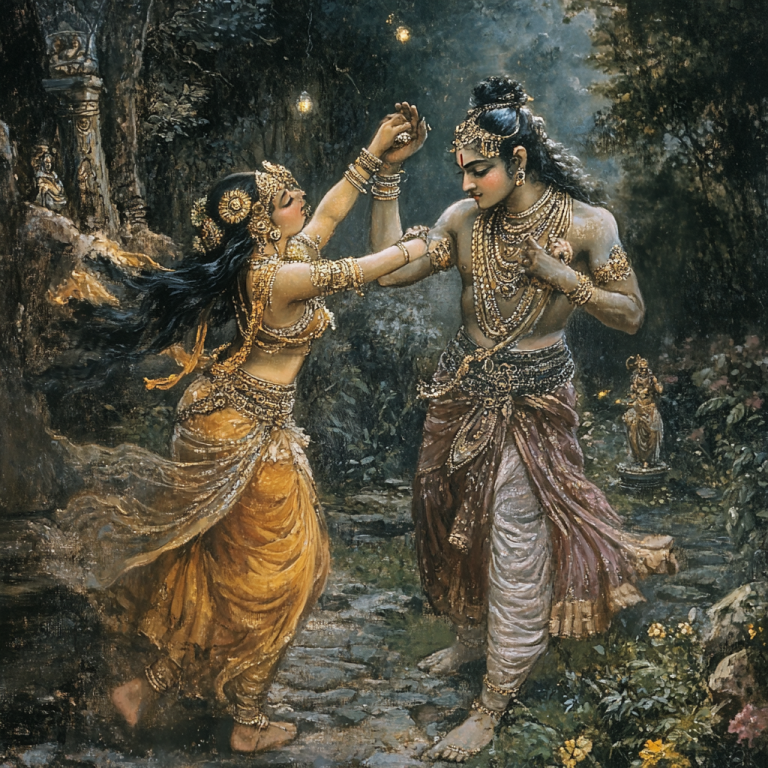
Expanded Story: The Tale of Utanka’s Devotion and Divine Trials
Utanka’s Service to His Guru
Once, there was a learned sage named Ayoda-Dhaumya, renowned for his wisdom and the rigorous discipline he imposed on his disciples. Among them was a devoted pupil named Utanka, whose loyalty and humility set him apart. One day, Ayoda-Dhaumya said to Utanka, “My dear pupil, go to my house and serve my family. Perform all the household chores diligently. In doing so, you will gain not just my approval but also the wisdom of dedication and discipline.”
Utanka replied, “As you command, Master,” and went to the Guru’s home. For several years, he served his Guru’s wife with unflinching devotion. He fetched water, tended the fire, and carried out all tasks without complaint, his heart steadfast in the belief that such service was a path to enlightenment.
Pleased with Utanka’s devotion, Ayoda-Dhaumya taught him the scriptures, the Vedas, and the secrets of dharma, ensuring that his disciple equaled him in wisdom. After completing his education, the Guru blessed Utanka and sent him into the world, saying, “You are now a learned man. Spread the light of knowledge and live a life of virtue.”
Utanka’s Final Duty to His Guru
Before leaving, Utanka, in humility, said to his Guru, “Master, though I have served you, I feel I have not adequately repaid you for the gift of knowledge. Please allow me to offer you a Guru Dakshina (teacher’s fee) as a token of my gratitude.”
The Guru, satisfied with his disciple, replied, “I have no personal need, but ask my wife if she desires anything.”
Utanka approached his Guru’s wife and bowed deeply before her. She said, “In four days, we are hosting a feast for Brahmanas. I wish to adorn myself with a pair of earrings that belong to Queen Paushya, which are said to be of unparalleled beauty. Fetch them for me. But beware, failing in this task will bring ill fortune to you.”
Utanka’s Journey to King Paushya
Utanka set out on his quest. Along the way, he encountered a giant man riding a magnificent bull. The giant called out, “Utanka, eat the dung of this bull. It will bring you great fortune.”
Initially hesitant, Utanka replied, “How can I consume dung, even if you command me?”
The giant explained, “This is no ordinary bull. It is Airavata, the celestial mount of Indra – The King of Heaven, and the dung is nectar in disguise. Your Guru consumed it, and so must you.”
Humbled, Utanka partook of the dung and urine, then purified himself and continued his journey, unknowingly imbibing divine grace.
At the Palace of King Paushya
Upon reaching King Paushya’s palace, Utanka introduced himself and conveyed his request for the earrings. The King welcomed him warmly and said, “My Queen will be pleased to assist you. Please visit her chambers.”
However, when Utanka arrived, he found the Queen absent. Confused, he returned to the King, who explained, “Perhaps you did not purify yourself properly. To see the Queen, one must be ritually pure.”
Realizing his oversight, Utanka performed a detailed purification ritual and returned. This time, the Queen greeted him graciously, handing over the earrings. She warned, “These earrings are coveted by Takshaka – The King of Serpents, the King of Serpents. Guard them carefully.”
The Theft by Takshaka
On his way back, Utanka paused to drink water, placing the earrings on the ground. A beggar appeared and, seizing the opportunity, snatched the earrings. Utanka pursued him, but to his horror, the beggar transformed into Takshaka, the powerful Naga king and guardian of ancient secrets in the serpent realms.
Utanka tried to dig open the hole but found his efforts futile. In despair, he prayed to Indra for assistance. The King of Heaven, moved by Utanka’s devotion, sent his thunderbolt (Vajra) to open the pathway to the Naga Loka, the realm of the serpents.
The Trials in Naga Loka
Utanka entered the dazzling city of the Nagas, filled with golden palaces and shimmering jewels. There, he composed hymns in praise of the serpents:
“Ye Nagas, adorned with many-colored gems, ye who dwell in the forests and rivers, I seek your mercy. Grant me the earrings I seek, and I shall extol your greatness for eternity.”
The serpents were moved by his words, but Takshaka remained defiant. Realizing that persuasion alone would not suffice, Utanka prayed to Indra again. The god sent his celestial horse, Uchchaihshravas, whose fiery breath scorched the Naga Loka. This dramatic scene highlights the mystical symbolism of serpents in Hindu mythology, where Nagas embody both danger and wisdom.
Utanka’s Return
Riding Uchchaihshravas, Utanka returned to his Guru’s home just in time. The Guru’s wife, delighted with the earrings, blessed Utanka, saying, “May you prosper and achieve great renown.”
Utanka then approached his Guru and narrated his journey. He asked, “Master, who was the giant on the bull, and what was the significance of his command?”
The Guru explained, “The giant was Indra, and the bull was his celestial mount, Airavata. By consuming the dung, you partook of divine nectar, granting you strength to succeed in your trials.”
Utanka also recounted the wondrous sights in Naga Loka, including the two women weaving black and white threads. The Guru revealed their significance… These motifs are further elaborated in other stories from the Mahabharata, where divine visions often symbolize deeper cosmic truths.
| Vision | Symbolism |
|---|---|
| Two women weaving | Night and day, weaving the fabric of time. |
| The wheel with 12 spokes | The year, driven by the six seasons. |
| Handsome man and horse | Parjanya (Rain God) and Agni (Fire God). |
Legacy of Utanka
Utanka’s devotion, humility, and perseverance made him an exemplar of dharma. His story underscores the importance of faith in divine grace and the sacred bond between a Guru and disciple. Later, Utanka reappears in mythology, playing pivotal roles in other tales, including aiding Janamejaya – Son of Parikshit during the Sarpasatra (snake sacrifice), an episode deeply rooted in the divine nature of Nagas and the karmic cycles that bind gods, humans, and serpents alike.
Sources & further reading
These themes are explored in greater depth across the following authoritative resources:
- Stanford Encyclopedia of Philosophy, Hindu Philosophy
- Britannica, Moksha
- Britannica, Brahman
- Internet Sacred Text Archive, Upanishads
- Sarvepalli Radhakrishnan, Indian Philosophy (2 vols., Oxford University Press, 1923)
External resources for further reading. Apam Napat is not affiliated with these publishers; citation does not imply endorsement.
Based on the classical texts of Hindu mythology, see our sources.