
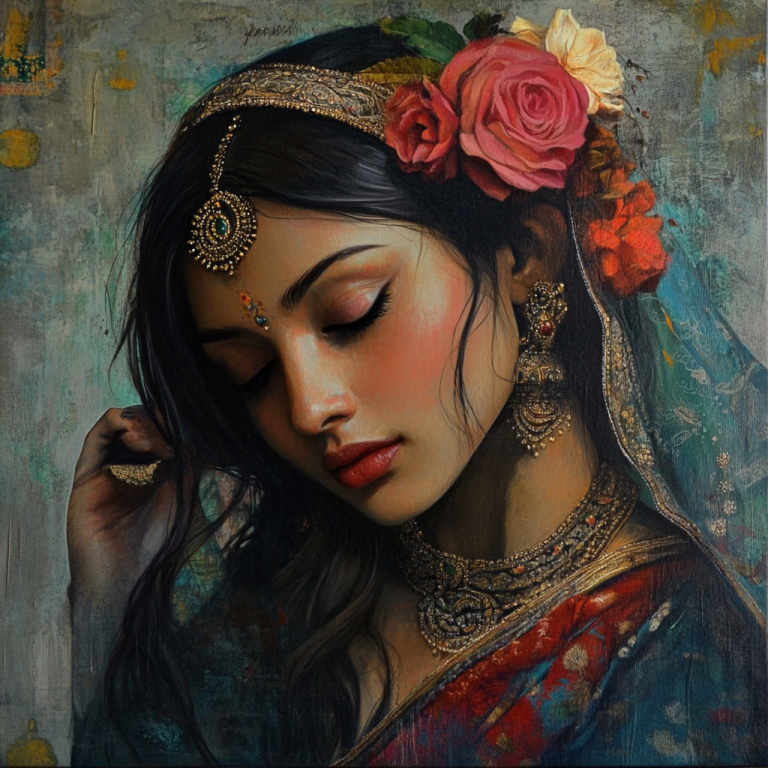
Urmila – The Unsung Heroine of the Ramayana – Epic of Hinduism
Urmila, a princess of the royal house of Mithila, is one of the most poignant and underappreciated characters in the epic Ramayana. She was the daughter of King Janaka and Queen Sunaina of Mithila and the younger sister of Sita, the beloved wife of Rama, the hero of the epic. Urmila’s story, though not as elaborately told as that of Sita, is marked by immense sacrifice, love, and devotion, making her a symbol of strength and endurance in Hindu mythology.
Marriage to Lakshmana
Urmila was married to Lakshmana, Rama’s younger brother, on the same day that Sita wed Rama. Their bond is deeply explored in both literary and devotional traditions, as shown in detailed profiles of Lakshmana’s character, emphasizing his unwavering devotion and martial prowess.
Along with their sisters Mandavi and Shrutakirti, who married Bharata – The King Who Gave His Name to India and Shatrughna respectively, the unions symbolized a harmonious alliance between the royal houses of Mithila and Ayodhya.
| Marriage Details | Description |
|---|---|
| Husband | Lakshmana, the devoted younger brother of Rama |
| Sisters and Brothers-in-law | Sita married Rama, Mandavi married Bharata, and Shrutakirti married Shatrughna – Twin of Laxmana |
| Symbolism | These marriages united two noble dynasties, emphasizing unity and dharma. |
Urmila’s Greatest Sacrifice
While Sita accompanied Rama during his fourteen-year exile, Urmila stayed behind in Ayodhya, a decision that reflected her unwavering commitment to duty and sacrifice. Her story becomes particularly compelling when viewed through the lens of her separation from her beloved husband.
- Lakshmana’s Oath:
Lakshmana, out of his deep devotion to Rama, vowed to serve him unwaveringly throughout the exile. This meant he would renounce sleep, food, and comfort to guard and support Rama and Sita during their journey. Before leaving, he sought Urmila’s understanding and permission. - Urmila’s Sacrifice:
Urmila accepted Lakshmana’s decision without hesitation, showcasing her selflessness and love. She is believed to have taken upon herself the burden of sleep for the entirety of the exile, allowing Lakshmana to remain awake and vigilant. This silent sacrifice is often referred to as Urmila Nidra (Urmila’s Sleep).
| Act of Sacrifice | Significance |
|---|---|
| Urmila’s Nidra | Symbolizes her unseen strength and devotion, ensuring Lakshmana’s duty to Rama. |
Role in Ayodhya During the Exile
While Rama, Sita, and Lakshmana endured hardships in the forest, Urmila remained in Ayodhya, serving as a pillar of strength for the family. Her emotional support to Queen Sumitra – Mother of Laxmana and Shatrughna, Lakshmana’s mother, was instrumental during the prolonged separation, showcasing her role as both daughter-in-law and emotional anchor.
| Contribution | Details |
|---|---|
| Support to Kaushalya and Sumitra – Mother of Laxmana and Shatrughna | Urmila provided emotional support to the elder queens of Ayodhya during the turbulent years. |
| Symbol of Patience | Her role exemplified the virtues of patience, loyalty, and sacrifice expected of royal women. |
Reunion After the Exile
When Rama, Sita, and Lakshmana returned to Ayodhya after the exile and the victory over Ravana, Urmila was reunited with her husband. Though their separation had lasted fourteen years, her unwavering love and dedication had only strengthened their bond.
- A Silent Reunion:
The Ramayana does not elaborate on Urmila’s emotions during the reunion, but her quiet endurance speaks volumes about her character. She remains a symbol of resilience, her sacrifices underpinning the epic’s broader themes of duty and devotion.
Connections to Other Entities and Stories
| Entity/Story | Connection to Urmila |
|---|---|
| Sita | Urmila’s elder sister, who accompanied Rama during the exile, mirroring her own silent sacrifices. |
| Lakshmana | Her husband, whose unwavering service to Rama was made possible by her sacrifices. |
| Rama and Bharata | Her brothers-in-law, whose adherence to dharma influenced her sense of duty. |
| Kaikeyi – Mother of Bharata of the Ramayana’s Betrayal | Urmila’s endurance provided strength to the royal family during Ayodhya’s darkest period. |
Symbolism and Themes
| Theme | Symbolism in Urmila’s Story |
|---|---|
| Sacrifice and Duty | Urmila’s willingness to part with Lakshmana and bear the burden of sleep embodies ultimate sacrifice for dharma. |
| Patience and Endurance | Her story highlights the inner strength of women, who often support great deeds behind the scenes. |
| Silent Strength | Urmila’s quiet contributions serve as a reminder of the unsung heroes in epic tales. |
Legacy of Urmila
Urmila’s life, though not as elaborately chronicled as those of Sita or Lakshmana, is a cornerstone of the Ramayana’s narrative. Her legacy is more fully recognized in this tribute to Urmila’s strength and sacrifice, where her story is honored as a testament to the silent power of devotion.
Through her patience, loyalty, and love, Urmila remains a beacon of hope and inspiration, proving that even in silence, one can achieve greatness. Her sacrifices remind us that behind every act of heroism lies unseen dedication and perseverance.
Sources & further reading
These themes are explored in greater depth across the following authoritative resources:
- Stanford Encyclopedia of Philosophy, Hindu Philosophy
- Britannica, Moksha
- Britannica, Brahman
- Internet Sacred Text Archive, Upanishads
- Sarvepalli Radhakrishnan, Indian Philosophy (2 vols., Oxford University Press, 1923)
External resources for further reading. Apam Napat is not affiliated with these publishers; citation does not imply endorsement.
Based on the classical texts of Hindu mythology, see our sources.