
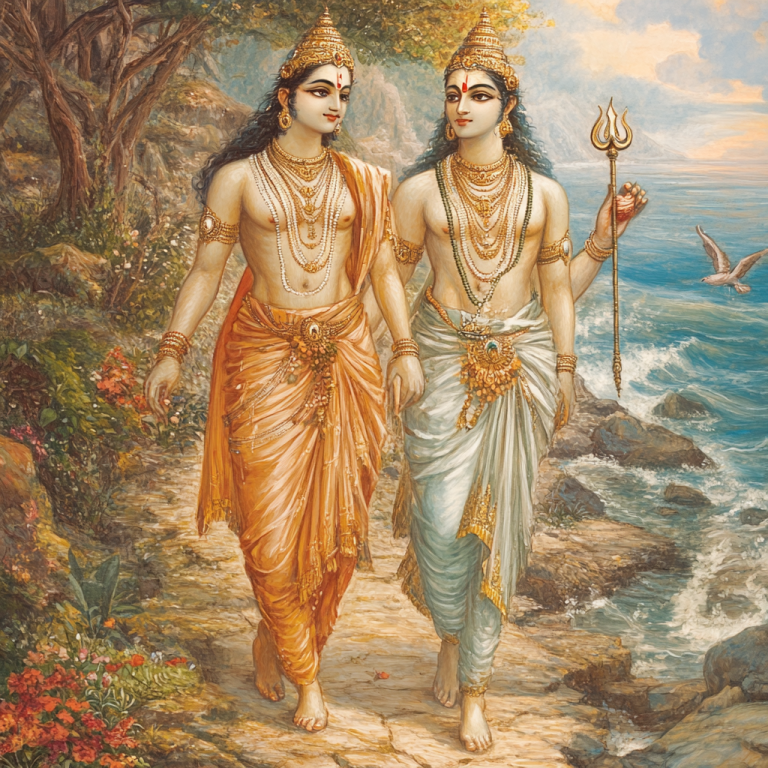
The Tale of Vyushitaswa and Bhadra
In ancient times, there lived a noble king named Vyushitaswa, a scion of the illustrious Puru dynasty. Renowned for his commitment to truth and justice, Vyushitaswa ruled his kingdom with righteousness, ensuring peace and prosperity for all his subjects.
As a devoted patron of the Vedic rituals, he performed numerous sacrifices to honor the gods, including the grand Ashwamedha – The Horse Sacrifice Yagna (Horse Sacrifice), a tradition richly detailed among various stories from the Mahabharata, symbolizing sovereignty and divine approval. These sacrifices attracted sages, celestial beings, and even Indra, the king of the gods, who became so enthralled by the Soma offerings at one such ritual that the gods themselves completed the sacrifice on behalf of the king. This divine endorsement elevated Vyushitaswa’s glory to unprecedented heights, making his name synonymous with virtue and dharma.
His rule was a golden age-there was no hunger, crime, or suffering in his land. Contentment reigned among his subjects, and the king’s fame spread across the three worlds.
The Marriage and Tragedy
Vyushitaswa married the exquisite Bhadra, the daughter of the revered king Kakshivat. Bhadra’s beauty rivaled that of the celestial nymphs (Apsaras), and her virtues made her a perfect companion for the righteous king. Their union was one of profound love and harmony.
However, fate struck a cruel blow. The king, in his pursuit of worldly pleasures and his deep affection for his wife, succumbed to phthisis (a wasting disease, possibly consumption), brought on by sexual excess. His untimely demise plunged Bhadra into a deep abyss of sorrow.
Bhadra’s Grief and Divine Intervention
Bereft of her husband, Bhadra lamented her plight before his lifeless body, expressing the despair of a widow in a world where a woman’s purpose was often defined by her role as a wife-a reality also mirrored in cultural depictions of Asura influence and their impact across ancient mythological narratives.
“O my beloved lord,” she cried, “a woman’s life becomes purposeless without her husband. How shall I continue to exist in this world, bereft of you? Let the gods have mercy and take me to your side, so I may accompany you to the celestial realms. Without you, my existence is a torment. Even a fleeting glimpse of you as you were in life would grant me peace.”
As her grief echoed through the palace, a divine voice reverberated from the heavens, bringing hope amidst despair:
“Rise, O noble daughter of Kakshivat. Cease your lamentation and purify yourself with a sacred bath. By the grace of the celestials, you shall bear children, even from your departed lord. Lay his body upon your bed, and progeny of great virtue shall be born unto you.”
The Birth of the Children
Following the divine command, Bhadra performed the rituals as instructed. Purifying herself, she brought her husband’s body to her chambers. Through a miraculous act, by the grace of the gods, seven illustrious sons were born to her. These sons-three Salwas and four Madras-carried forward the legacy of Vyushitaswa, upholding the principles of dharma and valor.
Kunti’s Purpose in Narrating the Tale
This poignant tale is narrated by Kunti to her husband Pandu to underscore the importance of progeny and to encourage him to rise above his self-imposed abstinence, invoking her own divine boon as a solution to their dilemma.
Connections to Other Tales in Hindu Mythology
- The Role of Soma in Sacrifices:
- The story reflects the power of Soma, often mentioned in the Vedas as a divine nectar that invigorates the gods. Its role in elevating the status of Vyushitaswa mirrors the transformative power of Soma in rituals performed by other kings like Harishchandra and Rantideva.
- Divine Conception:
- Similar miraculous births occur elsewhere in mythology, such as Kunti invoking Surya to conceive Karna, emphasizing the recurring theme of divine intervention to preserve and strengthen righteous dynasties.
- The Ashwamedha Yagna:
- Like Vyushitaswa, other rulers, including Yudhishthira and Rama, conducted the Ashwamedha sacrifice to establish their supremacy and divine favor.
- Parallels with the Tale of Savitri and Satyavan – Husband of Savitri:
- Bhadra’s lamentation echoes Savitri’s plea to Yama, the god of death, to restore her husband’s life. Both tales highlight the unwavering devotion of a wife to her husband, a recurring theme in Hindu mythology.
This tale not only exemplifies the virtues of devotion and righteousness but also serves as a reminder of the cyclical nature of life and death. Through divine intervention and unwavering dharma, the legacy of the virtuous continues, inspiring future generations.
Sources & further reading
These themes are explored in greater depth across the following authoritative resources:
- Stanford Encyclopedia of Philosophy, Hindu Philosophy
- Britannica, Dharma
- Britannica, Karma
- Internet Sacred Text Archive, Bhagavad Gita
- A. K. Ramanujan, Speaking of Siva (Penguin Classics, 1973)
External resources for further reading. Apam Napat is not affiliated with these publishers; citation does not imply endorsement.
Based on the classical texts of Hindu mythology, see our sources.