
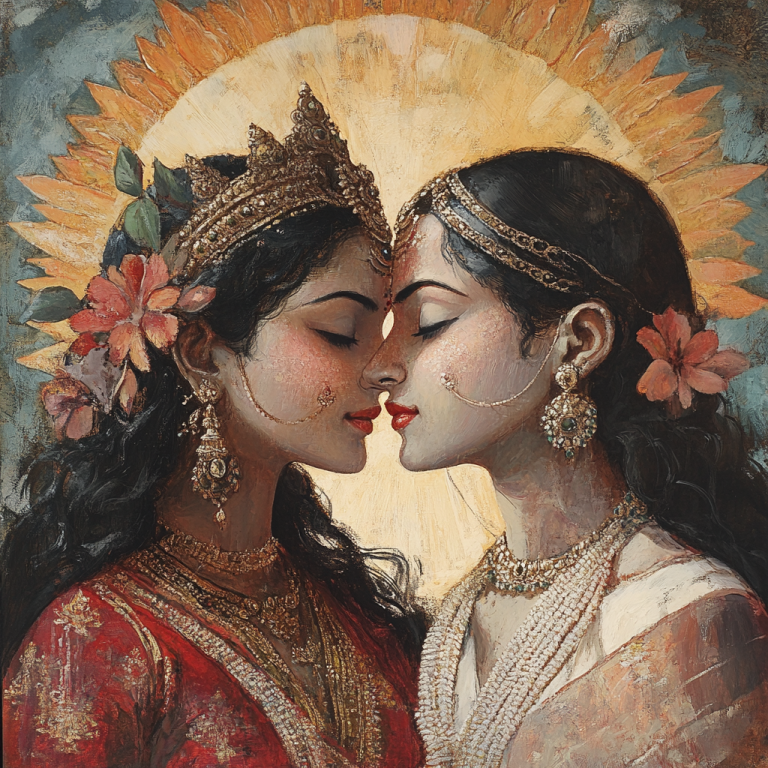
The Tale of Sharmishta – Mother of Puru, Devayani, and Yayati
The Quarrel Between Devayani and Sharmishta
During the reign of Vrishaparva, king of the Asuras, his daughter Sharmishta and her close friend, Devayani, daughter of Shukra (the revered Guru of the Asuras), shared an inseparable bond. Despite their different statuses-one being the princess of the Asuras and the other a sage’s daughter-they often spent their days together.
One day, accompanied by palace maidens, they went to bathe in a fragrant forest pond. After enjoying the day in water sports, they emerged to change into their dry clothes. As fate would have it, their garments were inadvertently exchanged. This seemingly trivial incident escalated into a fierce argument when Sharmishta, consumed by anger, lashed out at Devayani, saying:
“O Devayani, how dare you wear garments meant for me? I am the daughter of the king, while you are the daughter of a Brahmana who lives by serving my father. You are nothing but a servant. Know your place!”
In her fury, Sharmishta pushed Devayani into a nearby well and departed with the palace maidens, leaving her friend stranded. Although Devayani was unhurt, her pride and dignity were deeply wounded. Darkness fell, and her fear and humiliation grew. Each word from Sharmishta echoed in her mind, fueling her desire for retribution.
The Meeting with Yayati
At this critical juncture, King Yayati, a valiant ruler of the Chandra – The Moon Vamsha (Lunar Dynasty), happened upon the well while hunting in the forest. Thirsty and separated from his retinue, Yayati approached the well for water, only to find the distraught Devayani trapped within.
Introducing himself, he extended his hand to help her out. Grateful yet emboldened, Devayani took stock of the handsome king and declared:
“O King, by the custom of our times, a maiden whose hand is grasped by a man is bound to him in marriage. By rescuing me, you have made me your wife. You must marry me.”
Though struck by her beauty, Yayati hesitated, citing the stark difference in their castes. “You are the daughter of the great sage Shukra, whose lineage is superior to mine. A Kshatriya like me cannot marry a Brahmana without the consent of her father,” he said. “I will only wed you if your father approves.”
He escorted Devayani back to Shukra’s hermitage, where she poured out her grievances, seeking her father’s intervention.
Devayani’s Lament and Shukra’s Resolve
Devayani wept bitterly before her father, recounting the insults hurled at her by Sharmishta:
“O father, I have been humiliated and disgraced. Sharmishta, my closest friend, mocked our lineage, calling you a beggar and me her servant. Such shame is unbearable. A daughter cannot live in a realm where her father’s honor is trampled. Punish the Asuras, or let us leave this kingdom forever.”
Initially, Shukra sought to console her, emphasizing the virtues of forbearance and the impulsiveness of youth. He said:
“Greatness lies not in retaliation, but in patience. Words spoken in haste often stem from immaturity, not malice. Sharmishta will repent in time.”
However, Devayani’s persistent pleas eventually moved Shukra to withdraw from the Asuras’ service, much to the alarm of Vrishaparva, who soon learned the cause of the sage’s displeasure.
Sharmishta’s Submission
Realizing that the Asuras’ survival depended on Shukra’s guidance, Vrishaparva humbly approached the sage to seek forgiveness. Shukra revealed that the power to resolve the matter lay with his daughter. Vrishaparva then pleaded with Devayani, who issued a stern condition:
“I will stay in your kingdom only if Sharmishta, who insulted me, becomes my servant. She must leave her palace and accompany me to the hermitage, where she will serve me for life.”
The proud Sharmishta, though deeply regretful, accepted her friend’s demand as just. Her humility echoes later elaborations in stories focusing solely on Sharmishta’s character and significance within the larger mythological tradition.
Devayani and Yayati’s Marriage
Sometime later, Devayani encountered Yayati again in the forest. Still enamored, she persuaded him to seek her father’s approval for their union. Shukra, though reluctant, consented under one condition:
“O King, you must vow to remain monogamous and never look upon Sharmishta, who will accompany Devayani as her servant.” This sternness echoes the protective instincts seen in other figures linked to Shukra’s lineage, including Kacha, whose loyalty and devotion played a pivotal role during his time among the Asuras.
Yayati agreed, and their marriage was solemnized. Sharmishta dutifully followed them to the palace, continuing to serve Devayani.
Sharmishta and Yayati’s Forbidden Union
Despite his promise, Yayati found himself captivated by Sharmishta’s beauty. One day, unable to resist, he confessed his feelings to her. Sharmishta, who secretly admired him, reciprocated. Thus began a secret relationship that culminated in the birth of three sons: Anu, Dhruhyu, and Puru.
When Devayani eventually discovered the betrayal, she fled to her father in anguish. Shukra, enraged by Yayati’s broken vow, cursed him:
“May you be instantly afflicted with old age, your vitality drained, yet your desires burning as fiercely as ever.”
The Redemption of Yayati
Reduced to a frail old man, Yayati sought Shukra’s forgiveness. The sage, moved by his contrition, offered a conditional reprieve:
“If one of your sons willingly exchanges his youth for your old age, you may regain your vigor.”
Yayati approached his five sons, but only Puru, the youngest and most devoted, agreed to make the sacrifice. Restored to his youth, Yayati indulged his desires for many years, only to realize the futility of material pleasures. Interestingly, some later traditions intertwine elements of Yayati’s story into the mythological backdrop of the Ramayana narratives, drawing subtle parallels between cosmic lineages and moral struggles.
Connections to Other Stories in Hindu Mythology
- Parallels with Draupadi and Kunti:
- Like Sharmishta, Draupadi served as a pivotal figure in her husband’s destiny, shaping the lineage of the Pandavas. Kunti’s invocation of celestial beings to bear sons also mirrors the divine interventions in Yayati’s life.
- Themes of Curse and Redemption:
- Yayati’s curse and eventual redemption parallel the stories of Nahusha – An Ancestor of the Pandavas and Indra, where desires lead to downfall, but penance restores order.
- The Role of Dharma:
- The tale underscores the consequences of violating dharma, as seen in Ravana’s downfall and Savitri’s adherence to her dharmic duty.
Conclusion
The story of Sharmishta, Devayani, and Yayati intertwines the complexities of human relationships with the inexorable workings of karma. It illustrates how pride, love, and sacrifice shape destinies, leaving an enduring legacy that reverberates through the annals of Indian mythology.
Sources & further reading
These themes are explored in greater depth across the following authoritative resources:
- Britannica, Asura
- Britannica, Naga
- Mythopedia, Hindu Mythology
- Internet Sacred Text Archive, Mahabharata
- Wendy Doniger, Hindu Myths (Penguin Classics, 1975)
External resources for further reading. Apam Napat is not affiliated with these publishers; citation does not imply endorsement.
Based on the classical texts of Hindu mythology, see our sources.