
The Game of Dice: A Turning Point in the Mahabharata – The Great Epic
Vidura’s Omen and Yudhishtra – The Eldest Pandava’s Dilemma
When Vidura, the wise minister of the Kuru court, arrived at Indraprastha with Duryodhana’s invitation, his foreboding was clear. He warned Yudhishtra about the nature of gambling and the deceitful designs of Shakuni, the King of Gandhara. Vidura’s words-laden with caution-underscored his affection for the Pandavas and his understanding of Duryodhana’s malice.
However, Yudhishtra, bound by the etiquette of a Kshatriya and his vow to avoid disputes, felt compelled to accept the summons. His opponent, however, would be none other than Shakuni – Brother of Gandhari, the cunning master of deceit, whose skills at dice were infamous throughout the Kuru court.
The Gathering Storm in Hastinapura
Upon their arrival at Hastinapura, the Pandavas paid their respects to the Kuru elders-Dhritharashtra, Bhishma, Drona, and Kripa. Yet, the atmosphere was tense, charged with the undercurrents of the Kaurava brothers’ rivalry, a deep-rooted conflict that had festered since their youth.
The sabha (assembly hall), built with the wealth of Maya the Asura, became the arena for the fateful game. The stage was set not just for a match of dice but for the unravelling of relationships, values, and the seeds of the great war.
The Game Begins: Yudhishtra Falls into Shakuni’s Trap
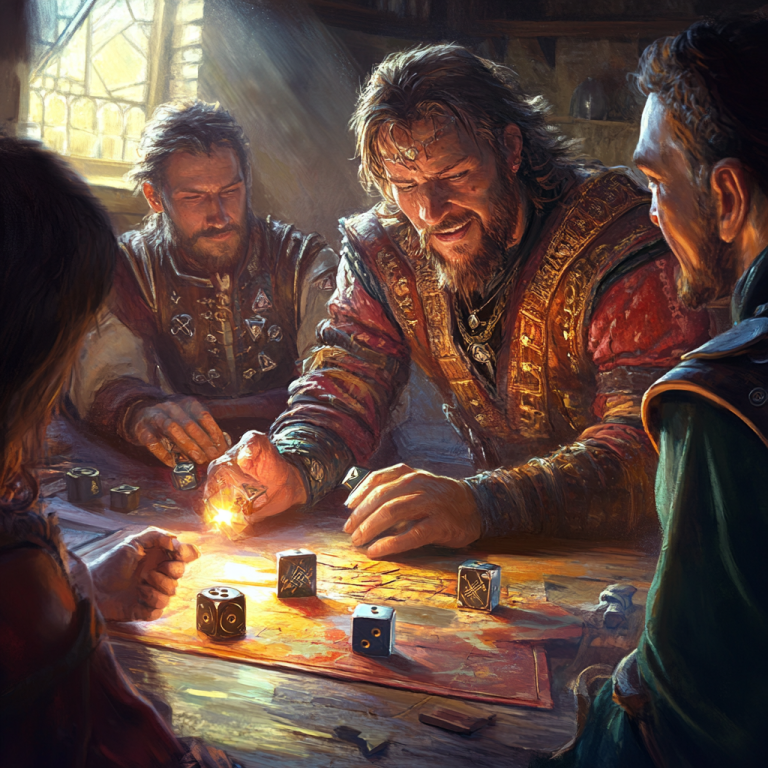
As the dice rolled, Shakuni, a master manipulator, revealed his true prowess. Playing as Duryodhana’s proxy, he wielded the loaded dice with precision, preying on Yudhishtra’s sense of duty and honor.
- The Stakes Escalate:
- Yudhishtra staked his jewels, then his treasury, followed by his army, his servants, and even his prized war elephants and horses.
- Each loss deepened his compulsion, as Shakuni taunted and goaded him, exploiting the gambler’s frenzy.
- The Descent into Madness:
- Yudhishtra wagered his kingdom, his brothers, and finally himself, losing all. This mirrors the theme of self-destructive pride found in other mythological tales, such as Ravana, whose hubris blinded him to the warnings of his own family.
- Draupadi’s Name Enters the Game:
- In an act that shocked even the hardened spectators, Yudhishtra staked Draupadi, his beloved queen. This act drew gasps of disapproval from the assembly, yet no one intervened. Bhishma, the embodiment of dharma, remained silent, bound by his vow to serve the Kuru throne.
Vidura’s Impassioned Plea
Unable to bear the unfolding injustice, Vidura – The Wise, ever the voice of conscience, rose to address Dhritharashtra. His warnings, born of wisdom and loyalty, would go unheeded, sealing the tragic fate of the Kuru dynasty. His words were scathing:
“O King, your son is treading the path of destruction. The ancients say, for the sake of a family, one man may be sacrificed. Let Arjuna slay Duryodhana now, for the sake of the Kuru clan.”
His plea fell on deaf ears. Dhritharashtra, blinded by his love for his son, ignored Vidura’s wisdom. The silence of the elders-despite their wisdom and experience-paralleled the silence of Indra during the humiliation of Ahalya, where the divine power failed to intervene in a mortal injustice.
Shakuni’s Victory and Duryodhana’s Triumph
When Shakuni cast the dice for the final round, fate-manipulated by deceit-sealed the Pandavas’ doom. Draupadi, the proud princess of Panchala, was declared lost.
This moment marked a profound violation of dharma: a queen, bound to five heroic husbands, was reduced to a mere stake in a game. It mirrored the indignities faced by Sita, who was abducted by Ravana despite being under the protection of Rama.
The Foreshadowing of Mahabharata’s Climax
- Bhishma’s Torment:
Bhishma’s silence during the game highlighted his internal conflict. His duty to the Kuru throne clashed with his sense of justice, a predicament that would later lead to his tragic role in the Kurukshetra war. - The Role of Karma and Fate:
- Just as Vishwamitra – The King Who Became a Great Sage faced humiliation at the hands of Vasishta, leading him to pursue asceticism, the humiliation of the Pandavas in the Kuru court planted the seeds of their eventual triumph.
- This episode exemplifies the law of karma, where adharma leads to inevitable consequences, setting in motion the events that would culminate in the war depicted with searing detail in Mahabharata Book 13, where the cost of lost dharma becomes undeniable.
- Draupadi’s Vow:
Although not yet spoken, this event sets the stage for Draupadi’s powerful vow, where she would swear to see her tormentors punished. This vow would echo through the halls of Hastinapura, galvanizing the Pandavas to reclaim their honor.
Connections to Broader Mythology
- The Loaded Dice and Cosmic Play:
- Shakuni’s manipulation of the dice can be likened to the deceptive Maya (illusion) used by Krishna during the battle of Kurukshetra to outwit Karna and Duryodhana.
- The game of dice also draws parallels to the eternal play of Lila, where mortals are mere players in a cosmic design orchestrated by the divine.
- The Silence of Elders:
- Bhishma and Drona’s silence during this injustice mirrors the silence of Daksha Prajapati – The Creators during the humiliation of Sati at his own yajna, leading to devastating consequences.
- The Fall of Dynasties:
- Just as the Yadavas were destroyed due to infighting, the events of the dice game ensured the destruction of the Kuru dynasty.
Conclusion
The game of dice is not just a tale of gambling; it is a microcosm of the Mahabharata itself-a battle of dharma versus adharma, of human folly entangled with divine will. The humiliation of the Pandavas and Draupadi’s eventual disrobing set the stage for the great war, a conflict that would restore balance to a world teetering on the brink of chaos.
Sources & further reading
These themes are explored in greater depth across the following authoritative resources:
- Stanford Encyclopedia of Philosophy, Hindu Philosophy
- Britannica, Dharma
- Britannica, Karma
- Internet Sacred Text Archive, Bhagavad Gita
- A. K. Ramanujan, Speaking of Siva (Penguin Classics, 1973)
External resources for further reading. Apam Napat is not affiliated with these publishers; citation does not imply endorsement.
Based on the classical texts of Hindu mythology, see our sources.