
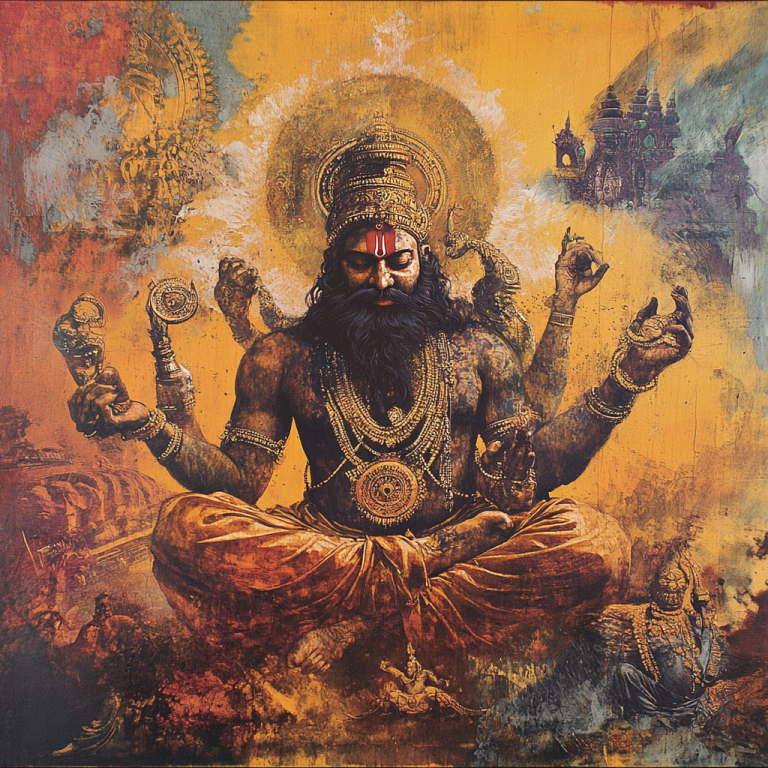
The Concept of Time in Hindu Mythology: Eternal Cycles and Cosmic Order
This cosmic time is deeply embedded in texts like the Bhagavata Purana ([Bh.P.6.1.10]) and the Padma Purana, which describe time as a divine force, both measured and immeasurable, infinite yet cyclical.
Cosmic Units of Time: From Deva-Years to Kalpas
The foundation of time measurement begins with a single Deva-year, equivalent to 360 terrestrial years. Expanding from this unit, the grand cosmic timeline unfolds as follows:
| Unit | Duration | Description |
|---|---|---|
| Maha-Yuga | 4,320,000 earthly years | Consists of four Yugas: Satya Yuga, Treta Yuga, Dvapara Yuga, and Kali Yuga. |
| Chatur-Yuga | 1 Maha-Yuga | Represents the fourfold cycle of cosmic ages. |
| Manvantara | 71 Chatur-Yugas | Time ruled by a single Manu, including his Devas, Indra, and SaptaRishis. |
| Kalpa | 1,000 Chatur-Yugas (4.32 billion earthly years) | A day of Brahma, mirrored by an equally long night. |
| Brahma’s Lifespan | 100 Brahma-years (~311 trillion earthly years) | The entire lifespan of Brahma, after which the universe dissolves into Mahapralaya. |
The Four Yugas: The Cycle of Dharma
Each Maha-Yuga begins with the Satya Yuga, a golden age of virtue, and declines through Treta and Dvapara Yugas, culminating in the Kali Yuga, an age of strife and spiritual degradation.
| Yuga | Duration (Earthly Years) | Attributes |
|---|---|---|
| Satya (Krita) | 1,728,000 | Dharma stands on all four legs; peace, truth, and spirituality thrive. |
| Treta | 1,296,000 | Dharma diminishes by a quarter; the emergence of greed and desire. |
| Dvapara | 864,000 | Dharma stands on two legs; the rise of conflicts and moral decline. |
| Kali | 432,000 | Dharma is reduced to one leg; the age of quarrel and hypocrisy. |
Currently, we are in the Kali Yuga of the Vaivasvata Manvantara, which began after the Mahabharata – The Great Epic war, approximately 5,000 years ago.
Manvantaras: The Epochs of Manus
Each Manvantara, spanning 71 Chatur-Yugas, is governed by a Manu, alongside specific Devas, Indras, and SaptaRishis. Early sages like Marichi, one of the mind-born sons of Brahma, played crucial roles in guiding these cosmic cycles.
Past Manvantaras
| Manvantara | Manu | Devas | Indra | SaptaRishis | Vishnu’s Incarnation |
|---|---|---|---|---|---|
| 1st | Swayambhuva | Yama and others | Vishnu | Marichi and six others | Varaha (Boar) |
| 2nd | Svarosisha | Dushita and others | Bhanusangyak | Stambha, Dhattatreya, Atri, and others | Vibhu |
| 3rd | Uttama | Pavana, Srunjaya | Sadhyanga | Sons of Vasishta | Satyasena |
| 4th | Tamasa | Satyakars | Trichika | Jyothis, Vyoga, and others | Hari |
| 5th | Raivata | Hiranyaroman, Vedhasiras | Vibhu | Hiranyaroman, Vedhasiras, Urthvabahu | Vaikuntan |
| 6th | Chakshusha | Havishman and others | Indradhyumna | Led by Havishman | Ajita |
Current (7th) Manvantara
The Vaivasvata Manvantara is governed by Vaivasvata Manu, son of Vivasvant (Surya).
| Key Entities | Details |
|---|---|
| Devas | Adityas, Ashwinis, Maruts, Rbhus |
| Indra | Purandara |
| SaptaRishis | Kashyapa, Atri, Vasishta, Vishwamitra – The King Who Became a Great Sage, Gautama, Jamadagni, Bharadwaja |
| Vishnu Avatar | Vamana (the dwarf, who subdued Bali and restored cosmic order) |
Connections to Mythological Narratives
- Swayambhuva Manu and Varaha Avatar:
Swayambhuva Manu’s era witnessed Vishnu’s Varaha avatar, symbolizing the deep interplay between divine intervention and the mortal realm, a dynamic mirrored across many stories found in The Timeless Influence of Puranic Mythology on Hindu Culture and Modern Life. - Kurma and Mohini Avatars:
The Chakshusha Manvantara witnessed the Kurma (Tortoise) avatar, central to the churning of the ocean (Samudra Manthan), where Vishnu also appeared as Mohini, distributing the nectar of immortality. - Vaivasvata Manu and the Great Flood:
Vaivasvata Manu’s tale echoes the story of Noah in Abrahamic traditions. Saved by Matsya (Fish), an avatar of Vishnu, Manu preserved life by carrying seeds and species aboard a divine ark during a cataclysmic flood.
Future Manvantaras: Prophecy and Cycles to Come
The lineage of Manus will continue into the future Kalpas, ensuring the cyclical progression of creation. Savarni Manu, the eighth Manu, will govern the next Manvantara, followed by Ruchi, Bhautya, and others, leading to new epochs with unique Devas, Indras, and sages.
The Endless Dance of Time
This grand schema emphasizes the Hindu worldview of sanatana dharma, where time is eternal yet rhythmic-a vision sustained by the Hindu Trinity: Brahma the creator, Vishnu the preserver, and Shiva the destroyer, each playing pivotal roles in the cosmic dance of existence.
By framing human existence within this cosmic timeline, Hindu mythology also connects the mortal with the eternal, reinforcing an intricate tapestry of divine forces, explored comprehensively in outlines of Hindu gods.
Sources & further reading
These themes are explored in greater depth across the following authoritative resources:
- Stanford Encyclopedia of Philosophy, Hindu Philosophy
- Britannica, Dharma
- Britannica, Karma
- Internet Sacred Text Archive, Bhagavad Gita
- A. K. Ramanujan, Speaking of Siva (Penguin Classics, 1973)
External resources for further reading. Apam Napat is not affiliated with these publishers; citation does not imply endorsement.
Based on the classical texts of Hindu mythology, see our sources.