
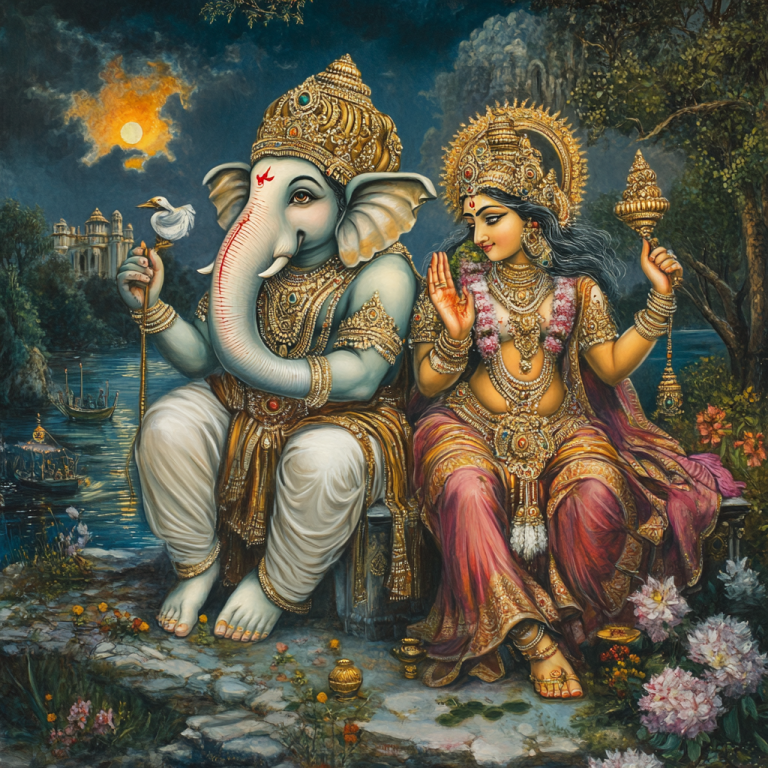
The Tale of Tapati and King Samvarana
The Radiant Tapati
Tapati, the radiant daughter of Vivaswat (Surya), the Sun God, was unparalleled in beauty and virtue. Her grace surpassed even that of the celestial Apsaras and Gandharvas like Vishvavasu – A Prominent Gandharva and Tumburu – A Gandharva Chief, whose melodies enchant the heavens. She was the younger sister of Savitri, another manifestation of the Sun, and her magnificence was often likened to that of Goddess Lakshmi herself. When she reached marriageable age, her father sought a groom worthy of her splendor.
King Samvarana and His Fateful Encounter
During this time, Samvarana, the son of Riksha and a mighty ruler of the Kuru dynasty, reigned over his kingdom with great distinction. Renowned for his valor and piety, he was a devout worshiper of Surya, offering daily prayers to the Sun God.
One day, while hunting in the Paripatra mountains, his horse collapsed from exhaustion, leaving him stranded. Hungry and fatigued, Samvarana wandered the forest in search of sustenance. Amidst this desolation, he encountered a maiden of unparalleled beauty, whose radiance seemed to illuminate the forest. Her presence left him spellbound, and he felt as though he had glimpsed Sri Lakshmi herself.
The King, captivated, approached her and said, “Who are you, O celestial being, gracing these solitary woods with your presence? Your beauty surpasses all I have ever seen or heard of. I am King Samvarana, of the illustrious Kuru dynasty. My heart has been captivated by your divine charm. I implore you-will you consent to be my wife?”
The maiden remained silent, her graceful demeanor unshaken. While the King poured out his heart, she vanished before his eyes, leaving him stricken with grief and longing. Falling to the ground, he lamented his misfortune, comparing his anguish to that of a thirsty man denied water.
The Revelation of Tapati
As the King mourned, the maiden reappeared. This time, her voice was as melodious as her beauty was captivating. She said, “O noble King, I am Tapati, the daughter of Vivaswat and sister to Savitri. Though I admire your valor and virtue, I am bound by my father’s will. You must seek his permission for my hand in marriage. If he consents, I shall gladly become your wife.”
With these words, Tapati ascended to the heavens, leaving the King yearning for her.
Samvarana’s Penance
Distraught and consumed by his love for Tapati, Samvarana resolved to perform a penance to win the favor of Surya. His chief minister, upon finding him in this state, tried to persuade him to return to his kingdom, but the King was firm in his resolve. He began a rigorous penance, offering prayers to Surya day and night without rest.
On the twelfth day of his austerities, the great sage Vasishta – Perceptor of the Ishvahu Clan, the spiritual guide of the Kuru dynasty, arrived. Through his yogic insight, Vasishta discerned the cause of Samvarana’s grief and vowed to help him.
Vasishta’s Plea to Surya
Vasishta journeyed to the celestial abode of Surya. Offering due reverence, he said, “O illustrious Lord of Light, your daughter Tapati has captivated the heart of King Samvarana, an illustrious and virtuous ruler of the Kuru race. He has been offering you ceaseless worship, seeking your favor. Your daughter has directed him to seek your consent for their union. I beseech you to grant this boon to the King, who is in every way worthy of Tapati.”
Surya, pleased with Vasishta’s request and moved by Samvarana’s devotion, replied, “King Samvarana is well known to me as a righteous and devoted ruler. I could not have chosen a better husband for my daughter, even if I searched the three worlds. Let this union take place according to the Vedic rites. I entrust my daughter Tapati to the noble King Samvarana through you, O sage.”
The Celestial Union
Vasishta conveyed Surya’s consent to Samvarana. The wedding was celebrated with grandeur, following the sacred Vedic rituals. The union of Tapati and Samvarana was blessed by the Devas and sages, marking the merging of celestial and royal lineage. Tapati, radiant and devoted, became the queen of the Kuru dynasty.
Their descendants carried the legacy of both their divine and royal lineage. From their union sprang a lineage that would later culminate in the birth of the Pandavas, the heroes of the Mahabharata – The Great Epic. For this reason, the Pandavas are also referred to as Tapatyas, honoring their ancestor Tapati.
Connections to Hindu Mythology
- Tapati and Surya’s Lineage
Tapati’s connection to Surya places her among other divine figures associated with the Sun, such as Savitri and Yama, highlighting the divine origins of the Kuru dynasty. - Gandharva Marriage
Samvarana’s courtship of Tapati is a classic example of the Gandharva marriage, one of the eight approved forms of marriage in Hindu tradition, characterized by mutual consent and love. - Vasishta’s Role
The intervention of Vasishta underscores the importance of spiritual guidance in resolving human dilemmas, a recurring theme in Hindu mythology. His role as a bridge between the mortal and divine realms reflects the power of devotion and penance. - Ancestral Legacy of the Pandavas
Tapati’s marriage to Samvarana connects the Pandavas to the Sun God, symbolizing their divine heritage and celestial favor. It also emphasizes the purity and righteousness of their lineage.
The righteousness associated with the Kuru dynasty would later be tested and shaped by figures like Vidura – The Wise, while ambitions and flaws would lead to Duryodhana’s downfall, culminating in the epic Kurukshetra war. - Themes of Devotion and Redemption
Samvarana’s unwavering devotion to Surya highlights the recurring theme of bhakti (devotion) as a means to achieve one’s desires, whether worldly or spiritual. - Vidura’s Wisdom and Lineage: Like Vasishta’s intervention in Samvarana’s life, figures like Vidura – The Wise, renowned for their wisdom and devotion to dharma, play crucial roles in guiding royal destinies throughout the Mahabharata.
This tale weaves together elements of love, devotion, and divine intervention, reflecting the harmonious interplay of human aspirations and celestial will in Hindu mythology.
Sources & further reading
These themes are explored in greater depth across the following authoritative resources:
- Britannica, Asura
- Britannica, Naga
- Mythopedia, Hindu Mythology
- Internet Sacred Text Archive, Mahabharata
- Wendy Doniger, Hindu Myths (Penguin Classics, 1975)
External resources for further reading. Apam Napat is not affiliated with these publishers; citation does not imply endorsement.
Based on the classical texts of Hindu mythology, see our sources.