
Exploring Brahman is like peeling back layers of existence itself. It’s about delving into questions of what is real, what is eternal, and how everything in the universe is interconnected. In this text, I’ll guide you through the intricate world of Brahman and its significance in understanding the ultimate reality.
Understanding Brahman
Brahman stands as the paramount concept of ultimate reality in Hinduism. It represents the universal force that pervades everything and transcends all.
Definition of Brahman
Brahman is the highest universal principle, the ultimate reality of the universe. Considered eternal, conscious, irreducible, infinite, and omnipresent, Brahman embodies the essence of all that exists. It encompasses both material and immaterial aspects, making it synonymous with the universe itself.
Historical Context of Brahman
The concept of Brahman evolved from Vedic literature. Initially, it encompassed hymns and rituals, then transitioned into a metaphysical understanding. The Upanishads, a part of Vedic literature, later elaborated on Brahman’s nature, defining it as the ultimate truth and core of existence.
Philosophical Concepts
Advaita Vedanta, emphasizing non-dualism, forms the core of my exploration of Brahman. Key insights reveal Brahman’s role and its intrinsic connection to Atman – The Soul, illustrating their fundamental unity.
Brahman in Advaita Vedanta
In the framework of Advaita Vedanta, Brahman signifies the ultimate, unchanging reality, infinite and transcendent. It’s frequently referred to as Sat-Chit-Ananda:
- Sat: Brahman represents pure existence, the essence inherent in all entities.
- Chit: Consciousness, an intrinsic attribute where Brahman is ever-aware.
- Ananda: Bliss, symbolizing the ultimate state of joy inherent in Brahman.
Adi Shankara, a pivotal figure in Advaita Vedanta, argued that comprehending Brahman transcends empirical knowledge, resting in direct realization.
Brahman and Atman Connection
In Advaita Vedanta, Brahman and Atman (the individual self) are fundamentally the same. This non-dualistic view asserts that the distinctions we perceive in our day-to-day lives are mere illusions (Maya).
- Unified Essence: Atman reflects Brahman within each individual, indicating that every person inherently possesses this ultimate reality.
- Moksha: Realizing the unity of Brahman and Atman leads to Moksha, or liberation, where one transcends the cycle of birth and rebirth (Samsara).
This philosophical understanding challenges our typical perceptions, guiding seekers towards the realization of their true nature.
The exploration of these philosophical concepts offers profound insight into the core principles of Advaita Vedanta, emphasizing the inherent unity of all existence.
Brahman in Different Traditions
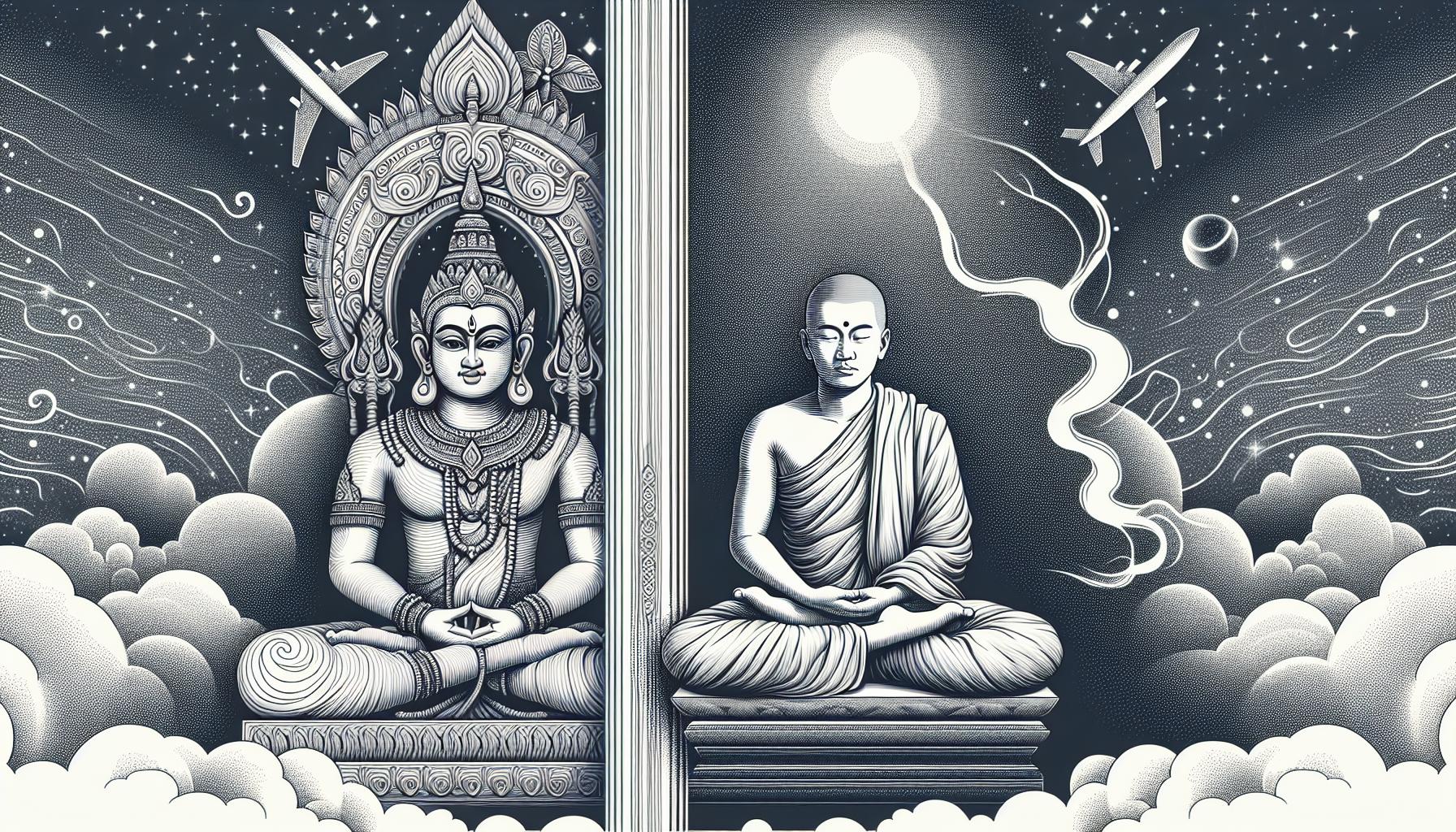
The concept of Brahman holds varying significance across Hinduism and Buddhism. I’ll explore these differences to highlight the unique perspectives each tradition offers.
Brahman in Hinduism
In Hinduism, Brahman stands as the ultimate reality, encompassing everything. It’s both the material and efficient cause of all existence, described as unchanging and permanent. Hindu scriptures, including the Vedas and Upanishads, extensively discuss Brahman, portraying it as the highest cosmic principle.
Brahman manifests in two forms: Nirguna Brahman (without attributes) and Saguna Brahman (with attributes). Nirguna Brahman represents the formless, infinite aspect, while Saguna Brahman is perceived with various qualities and forms, like deities. Advaita Vedanta, a prominent Hindu philosophy, emphasizes that recognizing the unity of Atman (self) with Brahman leads to Moksha (liberation).
Brahman in Buddhism
Buddhism doesn’t centralize the concept of Brahman. Instead, it focuses on impermanence and the principle of anatta (no self). Early Buddhist texts, like the Pāli scriptures, avoid direct reference to Brahman.
Buddhist teachings reject the notion of an eternal, unchanging reality. They place emphasis on the transient nature of all phenomena, asserting that clinging to the idea of a permanent self or reality leads to suffering. The Buddha’s teachings center around Pratītyasamutpāda (dependent origination), explaining the interconnectedness and continuous change of all things.
Comparative Analysis
Comparing Brahman views in Hinduism and Buddhism highlights a significant philosophical divergence. Hinduism’s Brahman is an eternal, all-encompassing reality, while Buddhism denies any permanent essence, promoting the concept of impermanence. This core difference shapes each tradition’s understanding of the universe and the self.
Experiencing Ultimate Reality
Experiencing ultimate reality involves realizing one‘s true nature as Brahman. Here, I’ll explore the paths and practices leading to this profound revelation.
Paths to Realization
Several paths can lead to realizing Brahman, each suited to different individuals based on their inclinations and temperaments.
- Jnana Marga (Path of Knowledge): This path emphasizes wisdom and understanding. It involves three steps:
- Sravana (Hearing or Listening): Absorbing teachings from sacred texts and spiritual leaders.
- Manana (Reflection): Contemplating the teachings to remove doubts.
- Nididhyasana (Meditation): Deep, sustained meditation to internalize the teachings and realize one’s unity with Brahman.
- Bhakti Marga (Path of Devotion): This path focuses on loving devotion towards a personal deity. Practitioners dedicate their actions and thoughts to their chosen deity, which leads to the realization of their oneness with Brahman.
- Karma Marga (Path of Action): Here, selfless service and right action are paramount. By performing duties without attachment to outcomes, individuals purify their minds and eventually recognize their divine nature.
- Raja Marga (Path of Meditation): This involves disciplined mental and physical practices to control the mind and senses. Techniques like pranayama (breath control) and dhyana (meditation) play crucial roles here.
Meditation and Brahman
Meditation is pivotal in realizing Brahman as it calms the mind and transcends ordinary consciousness. By practicing meditation consistently, one can reach a state of deep inner stillness and insight.
- Preparation: Creating a conducive environment for meditation. This might involve a quiet space, comfortable seating, and a regular practice schedule.
- Mindfulness Meditation: Focusing the mind on the present moment, observing thoughts and sensations without judgment.
- Mantra Meditation: Repeating sacred sounds or phrases, like “Om,” to focus and steady the mind.
- Outcomes: Over time, meditation leads to heightened awareness, inner peace, and the eventual dissolution of the ego. This cultivates an experiential understanding of Brahman, beyond intellectual comprehension.
By integrating these paths and practices into daily life, the realization of Brahman becomes a genuinely transformative journey.
Modern Interpretations
Contemporary scholars and philosophers offer diverse insights into the concept of Brahman, reflecting its complexity and depth within Hindu philosophy.
Contemporary Scholars’ Views
Modern scholars dissect Brahman to offer varied interpretations. In Advaita Vedanta, Brahman is distinct from all phenomenal entities, seen as the ultimate non-differentiated reality. Adi Shankara, a prominent figure, argues that human experiences and distinctions are mere illusions (Maya).
Other schools of thought, like Vishishtadvaita Vedanta (qualified non-dualism), present Brahman as both immanent and transcendent, integrating personal deities and world views within this framework. Dvaita Vedanta (dualism), positing a strict distinction between Brahman and individual souls, also enriches the discourse on ultimate reality.
Brahman in Popular Culture
The concept of Brahman extends into popular culture through various media, offering a bridge between ancient philosophy and modern life. Movies, books, and music highlight themes related to self-realization and the quest for higher truth. Works like the novel “Siddhartha” by Hermann Hesse explore individual journeys towards understanding ultimate reality, echoing the essence of Brahman.
Television series and films often depict spiritual struggles and the search for meaning, further illustrating the relevance of Brahman in contemporary contexts. For example, the series “The Good Place” touches on themes of ethical living and ultimate reality, indirectly resonating with the principles of Brahman.
Conclusion
Understanding Brahman as the ultimate reality offers profound insights into the nature of existence and the self. It serves as a bridge between ancient wisdom and contemporary thought, encouraging a deeper exploration of our own consciousness. By engaging with the diverse paths and interpretations within Hindu philosophy, we can begin on a personal journey toward self-realization and higher truth. Whether through meditation, scholarly study, or cultural expressions, the quest for Brahman remains a timeless pursuit that resonates with the human spirit.
Sources & further reading
These themes are explored in greater depth across the following authoritative resources:
- Stanford Encyclopedia of Philosophy, Hindu Philosophy
- Britannica, Moksha
- Britannica, Brahman
- Internet Sacred Text Archive, Upanishads
- Sarvepalli Radhakrishnan, Indian Philosophy (2 vols., Oxford University Press, 1923)
External resources for further reading. Apam Napat is not affiliated with these publishers; citation does not imply endorsement.
Frequently asked questions
What is Brahman in Hindu philosophy?
How did the concept of Brahman evolve?
What does Brahman mean in Advaita Vedanta?
Who was Adi Shankara?
What is the relationship between Brahman and Atman?
Based on the classical texts of Hindu mythology, see our sources.